What Sensitivity Readers Actually Do (And Why They're So Controversial)
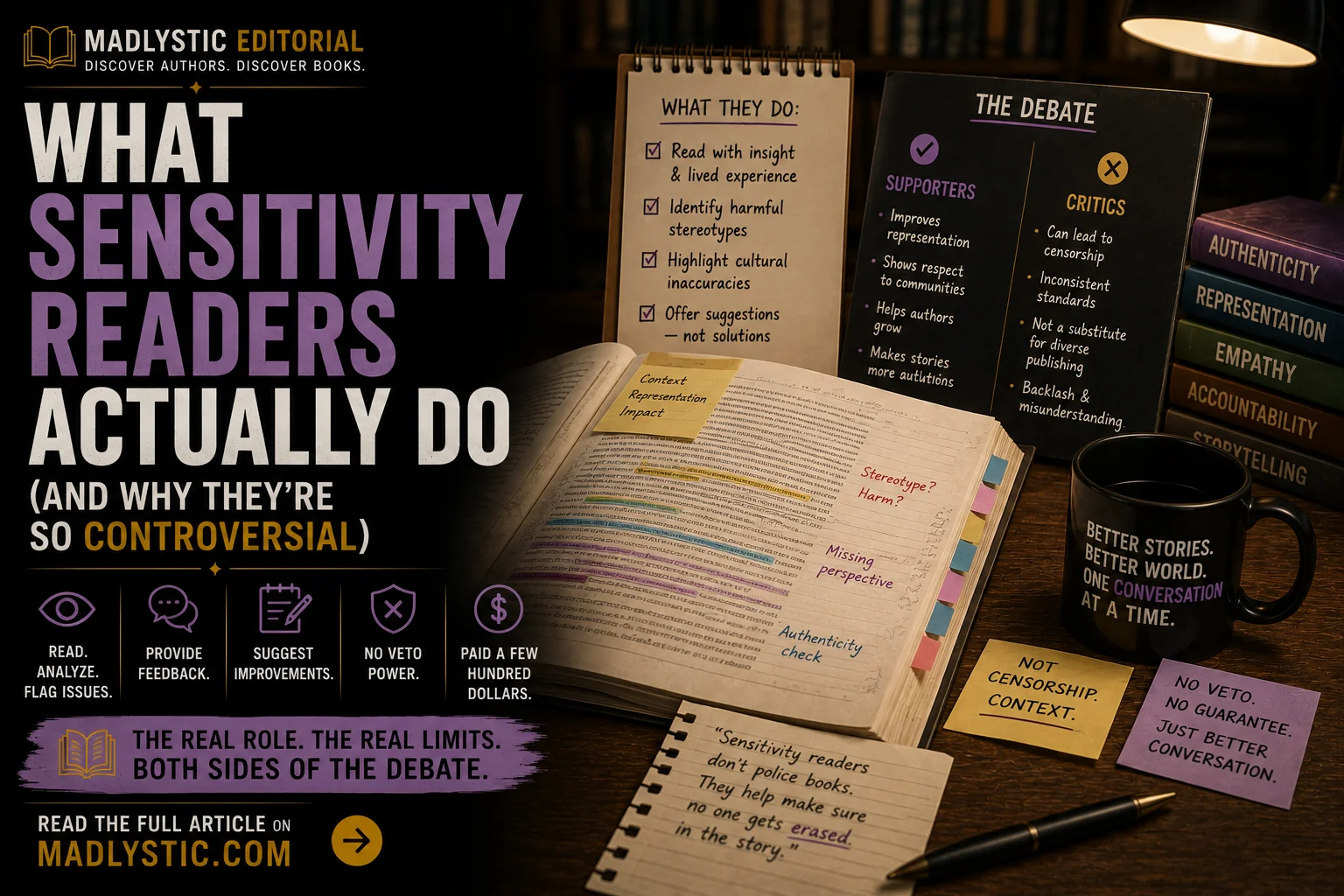
They're paid a few hundred dollars, hold no veto power, and can't guarantee a book avoids backlash — yet sensitivity readers have become one of publishing's most contested roles. Here's what the job actually involves, and both sides of the real debate around it.
Published August 3, 2026
9 min read
Quote of the Day
"Even if authors mean well, even if the intention is good, it doesn't change the impact." — Justina Ireland, YA author who founded one of the first sensitivity reader databases
Somewhere between a beta reader and a fact-checker sits a role most readers have heard of but few could actually describe accurately: the sensitivity reader. The term gets thrown around in publishing controversies constantly, usually attached to strong opinions on both sides — yet the actual job, what it pays, what power it does or doesn't hold, and why it exists at all rarely gets explained plainly, separate from whichever side of the debate is doing the explaining.
What the job actually is, stripped of the controversy
A sensitivity reader — also called an authenticity reader or cultural consultant — reviews a manuscript specifically for representation: stereotypes, cultural inaccuracies, outdated or harmful language, and unintentional bias in how a character or community is portrayed. They're typically people with genuine lived experience of the specific identity or culture being depicted, brought in when an author is writing outside their own direct experience and wants a second, informed opinion before publication.
The role emerged specifically within young adult publishing, a corner of the industry with a long history of intense public scrutiny over content aimed at younger readers. Concretely, the work looks like this: if a novel features a wheelchair-using character, a sensitivity reader with that lived experience might flag a scene where the character navigates a city with implausible ease, missing accessibility barriers that would realistically be there. If a story centers a cultural celebration, a reader from that background can check whether the specific details — food, traditions, family dynamics — actually ring true rather than reading as researched-from-outside guesswork.
What it pays, and why that number matters to the debate
Rates vary, but multiple sources converge on a similar range: somewhere between $250 and $600 for a full manuscript read, sometimes calculated per word instead (roughly $0.01 to $0.19 per word depending on experience and complexity). This detail turns out to matter directly to one of the most common criticisms of the practice: at a few hundred dollars per freelance read, this is unambiguously not a highly-paid, powerful gatekeeping position — it's closer to freelance consulting work, similar in scale to hiring a proofreader or beta reader, not a role with any formal authority over whether a book gets published at all.
The legitimate case in favor
Advocates for the practice make a straightforward argument: publishing has a well-documented diversity problem, with the industry itself remaining predominantly white even as the range of stories being told has broadened, and a sensitivity read is simply due diligence — the same instinct that leads a careful nonfiction writer to fact-check technical details, applied to lived cultural experience instead. Proponents also point to real, high-profile cases where a lack of this kind of review led to genuine harm and genuine backlash: Amélie Wen Zhao postponed her novel Blood Heir in 2019 after criticism over how it handled themes of indentured labor and slavery, and Kate Clanchy's Orwell Prize-winning memoir was eventually withdrawn by publisher Picador after readers and writers of color objected to specific language describing students from diverse backgrounds. In both cases, advocates argue, an earlier sensitivity read might have caught the issue before publication rather than after.
The legitimate case against, or at least skeptical of, the practice
The critique isn't uniformly bad-faith either, and it's worth taking seriously on its own terms. Some authors and industry figures argue the practice functions as a kind of performative gesture — cheap enough, at a few hundred dollars per manuscript, that a publisher can claim to be taking representation seriously without making any deeper, more expensive structural investment in actually diversifying who gets published and promoted in the first place. Others raise a more philosophical objection: that a single reader's lived experience of an identity can't reasonably stand in for an entire community's, given how much internal diversity of opinion, background, and experience exists within any group — a concern one advocacy resource addressed directly by recommending authors hire more than one sensitivity reader specifically because people from the same broad community are still shaped by very different individual experiences and shouldn't be treated as interchangeable.
The part where the debate genuinely gets confused
A meaningful amount of the public controversy around sensitivity readers appears to stem from a factual misunderstanding of what power the role actually holds. One author and former publishing professional who's written extensively on the controversy noted plainly that sensitivity readers, like any other beta reader or freelance consultant, hold no veto power over publication and no formal gatekeeping authority whatsoever — the decision to publish, revise, or withdraw a book always remains with the author and publisher, not the sensitivity reader. Cases where a book actually gets pulled or delayed, like Clanchy's, are typically driven by broader public and industry reaction after the fact, not a sensitivity reader's private report beforehand. Conflating those two very different things — a paid consultant's advisory feedback, and the industry or public's reaction to a published book — is a large part of why the debate often generates more heat than clarity.
Where this leaves an author actually weighing whether to use one
Most guidance converges on similar practical advice, regardless of where a given writer lands on the broader debate: if you're writing meaningfully outside your own lived experience — a culture, a disability, an identity you haven't personally lived — a sensitivity read is a reasonable, relatively low-cost way to catch avoidable errors before publication, the same way any other specialized consultant might catch a technical or historical inaccuracy. It's not a guarantee against controversy, and it was never designed to be one. It's simply one additional, informed set of eyes on a specific aspect of the manuscript, treated with the same seriousness — and the same fair compensation — as any other freelance editorial service.
Conclusion
The sensitivity reader debate tends to generate far more heat than the actual, mechanical facts of the job would suggest on their own: a freelance consultant, paid a few hundred dollars, offering informed feedback on representation, with zero formal power to block or approve a book's publication. Whether that role is a genuinely useful safeguard or an insufficient, performative gesture largely depends on what a given critic believes publishing's deeper diversity problem actually requires to fix — and that's a real, substantive disagreement worth having honestly, rather than one that gets resolved by misunderstanding what the job itself actually is.
Share this article
Share this article with readers who'll want to read it.