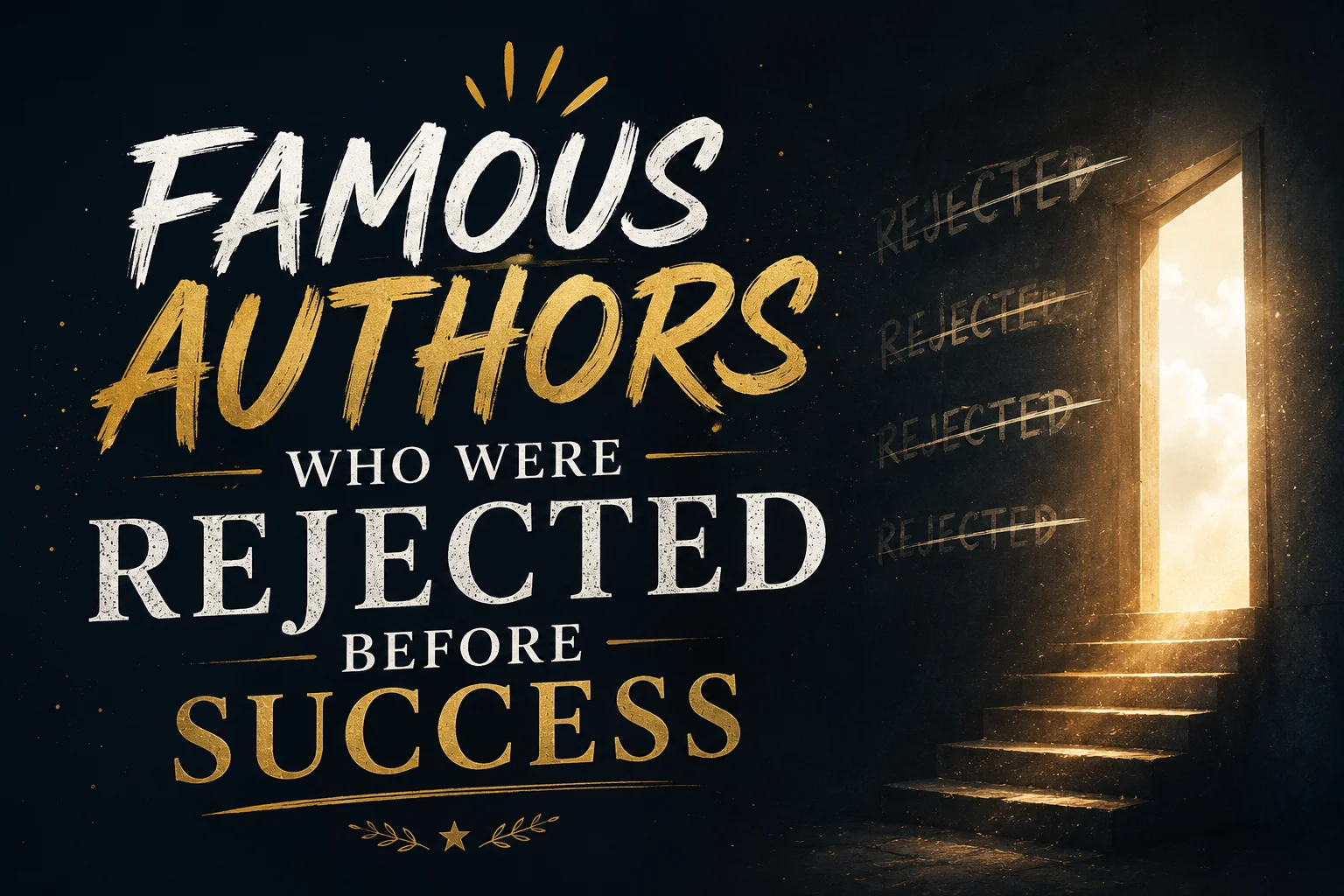
12 Famous Authors Who Were Rejected Before Success
12 Famous Authors Who Were Rejected Before Success | Inspiring Stories Explore the inspiring stories of famous authors like J.K. Rowling, Stephen King, and Agatha Christie who overcame rejection to become bestselling legend
Published July 4, 2026
Success in publishing often looks effortless from the outside. We see bestselling novels, movie adaptations, and shelves lined with famous names—but rarely the years of rejection, self-doubt, and persistence that came before.
Many of today's most celebrated authors heard "no" dozens of times before finally receiving the "yes" that changed their lives. Their stories remind us that rejection isn't the end of the journey—it's often the beginning.
If you're an aspiring writer facing rejection, these authors prove that perseverance can make all the difference.
1. J.K. Rowling
Before Harry Potter became one of the best-selling book series in history, J.K. Rowling struggled as a single mother living on welfare.
Her manuscript for Harry Potter and the Philosopher's Stone was rejected by 12 publishers before a small publishing house finally took a chance on it.
Today, the Harry Potter series has sold hundreds of millions of copies worldwide.
Lesson: Never let rejection convince you your story isn't worth telling.
2. Stephen King
Stephen King's first novel, Carrie, was rejected around 30 times.
Frustrated, he threw the manuscript into the trash.
His wife rescued it, encouraged him to keep trying, and eventually the novel was accepted for publication.
It became a bestseller and launched one of the most successful writing careers in history.
Lesson: Sometimes you need someone who believes in your story before you do.
3. George Orwell
Although George Orwell eventually became one of literature's most influential writers, his masterpiece Animal Farm was rejected by several publishers.
Some feared its political themes would be too controversial during World War II.
Once published, it became a literary classic.
Lesson: Timing can matter just as much as talent.
4. Agatha Christie
The "Queen of Mystery" wasn't an overnight success.
Her first detective novel was rejected multiple times before being accepted.
She went on to become one of the world's best-selling authors, with billions of copies sold.
Lesson: Even legendary storytellers start as beginners.
5. Dr. Seuss
The manuscript for And to Think That I Saw It on Mulberry Street was rejected 27 times.
Just as he was about to give up, he happened to meet an old college friend working in publishing.
The book was finally accepted.
Dr. Seuss would later become one of the most beloved children's authors ever.
Lesson: Persistence creates opportunities.
6. Beatrix Potter
Publishers repeatedly rejected The Tale of Peter Rabbit.
Instead of giving up, Beatrix Potter self-published the book in a small print run.
Its popularity eventually convinced a publisher to distribute it widely.
Today, Peter Rabbit remains a beloved classic.
Lesson: Sometimes believing in yourself comes before others do.
7. Frank Herbert
Frank Herbert's science fiction masterpiece Dune faced more than 20 publisher rejections.
Many believed it was too long and too complex.
Today, Dune is considered one of the greatest science fiction novels ever written.
Lesson: Don't simplify your vision just because others don't understand it immediately.
8. Louisa May Alcott
Louisa May Alcott was initially told to focus on teaching instead of writing.
Despite discouragement, she continued writing and eventually published Little Women, a novel that has inspired generations.
Lesson: Never let someone else decide your potential.
9. John Grisham
John Grisham's debut novel, A Time to Kill, was rejected by numerous publishers.
Eventually, a small publisher agreed to print just a few thousand copies.
His later novels became international bestsellers, making him one of the most successful legal thriller authors in the world.
Lesson: Every bestseller starts with a first reader.
10. Kathryn Stockett
The Help was rejected around 60 times before being accepted.
The novel later became a bestseller and was adapted into an award-winning film.
Lesson: One publisher's rejection doesn't determine your future.
11. William Golding
Lord of the Flies received more than 20 rejections.
One publisher even described it as "absurd."
Today, it is widely regarded as one of the greatest novels of the twentieth century.
Lesson: Opinions change—great stories endure.
12. Paulo Coelho
Although The Alchemist sold only a handful of copies after its initial publication, Paulo Coelho refused to give up.
He continued promoting his work until it found readers around the world.
Today, The Alchemist has been translated into dozens of languages and has sold millions of copies globally.
Lesson: Success sometimes arrives slowly—but it can arrive spectacularly.
Why Do Great Books Get Rejected?
Rejection doesn't always mean a manuscript is bad.
Common reasons include:
The publisher already has similar books.
Market trends change.
The manuscript isn't the right fit.
Timing isn't ideal.
Editors have limited publishing slots.
Publishing decisions are often business decisions—not judgments of talent.
What Every New Author Should Remember
If your manuscript gets rejected:
Keep improving your writing.
Revise your manuscript.
Seek constructive feedback.
Submit to other publishers.
Consider self-publishing.
Start writing your next book.
Many successful authors say the best way to handle rejection is to keep writing.
Final Thoughts
Behind nearly every bestselling novel is a story of persistence. Rejection letters, unanswered submissions, and moments of self-doubt are common chapters in many authors' journeys—not the final page.
If your work has been rejected, remember that you're in good company. Some of the greatest literary voices in history were told "no" before they were celebrated around the world.
Keep writing. Keep learning. Keep submitting.
Your next manuscript—or your next opportunity—could be the one that changes everything.
After all, every successful author was once an unknown writer with a story they refused to give up on.
Share this article
Share this article with readers who'll want to read it.