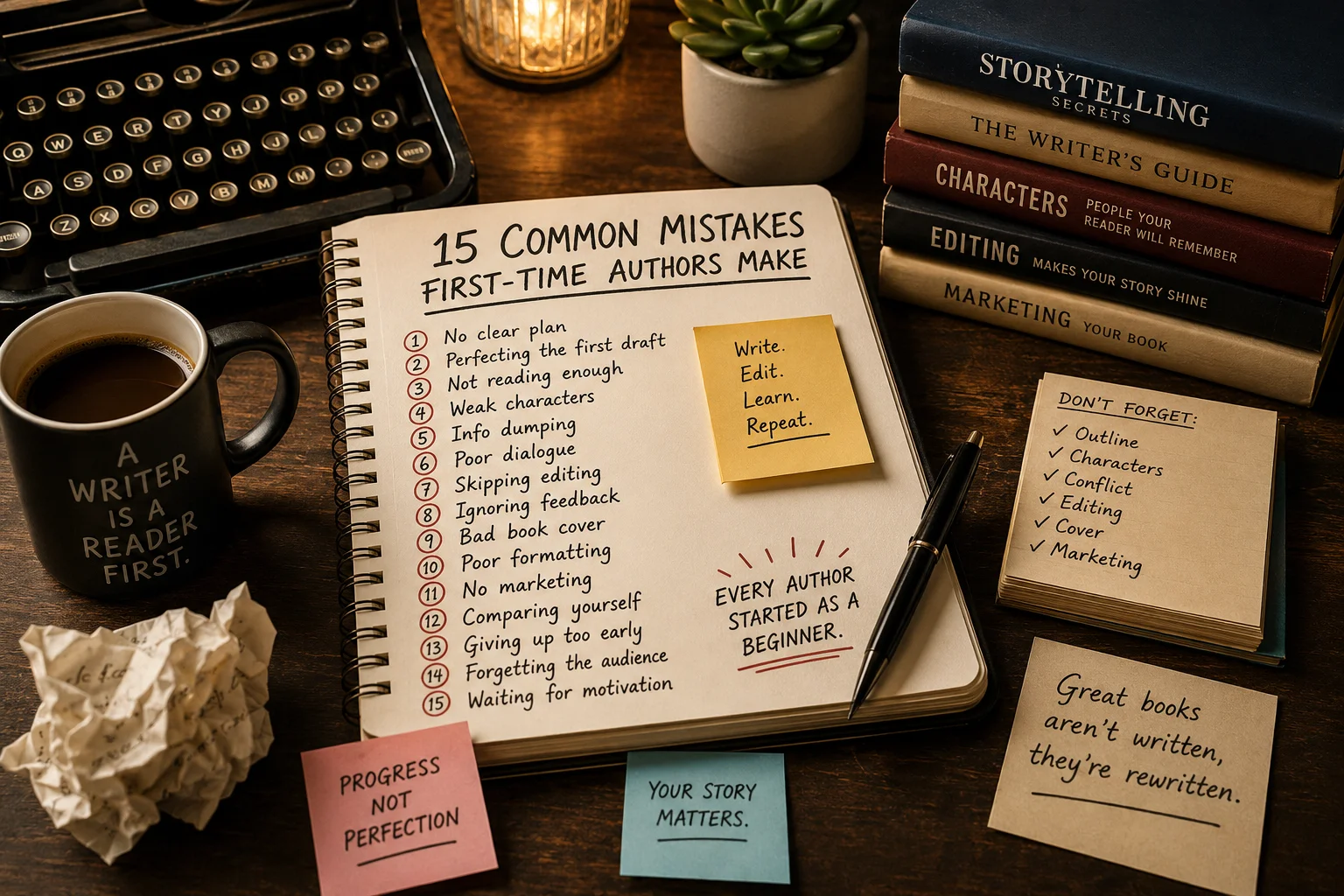
15 Common Mistakes First-Time Authors Make (And How to Avoid Them)
15 Common Mistakes First-Time Authors Make (And How to Avoid Them) Learn the 15 most common mistakes first-time authors make and discover practical tips to improve your writing, editing, publishing, and book marketing.
Published July 2, 2026
15 Common Mistakes First-Time Authors Make (And How to Avoid Them)
Writing your first book is one of the most exciting creative journeys you'll ever take. You begin with an idea, build characters, create worlds, and slowly watch your story come to life.
But finishing a manuscript is only half the battle.
Many first-time authors unknowingly make mistakes that can delay publication, weaken their storytelling, or make it harder for readers to connect with their work. The good news? Nearly every successful author has made these mistakes at some point—and learned from them.
Here are some of the most common pitfalls and how you can avoid them.
1. Starting Without a Clear Plan
Many new writers dive straight into Chapter One with only a vague idea of where the story is headed. While some authors thrive with a "write as you go" approach, many end up stuck halfway through.
How to avoid it:
Create a basic outline.
Know your beginning, middle, and ending.
Define your main conflict before writing.
Even a simple roadmap can save weeks of rewriting.
2. Trying to Make the First Draft Perfect
Perfectionism is one of the biggest reasons books never get finished.
Your first draft doesn't have to be flawless—it just has to exist.
Remember:
You can't edit a blank page.
Focus on finishing your story before polishing it.
3. Writing Without Reading
Great writers are almost always passionate readers.
Reading exposes you to:
Different writing styles
Story structures
Character development
Dialogue techniques
Genre expectations
If you want to improve your writing, read regularly.
4. Ignoring Character Development
Readers rarely remember plots alone—they remember characters.
Flat or unrealistic characters can make even an exciting story feel forgettable.
Ask yourself:
What does each character want?
What are they afraid of?
How do they change by the end?
Strong characters create emotional investment.
5. Overloading the Story with Information
It's tempting to explain everything about your world, magic system, history, or technology immediately.
This often results in long information dumps that slow the story.
Instead:
Reveal information naturally.
Let readers discover the world gradually.
Show instead of telling.
6. Weak Dialogue
Dialogue should sound natural—not like a lecture.
Avoid conversations where characters explain things they already know just for the reader's benefit.
Good dialogue:
Reveals personality
Moves the story forward
Creates tension
Sounds authentic
Read your dialogue aloud to hear how it flows.
7. Skipping the Editing Process
Your first completed draft is not your final book.
Professional authors revise their manuscripts multiple times.
Editing includes:
Grammar
Plot consistency
Character arcs
Pacing
Word choice
Formatting
Great books are rewritten, not merely written.
8. Ignoring Feedback
Many new authors fear criticism.
However, constructive feedback is one of the fastest ways to improve.
Consider:
Beta readers
Writing groups
Professional editors
Trusted fellow authors
Listen carefully—but remember that not every suggestion needs to be accepted.
9. Choosing the Wrong Book Cover
Readers really do judge books by their covers.
A poorly designed cover can make an excellent book look unprofessional.
Invest in:
A clean design
Readable typography
Genre-appropriate artwork
High-quality images
Your cover is your book's first impression.
10. Poor Book Formatting
Even a fantastic story can receive negative reviews if the formatting is difficult to read.
Before publishing:
Check margins
Use consistent fonts
Verify chapter spacing
Test on Kindle and mobile devices
Preview both eBook and paperback editions
Professional formatting improves the reading experience.
11. Publishing Without Marketing
Many first-time authors believe readers will automatically discover their book.
Unfortunately, that's rarely the case.
Successful authors actively promote their work through:
Social media
Author websites
Book communities
Email newsletters
Review campaigns
Writing the book is only part of the journey.
12. Comparing Yourself to Bestselling Authors
It's easy to compare your first novel to books written by experienced authors with decades of practice.
Don't.
Every bestselling author once wrote a first draft that needed improvement.
Focus on becoming better than your previous book—not someone else's.
13. Giving Up Too Early
Many aspiring authors quit after:
Writer's block
Negative feedback
Low sales
Rejections
Persistence is often the difference between authors who succeed and those who don't.
Every completed book teaches valuable lessons.
14. Forgetting Who the Audience Is
Trying to please everyone often results in a story that satisfies no one.
Know your readers.
If you're writing fantasy, understand fantasy readers.
If you're writing romance, know what romance readers expect.
Writing for a specific audience creates a stronger connection.
15. Waiting for Motivation Instead of Building Discipline
Motivation comes and goes.
Discipline finishes books.
Set a realistic writing routine:
500 words a day
One chapter each week
Thirty minutes every evening
Small, consistent progress eventually becomes a completed manuscript.
Bonus Tips for New Authors
Finish your first draft before editing.
Back up your work regularly.
Read books in your genre.
Learn the basics of publishing.
Celebrate every milestone.
Keep writing your next book.
Remember, every page you write improves your craft.
Final Thoughts
Every author starts somewhere. Mistakes are not signs of failure—they're part of the learning process. The key is to recognize them early, adapt, and keep improving with every story you write.
Your first book doesn't have to be perfect. It just has to be finished.
Whether you dream of seeing your novel on bookstore shelves or publishing it digitally for readers around the world, persistence, continuous learning, and a genuine love for storytelling will take you much farther than perfection ever will.
So keep writing, keep revising, and most importantly—keep believing in your story. The next page you write could be the one that changes everything.
Share this article
Share this article with readers who'll want to read it.