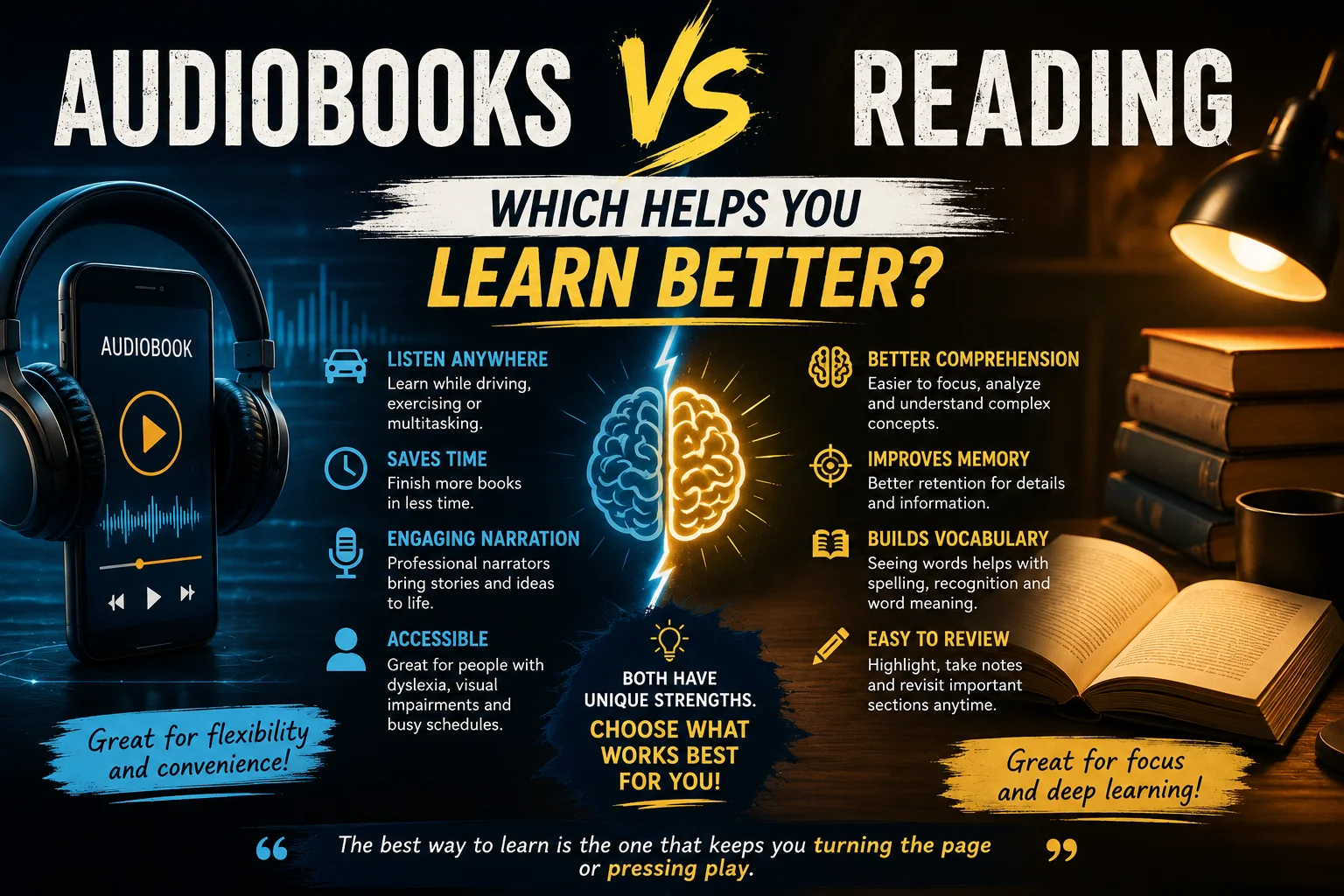
Audiobooks vs Reading: Which Helps You Learn Better?
Audiobooks vs Reading: Which Helps You Learn Better? Compare audiobooks and reading to discover which improves learning, memory, comprehension, vocabulary, and productivity. Find the best format for your goals.
Published July 4, 2026
Books have never been more accessible. Today, you can enjoy a story by turning physical pages, reading on an e-reader, or simply pressing play on an audiobook during your commute.
But one question continues to spark debate among readers and educators alike:
Do audiobooks help you learn as well as reading?
The answer isn't as simple as choosing one over the other. Both formats offer unique benefits, and the better choice often depends on what you're trying to learn, how you learn best, and your lifestyle.
Let's compare them.
What Happens When You Read?
Reading is an active process.
Your brain must:
Recognize words
Process grammar
Visualize scenes
Interpret meaning
Maintain focus
Because you're actively decoding text, reading often demands more concentration than listening.
This deep engagement can improve:
Vocabulary
Spelling
Reading speed
Comprehension
Long-term retention
What Happens When You Listen?
Audiobooks rely on listening comprehension.
Instead of decoding words, your brain focuses on:
Understanding speech
Following tone and emotion
Processing information through sound
Visualizing scenes from narration
Professional narrators can also add emotion, pacing, and character voices that enhance storytelling.
Learning Comparison
📚 Reading
Advantages
✅ Better spelling recognition
✅ Improved vocabulary through seeing words
✅ Easier to highlight and annotate
✅ Stronger focus for studying
✅ Better for technical books
🎧 Audiobooks
Advantages
✅ Learn while driving or exercising
✅ Great for multitasking
✅ Excellent pronunciation
✅ Helpful for people with dyslexia or visual impairments
✅ Makes long books feel less intimidating
Which Helps Memory?
Research suggests that both reading and listening can support comprehension, especially when readers are attentive. However, for complex material that requires close study—such as textbooks, technical manuals, or dense academic content—reading often makes it easier to pause, review, annotate, and revisit key sections.
For stories and general nonfiction, many people retain information just as well through audiobooks, particularly when they listen without distractions.
The biggest factor isn't the format—it's your level of attention.
Vocabulary Growth
Reading has one clear advantage.
When you see unfamiliar words written down, you're more likely to:
Remember their spelling
Recognize them later
Learn punctuation
Understand sentence structure
Audiobooks improve pronunciation but may not help you remember spelling.
Concentration
Reading encourages sustained focus.
Audiobooks are more flexible but easier to interrupt mentally.
Have you ever reached your destination while driving and realized you don't remember the last ten minutes of the audiobook?
That's because divided attention affects listening more easily than dedicated reading.
Speed
Audiobooks usually save time.
Many apps allow playback at:
1.25x
1.5x
2x speed
Experienced listeners can finish books much faster than traditional readers.
Reading speed varies significantly from person to person.
Best for Students
Reading Wins
For:
Textbooks
Research
Exams
Mathematics
Programming
Medical studies
Law
Highlighting and note-taking make reading the better option.
Best for Entertainment
Audiobooks shine when reading for enjoyment.
Professional narrators bring characters to life with:
Different voices
Emotional delivery
Dramatic pacing
Many listeners compare them to listening to a movie without visuals.
Accessibility Matters
Audiobooks have made literature more accessible than ever.
They're especially valuable for:
People with dyslexia
Readers with visual impairments
Busy professionals
Long commuters
Seniors
People recovering from eye strain
The best book is the one you can enjoy.
Can You Combine Both?
Absolutely.
Many readers use immersion reading, where they:
Read the physical or digital book
Listen to the audiobook simultaneously
Benefits include:
Better pronunciation
Improved focus
Increased reading speed
Enhanced comprehension
More enjoyable learning
This approach is also popular among language learners.
Which Should You Choose?
GoalBest OptionStudy for examsReadingLearn technical subjectsReadingImprove spellingReadingExpand vocabularyReadingCommuteAudiobooksExerciseAudiobooksRelax before bedEitherEnjoy novelsEitherLearn while multitaskingAudiobooksMaximum comprehensionReading + Audiobook
The Verdict
Instead of asking "Which is better?", ask:
"Which format helps me learn in this situation?"
If you're studying, taking notes, or learning complex concepts, reading remains the stronger choice.
If you're commuting, exercising, cooking, or simply trying to enjoy more books despite a busy schedule, audiobooks are an excellent alternative.
Both formats encourage learning, imagination, and lifelong reading habits. What matters most isn't whether you turn pages or press play—it's that you're engaging with ideas and stories consistently.
Final Thoughts
Reading and listening are not rivals—they're complementary ways to experience books. A printed page offers focus and depth, while an audiobook brings flexibility and convenience. The most successful learners often use both, choosing the format that best fits the moment.
Whether you're curled up with a paperback, reading on a Kindle, or listening through headphones, every chapter completed is a step toward greater knowledge and a richer imagination.
The best way to learn is the one that keeps you coming back for the next book.
Share this article
Share this article with readers who'll want to read it.
You may also like
Why We Re-read Books: The Hidden Science of Falling in Love With the Same Story Twice
July 18, 2026

Why Some Books Keep You Awake All Night
July 17, 2026

Why Some Books Become Classics While Others Are Forgotten
July 15, 2026

Penguin Book Fair Returns to Delhi with Unlimited Tote-Fill Book Shopping
July 11, 2026