How Fan Fiction Became a Publishing Pipeline
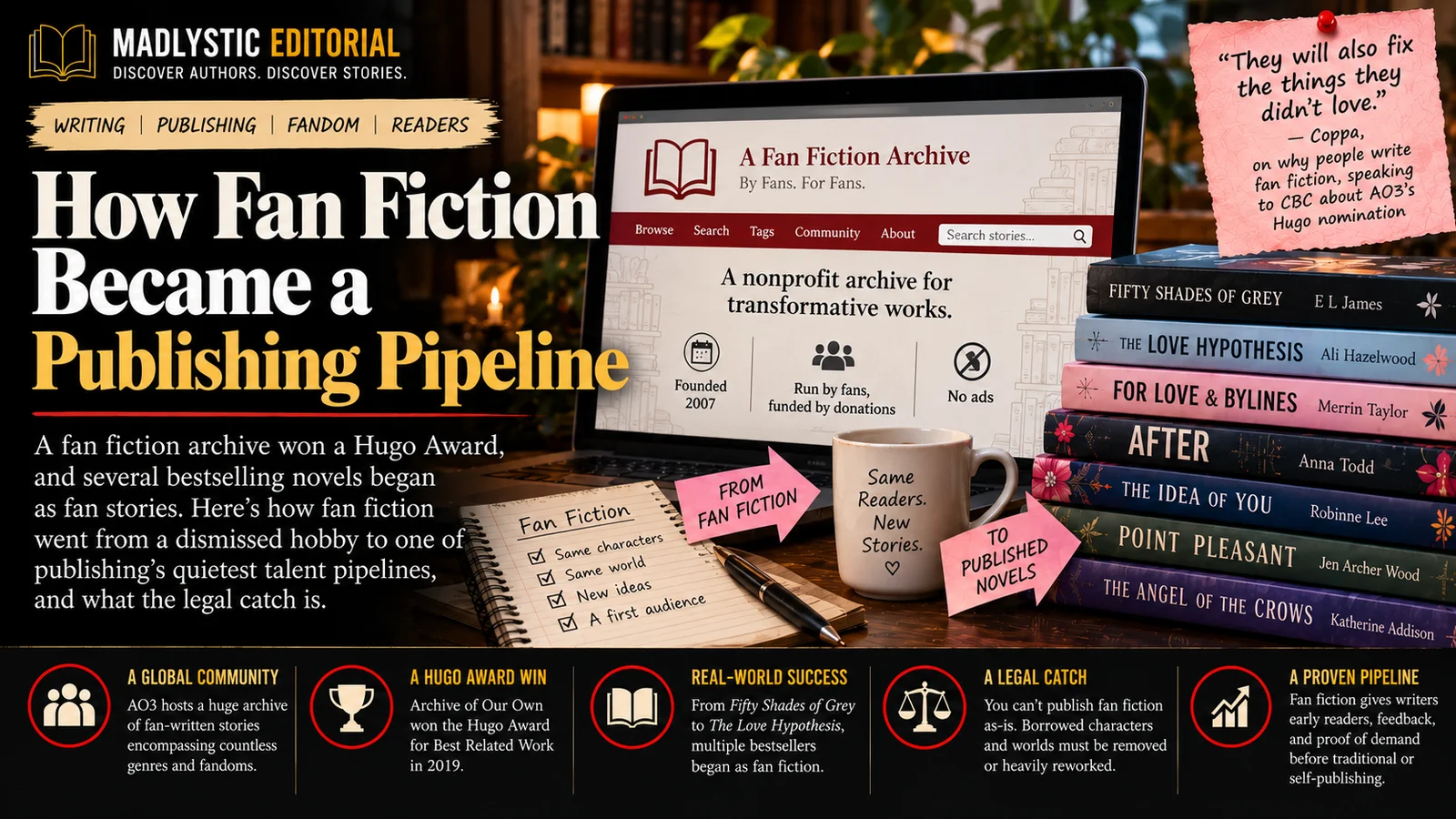
A fan fiction archive won a Hugo Award, and several bestselling novels began as fan stories. Here’s how fan fiction went from a dismissed hobby to one of publishing’s quietest talent pipelines, and what the legal catch is.
Published October 31, 2026
Quote of the Day
“They will also fix the things they didn’t love.” — Coppa, on why people write fan fiction, speaking to CBC about AO3’s Hugo nomination
For a long time, fan fiction was the thing readers did quietly and writers admitted to reluctantly. Stories about other people’s characters were treated as a hobby at best and a copyright problem at worst. Then a fan archive won one of science fiction’s biggest awards, and a growing list of bestsellers turned out to have started life on that same archive. The shift is real, and it matters for anyone thinking about how writers find their first readers.
The archive that won a Hugo
Archive of Our Own, usually shortened to AO3, was established in 2007 by the nonprofit Organization for Transformative Works. It’s run by fans, funded entirely by donations, and accepts no advertising. In 2019, AO3 won the Hugo Award for Best Related Work at the Dublin Worldcon. Its first-ever nomination had been treated as somewhat contentious by people who didn’t take fan-created work seriously, and the win became a landmark for the legitimacy of fan fiction as a form.
One of AO3’s co-founders, Naomi Novik, was also a Hugo-nominated novelist that same year for Spinning Silver, a reminder that the line between “fan writer” and “professional author” has always been thinner than it looks.
The books that started there
The best-known example is Fifty Shades of Grey by E. L. James, which began as fan fiction before becoming one of the best-selling books of its decade. More recent examples show how routine the path has become:
The Love Hypothesis by Ali Hazelwood began in 2018 as “Head Over Feet,” a Star Wars story about Rey and Kylo Ren posted to AO3. The story was already set in a modern academic lab rather than a galaxy far away, so removing the Star Wars elements was possible. It was published in 2021 and became a New York Times bestseller.
For Love & Bylines by Merrin Taylor began as an AO3 alternate-universe story called “The Second Time Around,” posted in 2019 and published in 2022.
After by Anna Todd, The Idea of You by Robinne Lee (inspired by a real boy-band member), Point Pleasant by Jen Archer Wood (originally Supernatural fan fiction), and The Angel of the Crows by Katherine Addison all followed the same general route.
The legal catch most people skip over
You can’t simply publish fan fiction as a novel, because the characters, settings, and names belong to someone else. What these authors did, and what the Hazelwood example shows clearly, is rework the story until nothing protected remains: new names, new setting, new world. That only works when the story’s real strength was never the borrowed universe. Hazelwood’s story already lived in a lab, so the chemistry between the leads carried over intact. A story that depends on a specific magic system or plot from the original can’t be rescued this way.
Why this pipeline works
Fan fiction solves the problem this blog keeps returning to, which is getting a first audience before any algorithm has a reason to help. A fan writer posts chapters to a community that’s already looking for exactly that kind of story, gets comments and feedback on every update, and learns what lands before spending money on editing or covers. By the time a story is reworked into a standalone novel, it has often been read, critiqued, and loved by thousands of people, which is the kind of proof of demand traditional publishers look for.
It also explains why the same names keep appearing in romance specifically. The genre rewards tropes, chemistry, and emotional payoff, and fan fiction communities have spent years refining exactly those things in public.
What it doesn’t guarantee
Most fan fiction is never published, and most of it shouldn’t be. It’s written for love of the source material, often serialized and unedited, and the gap between a popular fic and a finished, original novel is large. The authors above did the real work afterward: rewriting, restructuring, and building something that stands without the borrowed universe.
Conclusion
Fan fiction didn’t become a pipeline because publishers decided to be generous. It became one because writers kept showing up in a place where readers were already waiting, building audiences the traditional way no one had thought to look for them. The Hugo win was recognition of something that was already true: a lot of today’s bestselling fiction was shaped in public, one chapter at a time, by people who started out simply wanting more of a story they loved.
Share this article
Share this article with readers who'll want to read it.
You may also like
Traditional Publishing vs. Self-Publishing: Which Is Right for You?
November 24, 2026
How to Choose Amazon KDP Keywords and Categories
November 20, 2026
How Long Should a Book Be? Word Count by Genre (2027)
November 16, 2026
How to Self-Publish a Book on Amazon KDP (2027 Guide)
November 15, 2026