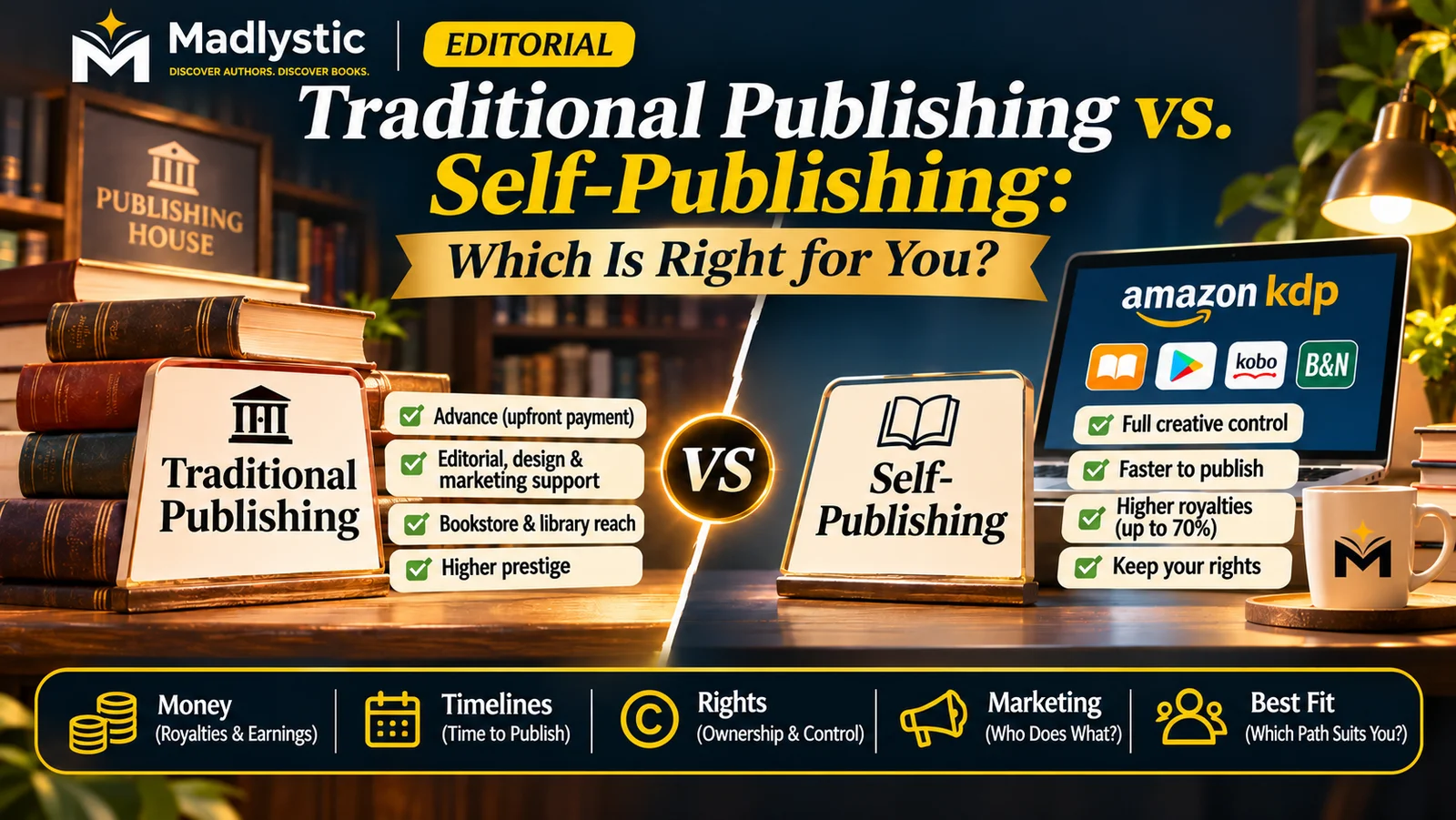
Traditional Publishing vs. Self-Publishing: Which Is Right for You?
One path offers an advance, a team, and bookstore reach. The other offers control, speed, and royalties up to 70%. Here's an honest comparison of traditional publishing and self-publishing, including money, timelines, rights, and who each path suits best.
Published November 24, 2026
10 min read
Quote of the Day
"Neither is intrinsically better." — a plain summary of the honest answer to publishing's oldest debate
Every writer with a finished manuscript reaches the same fork in the road: query agents and try for a traditional deal, or publish it yourself. Both paths produce successful authors every year, and both have real costs. The right choice depends less on which path is "better" and more on what you want from your book. Here's how the two compare on the things that actually matter.
How each path works
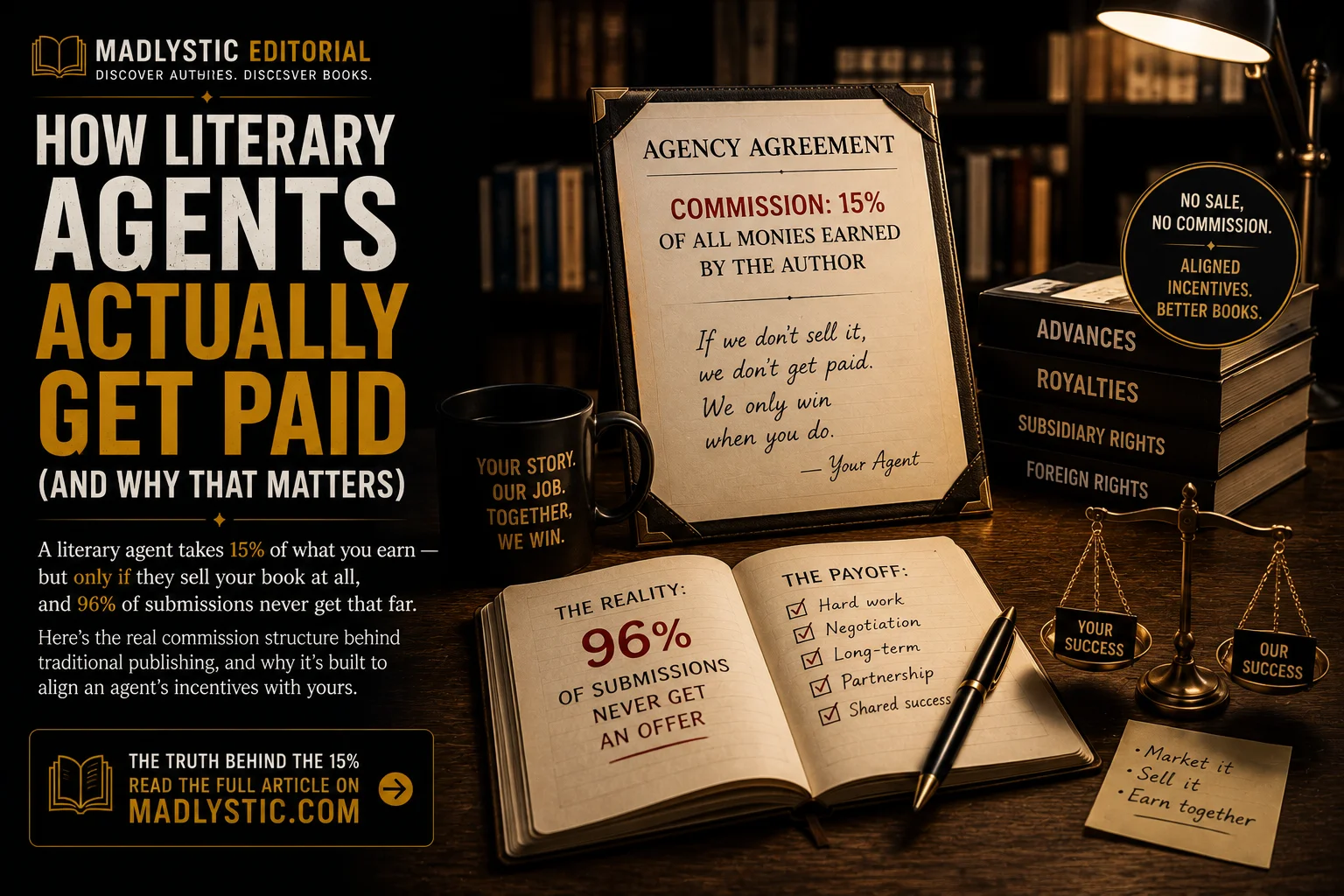
Traditional publishing: you usually sign with a literary agent, who sells your book to a publisher. The publisher pays you an advance, then handles editing, cover design, printing, and distribution to bookstores. In return, it owns the publishing rights and keeps most of the money from each sale. You pay nothing upfront. Read more in how literary agents actually get paid.
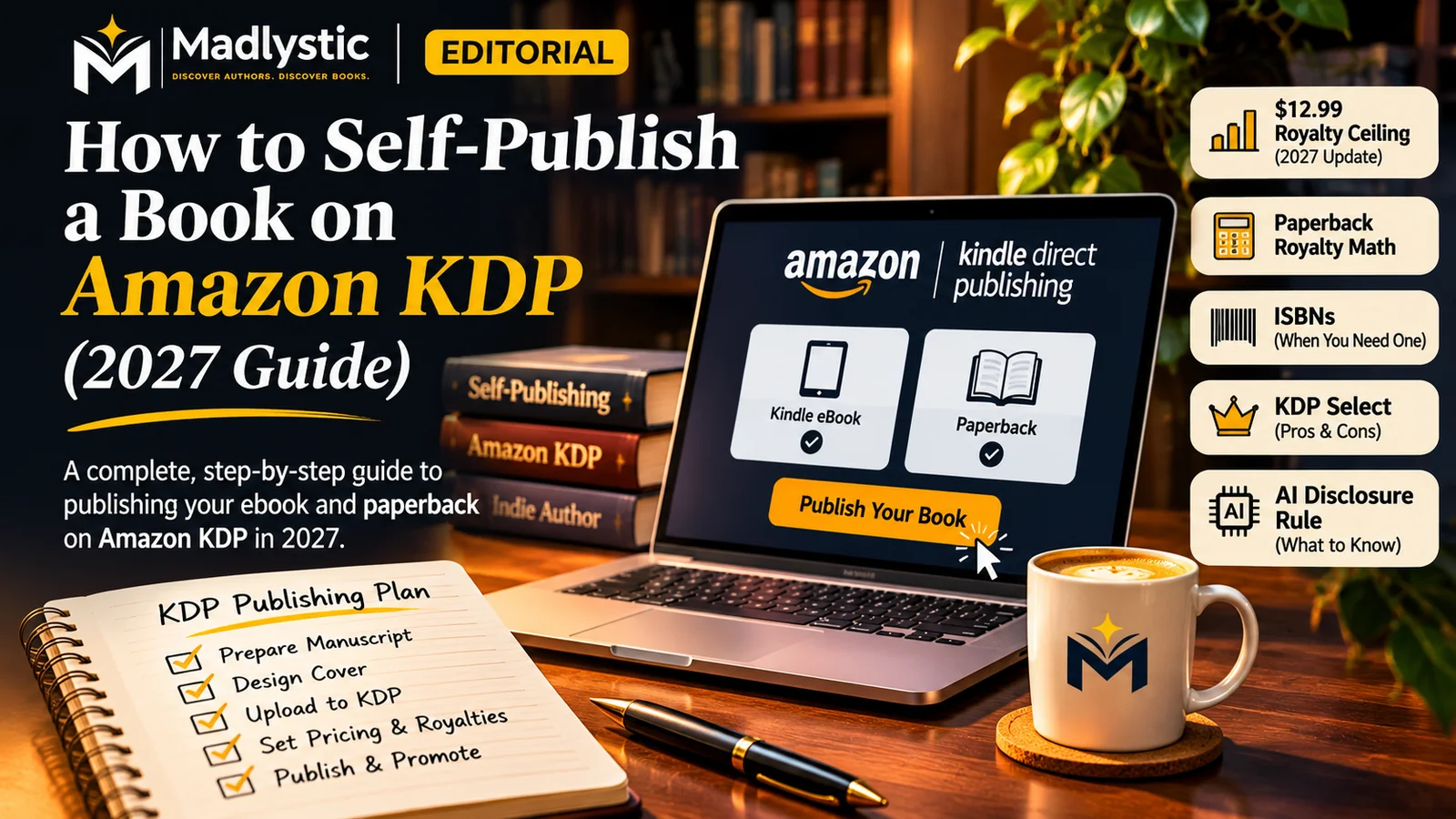
Self-publishing: you publish the book yourself through platforms such as Amazon KDP, keep your rights, and set your own price. You also pay for and manage editing, cover design, formatting, and marketing yourself. See our step-by-step KDP publishing guide.
Money: advances vs. royalties
This is where the two paths differ most.
Traditional publishing pays an advance before the book comes out, which you keep even if the book sells poorly. After that, you earn royalties only once your sales have "earned out" the advance. According to the Authors Guild's model contract and common industry guides, typical royalty rates are:
Hardcover: usually 10% to 15% of the list price, often rising as sales grow
Trade paperback: often around 7.5% of the list price
Ebook: usually 25% of the publisher's net receipts
Traditional publishers usually pay royalties twice a year.
Self-publishing pays no advance, but you keep a much larger share of every sale. On Amazon KDP, ebooks earn 70% when priced between $2.99 and $12.99, and paperbacks earn 50% to 60% of the list price minus printing costs. Most platforms pay monthly.
In short: traditional publishing reduces your risk upfront, and self-publishing rewards you more per copy if the book sells.
Upfront costs
Traditional: nothing. A legitimate publisher or agent never charges you to publish. If someone does, read the one rule that exposes almost every publishing scam.
Self-publishing: you pay for professional services. Editing alone can cost a few thousand dollars for a full novel, as we explain in the 4 types of book editing, plus cover design and any marketing.
Timeline
Traditional: querying agents can take months or longer, and only a small share of queried manuscripts get representation. After a book deal, publication often takes another year or two.
Self-publishing: once your book is edited and designed, it can go live on Amazon within days.
Control and rights
Traditional: the publisher usually has the final say on your cover, title, price, and release date, and it holds your publishing rights for the length of the contract.
Self-publishing: you decide everything and keep your rights, which means you can update the book, change the cover, or move platforms whenever you want.
Reach and prestige
Traditional: easier access to bookstores, libraries, major review outlets, and literary awards, plus a professional team behind your launch.
Self-publishing: strongest online, especially on Amazon and in genres where readers buy heavily in ebook and Kindle Unlimited, such as romance, fantasy, and thrillers. Getting into physical bookstores is much harder.
Marketing
Many new authors assume traditional publishers handle all the marketing. In reality, most debut authors are still expected to promote their own books, especially if the publisher's budget for the title is small. Self-published authors do all of it themselves. Either way, plan to market your book.
What about hybrid publishing?
Hybrid publishers sit in between: the author pays toward production in exchange for higher royalties and some publisher support. Some are legitimate, but the label is also widely used by vanity presses. Check any hybrid publisher carefully before paying anything.
Which path is right for you?
Traditional publishing may suit you if:
You want bookstore and library presence
You'd rather not pay upfront or manage production yourself
You're writing literary fiction, or nonfiction where credibility and prestige matter
You're patient with long timelines
Self-publishing may suit you if:
You want full control over your book and your rights
You want to publish quickly, or release a series on a steady schedule
You write in genres that sell strongly online
You're willing to invest in editing, design, and marketing
Many authors also do both, publishing some books traditionally and others independently. These are called hybrid authors, which is different from hybrid publishers.
Whichever path you choose, readers still have to find your book. Create your free author page on Madlystic to showcase your books and works in progress in one place.
Conclusion
Traditional publishing trades a share of your income and control for an advance, a professional team, and wider reach. Self-publishing trades upfront cost and effort for control, speed, and a much larger cut of every sale. Neither path guarantees success, and both reward the same things: a well-edited book, a strong cover, and a plan for reaching readers. Choose the path that fits your goals, your genre, and how much of the work you want to do yourself.
Frequently Asked Questions
Is self-publishing better than traditional publishing?
Neither is better for everyone. Traditional publishing offers advances and bookstore reach, while self-publishing offers control, speed, and higher royalties per sale.
How much do traditionally published authors earn per book?
Typical royalties are around 10% to 15% of the list price for hardcovers, about 7.5% for trade paperbacks, and 25% of net receipts for ebooks, paid only after the advance has earned out.
How much does self-publishing cost?
Publishing on platforms like Amazon KDP is free, but professional editing, cover design, and marketing can cost anywhere from a few hundred to several thousand dollars.
Do I need an agent to get traditionally published?
Most large publishers only accept submissions through literary agents. Some smaller presses accept submissions directly from authors.
Can I self-publish first and get a traditional deal later?
Yes, some authors do, especially after strong sales. But a publisher is usually less interested in a book that's already been published, so many authors pitch a new book instead.
Share this article
Share this article with readers who'll want to read it.