
Do You Actually Need an ISBN to Self-Publish?
Free ISBN from Amazon, or $125 from Bowker? Most guides skip the actual tradeoff. Here's the honest, complete answer — what an ISBN really does, when you genuinely need one, and the one mistake that quietly limits your book for good.
Published July 29, 2026
8 min read
Quote of the Day
"Your ISBN says who the publisher is." — a plain, one-line summary of the entire decision this article is about.
Every new self-published author eventually hits the same confusing fork in the road: KDP offers a free ISBN with one click, but a dozen writing forums insist you should pay $125 for your own instead. Both sides are right about something, and almost nobody explains why clearly enough to make an informed choice — most guides either oversell the free option or scare you into buying one you might not need yet. Here's the actual, complete picture.
What an ISBN actually is, and what it isn't
An ISBN — International Standard Book Number — is a 13-digit identifier that tells bookstores, libraries, and distributors exactly which specific edition of which specific book they're looking at. Every format needs its own separate number: your paperback, your hardcover, and your ebook are each treated as distinct products requiring distinct ISBNs, even though they contain identical words.
The single most common misconception, worth clearing up immediately: an ISBN has absolutely nothing to do with copyright. It doesn't protect your writing, register your ownership, or grant you any legal rights over your work. It's purely a cataloging tool — the equivalent of a UPC barcode for books. Copyright protection comes from an entirely separate process through the U.S. Copyright Office, and getting an ISBN does nothing for it whatsoever.
When you genuinely need one — and when you honestly don't
For an ebook sold exclusively through Amazon KDP, you don't need one at all. Amazon assigns your book its own internal identifier (an ASIN) and will happily sell it without any ISBN attached. If you're certain you'll only ever publish on Amazon and never anywhere else, this is a completely legitimate, permanent choice, not just a temporary shortcut.
For a print book, the calculation changes. No serious bookstore, library, or wholesale distributor will stock or catalog a physical book without a valid ISBN — it's the industry's baseline requirement for physical inventory tracking. If you want your paperback to exist anywhere beyond Amazon's print-on-demand system, an ISBN stops being optional.
The real tradeoff between free and paid — the part most guides gloss over
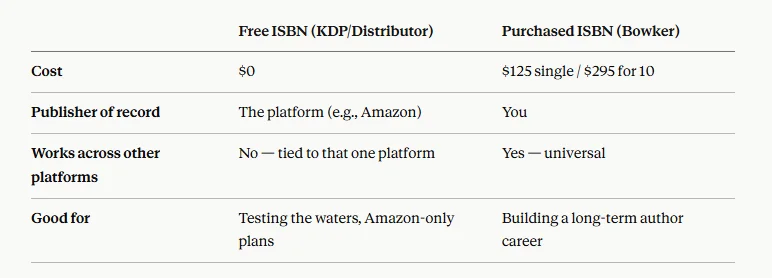
This is where the actual decision lives, and it's a genuine tradeoff, not a simple "always pay" or "always go free" answer. Amazon KDP, along with distributors like Draft2Digital and IngramSpark, will provide you a free ISBN when you publish. It's a completely real, working number — the catch isn't legitimacy, it's ownership. Whichever platform issues you that free ISBN gets listed as the publisher of record in every industry database that number touches, not you. That number is also permanently tied to that one platform: you cannot take a KDP-issued ISBN and use the same one to publish through IngramSpark or a physical bookstore's ordering system.
Buying your own ISBN, by contrast — in the US, exclusively through Bowker at myidentifiers.com, the only authorized agency, at $125 for a single number or $295 for a pack of ten — makes you the publisher of record, usable across any retailer, distributor, or library worldwide, permanently, with no expiration date.
Traditional Sale vs. Kindle Unlimited — wait, wrong table, here's the real one for this piece:
Why the "one mistake" actually matters long-term
Here's the practical consequence worth sitting with before clicking the free option out of convenience: if you publish your first book with a free KDP ISBN, then later decide you want it stocked in a physical bookstore, distributed through IngramSpark, or available on Kobo and Apple Books, you can't simply reuse that same number. You'll need an entirely new ISBN, which means, in the eyes of every library and distributor database, a new edition of your book — separate reviews, separate sales history, separate everything, even though it's the identical text. Multiple industry guides frame this plainly as the single most common regret among authors who went free first: the cost of a proper ISBN later is the same either way, but you lose whatever review momentum and metadata history accumulated under the free one.
The practical bottom line
If you're publishing a single ebook, exclusively through Amazon, with no plans to ever go wide or print physical copies — the free ISBN (or no ISBN at all, since Amazon doesn't require one for Kindle-only ebooks) is a completely legitimate, permanent choice. If you're planning any kind of ongoing author career — more than one book, any physical print run, any ambition to be stocked outside Amazon's ecosystem — buying your own ISBN from the start is the cheaper decision in the long run, not just the more "official"-feeling one. Since ISBNs never expire and the 10-pack works out to roughly $29.50 each, most authors planning more than a single book find the block purchase pays for itself the moment they publish a second title or a physical edition of their first.
Conclusion
The ISBN question isn't really about which option is "correct" — it's about being honest with yourself about what kind of publishing career you're actually building. A free ISBN is a real, valid tool for a specific, narrower use case: a single book, sold in a single place, with no plans to expand. The moment any part of that changes — a second book, a print edition, a store beyond Amazon — the free option's real cost shows up later, in lost metadata history and an extra $125 you'll likely spend anyway. Knowing that tradeoff upfront, rather than discovering it after your first book is already out, is the entire difference between a quick, easy launch and a genuinely durable publishing identity.
Share this article
Share this article with readers who'll want to read it.
You may also like
How to Self-Publish a Book on Amazon KDP (2027 Guide)
November 15, 2026
Why Many Kindle Unlimited Books Feel Surprisingly Similar
July 22, 2026
How to Tell If a Book on Amazon Was Written by AI (Before You Buy It)
July 21, 2026
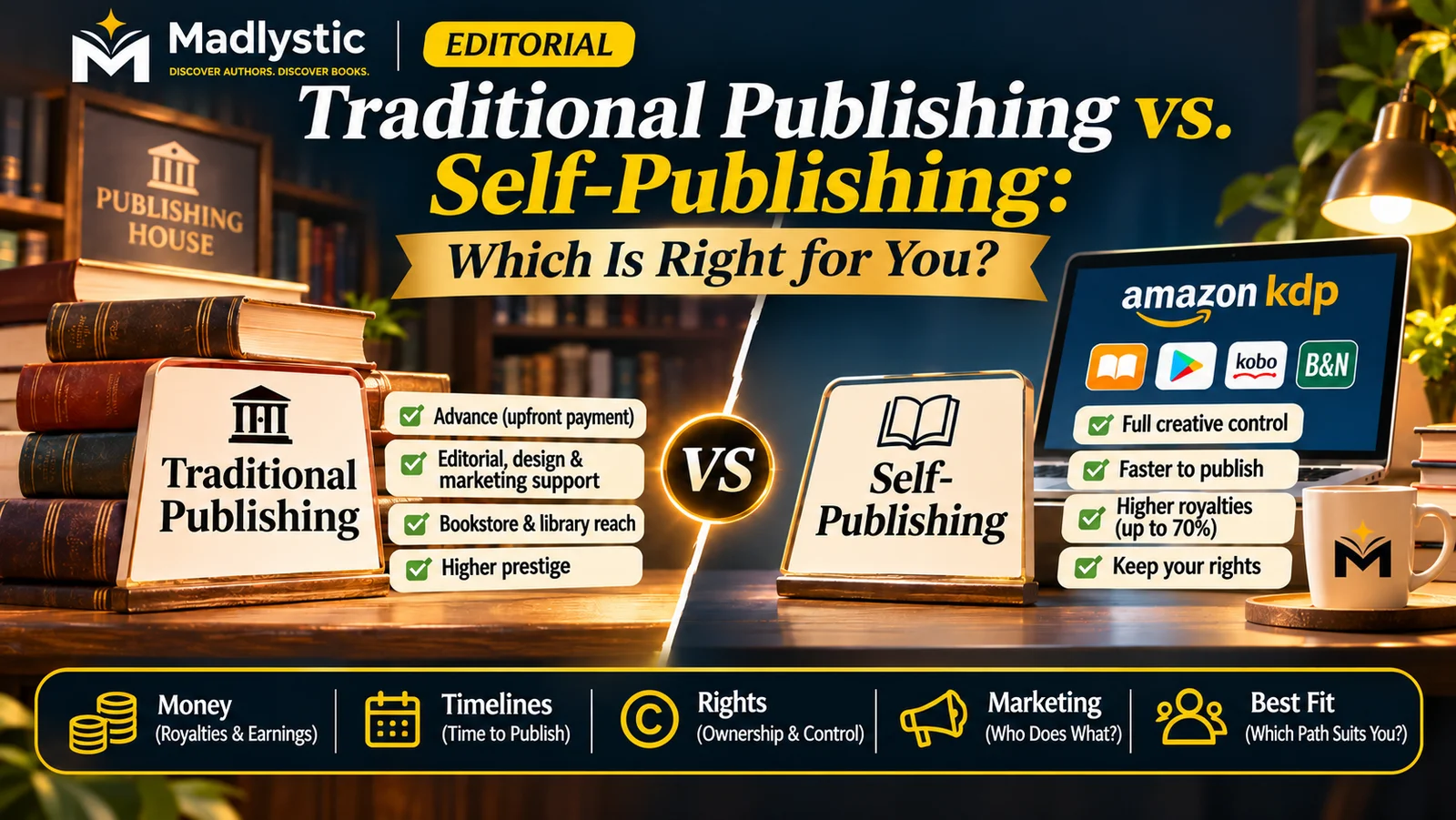
Traditional Publishing vs. Self-Publishing: Which Is Right for You?
November 24, 2026