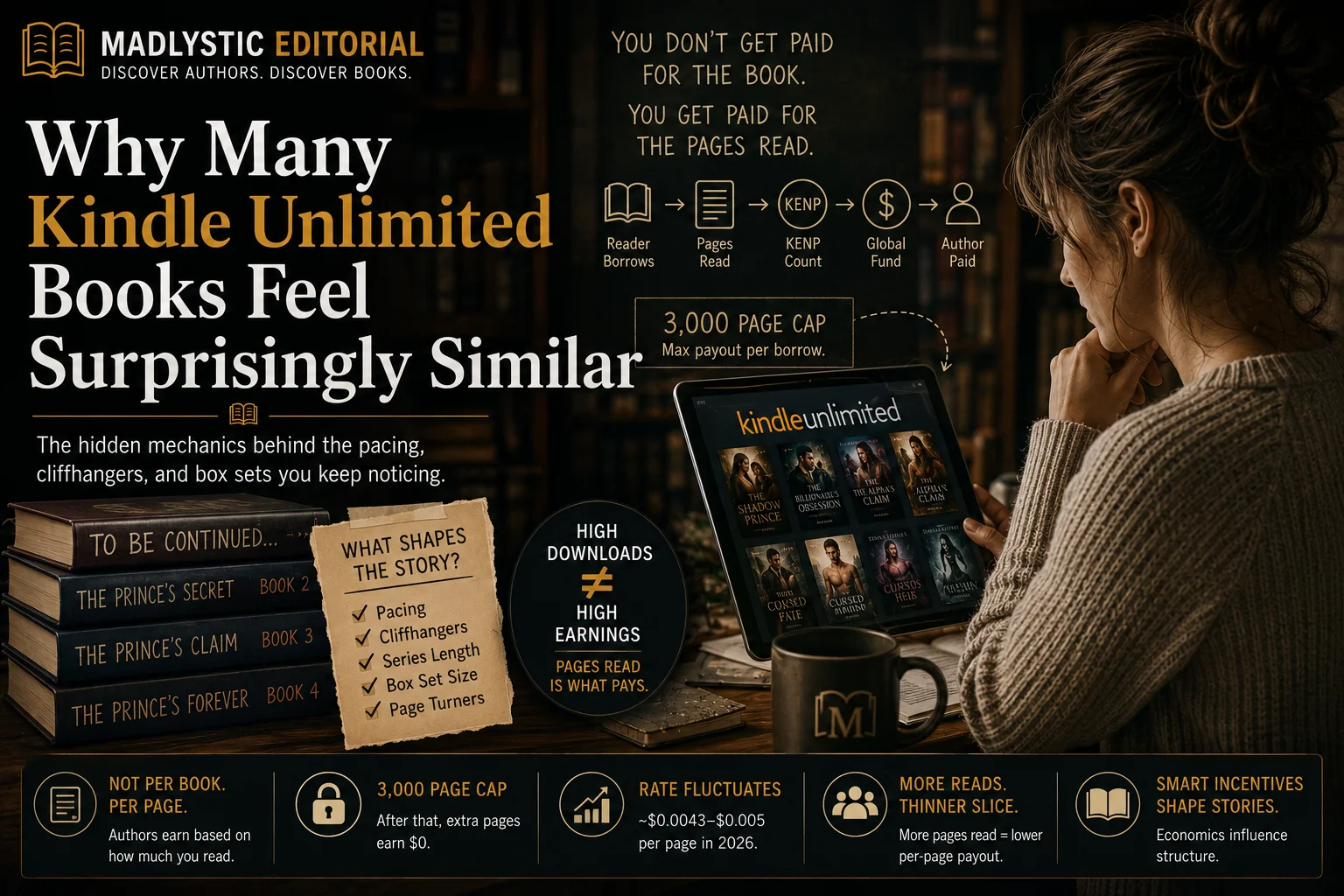
Why Many Kindle Unlimited Books Feel Surprisingly Similar
Kindle Unlimited doesn't pay authors per book — it pays per page a reader actually finishes. That single mechanic, and a hidden 3,000-page cap, quietly shapes how many books in this space get paced, structured, and bundled.
Published July 22, 2026
10 min read
Quote of the Day
"A high number of downloads does not always equal high earnings. Pages read is the metric that matters." — a core principle of how Kindle Unlimited royalties actually function, and the one fact most readers have never been told.
If you've read enough Kindle Unlimited romance or fantasy in the last few years, you may have noticed a pattern without quite being able to name it: books that arrive in three- or four-part box sets, cliffhangers that land suspiciously close to a natural stopping point, series that seem engineered to keep you turning pages rather than closing the app. This isn't true of every book in this space, and plenty of KU fiction looks nothing like this pattern at all — but where it does show up, it's rarely just a stylistic coincidence. It's often a traceable consequence of exactly how Amazon pays authors for Kindle Unlimited reads — a payment mechanic most readers have never heard explained, that's quietly influenced the structure of a meaningful share of books in this space for years.
The core mechanic: you're not paid for the book, you're paid for the pages someone actually reads
Kindle Unlimited doesn't work like a normal book sale. When a reader borrows a book through KU, the author isn't paid a royalty for the borrow itself — they're paid based on KENP, Kindle Edition Normalized Pages, a standardized page count Amazon uses so a longer book with tiny font doesn't unfairly out-earn a legitimately longer one. Each month, Amazon pools a fixed amount of money — the KDP Select Global Fund, which sat around $52-67 million in early-to-mid 2026 — and divides it by the total number of normalized pages read across every enrolled book that month. Whatever number comes out of that division is the per-page rate every author gets paid for that month, and it moves constantly: commonly landing somewhere between $0.0043 and $0.005 per page in recent months.
The genuinely important implication, worth sitting with, is this: a high number of downloads does not equal high earnings — only pages actually finished by a reader translate into payment. A reader who borrows a book and reads ten pages before giving up earns the author almost nothing. A reader who finishes all 400 pages earns the author the full amount. This is a fundamentally different incentive structure than a traditional book sale, where the author gets paid the moment someone buys it, regardless of whether they ever open it.
Traditional Sale vs. Kindle Unlimited, side by side

Why this changes what some authors are incentivized to write
Once you understand that payment is tied entirely to completed reading, the creative calculus can shift for authors who lean heavily on this system. A traditionally-published or straight-sale author is paid the same whether their book is un-put-downable or merely decent, as long as it sells. A Kindle Unlimited author, by contrast, is only paid for the pages a reader actually finishes — which means structural choices that keep a reader turning pages carry a direct, measurable financial consequence that doesn't exist in the same way under a straight-sale model. Chapter-ending cliffhangers, fast pacing, and hooks placed strategically throughout a book aren't only craft choices under this system — for authors who build their business around KU specifically, they're part of the literal mechanism by which payment happens at all. Not every KU author writes this way, and plenty succeed with slower, more traditional pacing — but for those optimizing specifically for this payment model, the incentive is real and traceable.
The hidden page cap that's reshaping how box sets get built
Here's the detail almost no reader has ever encountered, and it's genuinely fascinating once you see it: Amazon caps KENP payment at 3,000 pages per borrow, regardless of how long the actual book or bundle is. At a typical 2026 rate around $0.0049 per page, that cap works out to a maximum possible payout of roughly $14.66 per borrow — a hard ceiling no amount of additional length can push past.
For a single novel, this cap is essentially invisible, since most books run 400-550 KENP pages, nowhere near the threshold. But it becomes a real, deliberate design constraint the moment authors start bundling books into box sets. A typical romance novel runs 800-900 KENP pages, meaning a three-book bundle lands around 2,400-2,700 pages — safely under the cap, earning payment on every single page a reader finishes. Add a fourth book at the same length, though, and the bundle crosses into 3,200-3,600 KENP territory, meaning 200-600 pages of that fourth book earn the author literally nothing if a reader reads the whole bundle straight through, because payment simply stops accruing past the 3,000-page mark.
This is why, according to authors who've mapped out the actual economics, the standard architecture for many Kindle Unlimited romance box sets has become three to four books specifically structured to land as close to the 3,000-page ceiling as possible without exceeding it. That's not a coincidence of taste for the authors who do this deliberately. It's a direct response to a specific, calculable payment rule most readers browsing a "complete trilogy" bundle have no idea exists.
Why the per-page rate keeps drifting lower even as the fund grows
There's a counterintuitive wrinkle worth understanding too: the Global Fund itself has grown enormously since Kindle Unlimited launched in 2014 — from $2.5 million at launch to tens of millions of dollars monthly by 2026, a roughly 27-fold increase. And yet the per-page rate authors actually get paid has trended lower than its 2015 peak of about $0.00578 per page. The reason is straightforward once explained: the fund is divided by total pages read across the entire platform, and the number of KU subscribers and total pages read has grown even faster than the fund itself. More authors, more books, more total reading activity all competing for a share of the same pool means the per-page slice keeps getting thinner even as the overall pool gets bigger — a dynamic that isn't obvious unless someone actually walks through both sides of the equation together.
What this means for readers, not just authors
This isn't really an article about author income — it's an article about why certain books feel the way they do, once you understand the invisible economic scaffolding some of them are built on. Readers who've noticed certain structural patterns in Kindle Unlimited fiction — fast hooks, frequent cliffhangers, box sets sized suspiciously close to a round number — aren't necessarily imagining things. These incentives can genuinely influence how a book gets structured, though authors make very different creative choices even within the same payment model, and plenty of KU fiction looks nothing like this pattern at all. It's an influence on the margins, not a universal rule.
None of this makes KU books worse, categorically — plenty of genuinely excellent fiction exists within this system, written by authors who happen to also be smart about its mechanics. But understanding the mechanism does change how a reader might read the next suspiciously well-paced cliffhanger: not necessarily as pure creative instinct alone, but sometimes as the visible outcome of a payment infrastructure operating quietly underneath the story.
Conclusion
Most readers assume a book's structure comes purely from creative instinct — pacing, hooks, and cliffhangers as pure craft decisions, shaped only by what makes a better story. Kindle Unlimited quietly complicates that assumption for at least some of its catalog, because it's one of the few places in publishing where the actual payment mechanism is granular and transparent enough to trace directly back into creative structure: a 3,000-page cap that shapes some box-set architecture, a per-page rate that rewards finished reading over mere purchases, an entire payment pool that grows and shrinks based on aggregate reader behavior nobody outside the system usually thinks about. It's a genuinely rare, visible example of economics and craft intersecting in real time — and once you know the mechanism exists, it's hard not to notice it in at least some of what you read next.
Share this article
Share this article with readers who'll want to read it.
You may also like
How to Self-Publish a Book on Amazon KDP (2027 Guide)
November 15, 2026

Do You Actually Need an ISBN to Self-Publish?
July 29, 2026
How to Tell If a Book on Amazon Was Written by AI (Before You Buy It)
July 21, 2026
Traditional Publishing vs. Self-Publishing: Which Is Right for You?
November 24, 2026