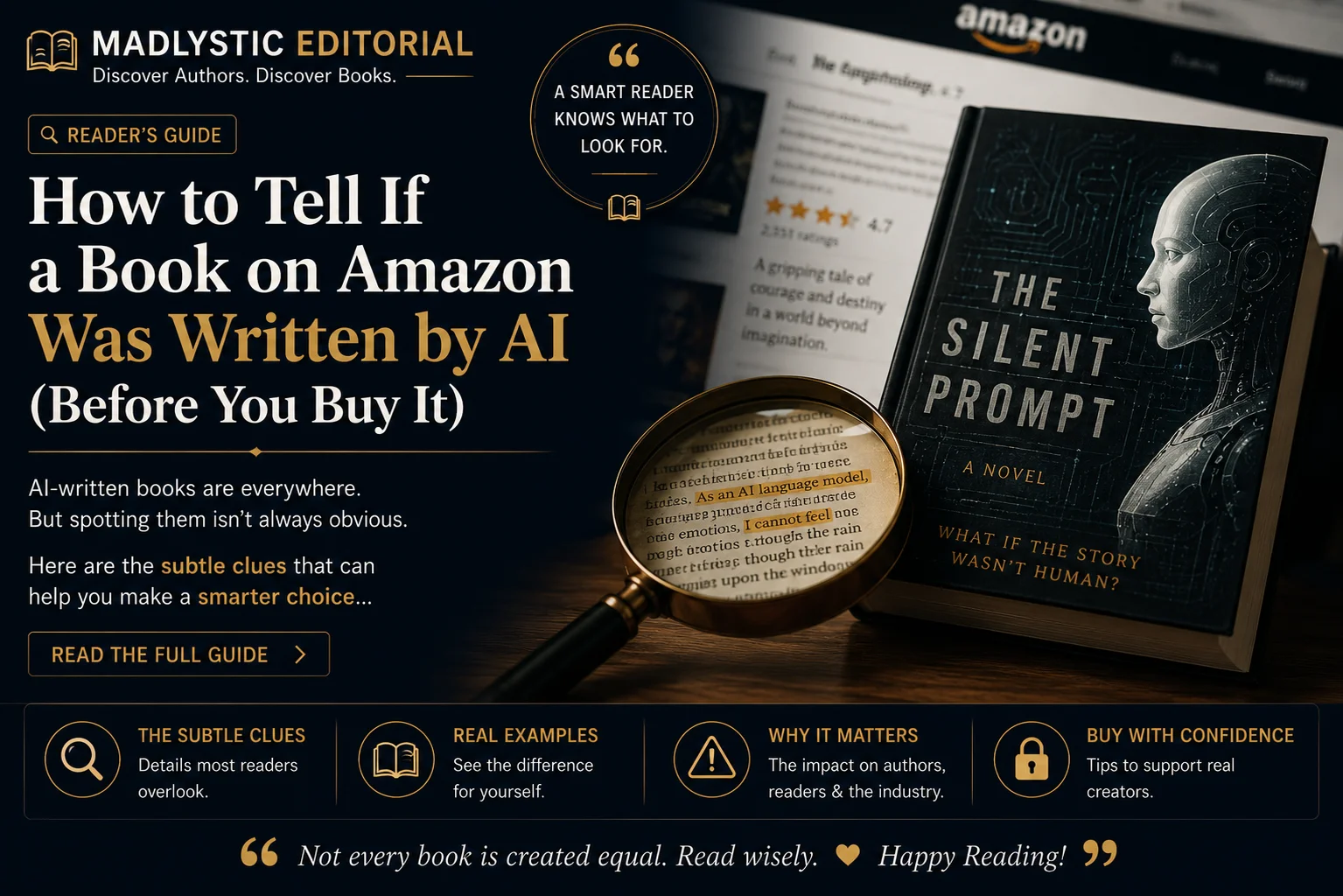
How to Tell If a Book on Amazon Was Written by AI (Before You Buy It)
Amazon's Kindle store is quietly filling with books nobody actually wrote — generated in bulk, wrapped in a stolen-looking cover, priced to catch a fast, confused sale. Here's how to actually spot one before you buy it.
Published July 21, 2026
11 min read
Quote of the Day
"The problem with these slop books isn't just that they're diverting revenue that should be in the pockets of writers who wrote books. The problem is that they're deceiving buyers." — Cory Doctorow, as quoted in Rolling Stone
Somewhere on Amazon right now, there's a book with your favorite author's writing style, a plausible-looking cover, and a title one word off from something you actually wanted to read. It wasn't written by a person. It was generated, uploaded, and priced to catch exactly the kind of fast, half-attentive purchase decision most people make while browsing on their phone. This isn't a rare edge case anymore. It's a large and growing category of the marketplace, and almost nobody has explained clearly, in plain terms, how an ordinary reader can actually tell the difference before they buy.
How big this actually is
This isn't a fringe problem anymore. Reports throughout 2025 and 2026 have documented what's now commonly called the "AI bookspam wave" — a surge of low-quality, often entirely AI-generated titles flooding Kindle Direct Publishing specifically, concentrated in categories like romance, self-help, travel guides, and public-domain rewrites, where a formulaic structure is easiest for a generator to mimic convincingly. Some single operators have been documented publishing dozens or even hundreds of titles under multiple invented pen names in a single year — a volume no human writer could plausibly produce, and one that only makes sense as an automated pipeline.
The most well-documented pattern is direct plagiarism-by-generation: an author publishes a genuine, successful book, and within months, near-identical titles appear from authors who don't seem to actually exist, with writing that's been run through an AI tool to lightly reword the original closely enough to ride its search traffic without technically copying it word for word. Writer Mat Auryn has spent two years fighting exactly this pattern after his book on psychic practice spawned a wave of AI-generated knockoffs riding his own search visibility.
What Amazon is actually doing about it — and why it doesn't solve the reader's problem
To be fair to Amazon, this isn't being ignored. KDP now requires authors to formally disclose whether a book contains AI-generated content — text, images, or translations — through a mandatory checkbox at upload, distinguishing "AI-generated" (a tool created the actual content) from "AI-assisted" (a human wrote it, AI helped refine it). Enforcement has tightened: Amazon's systems now scan writing patterns, metadata, and upload speed to catch undisclosed AI content, backed by human review for flagged titles, and accounts are capped at three new book uploads per day specifically to slow down mass-generation pipelines.
Here's the part that matters most for an actual reader, though: that disclosure is invisible to you. Amazon collects the AI-generated/AI-assisted answer, but readers never see it on the actual product page. You can be looking directly at a book's listing and have no visible indication whatsoever of what Amazon itself already knows about how it was made. The disclosure exists for Amazon's internal enforcement, not for your buying decision — which means the actual burden of spotting a generated book still falls entirely on you, the reader, standing in front of a book description with no reliable label to check.
The actual signals worth checking
None of these are perfect on their own, but stacked together they're a genuinely reliable filter:
The author has no findable footprint anywhere else. A real author, even a brand-new indie one, usually has something — a social account, a mention in a writing community, a Goodreads profile with actual reader interaction, an author page that isn't a single paragraph of generic biography. An author who exists only as a name on one listing, with zero digital footprint anywhere else, especially one who's published a suspiciously large number of books in a short window, is a real warning sign.
The description reads like it's summarizing itself rather than hooking you. Genuine book descriptions tend to have a distinct voice, specific stakes, maybe a bit of genuine excitement in the phrasing. AI-generated descriptions frequently read as a flat, generic outline of tropes — "a gripping tale of love, loss, and redemption" attached to absolutely nothing specific about the actual plot, characters, or setting. If you can't tell what actually happens in the book from its description, that's worth noticing.
The cover looks almost right, but slightly off. AI-generated cover art has a particular uncanny quality that's gotten harder to spot but hasn't disappeared entirely — text that's subtly misaligned, a stock-photo sameness to character faces, compositions that mimic bestseller covers in the same genre a little too closely without quite committing to a distinct visual identity of their own.
The reviews, if there are any, feel disconnected from the actual book. A cluster of reviews that are vague, oddly generic, or posted in a tight burst right after launch — especially if they praise things in broad strokes without referencing any specific scene, character, or plot detail — is a common pattern in both AI-generated review farming and books nobody has actually finished reading.
The price and release pattern is aggressive. A single account publishing many titles per month, all in the same narrow niche, all priced at the same low, impulse-friendly point, is a production-pipeline pattern rather than an individual author's typical release cadence.
Why this problem is actually about discovery infrastructure, not just detection
Here's the part worth sitting with, because it reframes the whole issue: this isn't really a story about AI being bad at writing. Plenty of the offending books are perfectly readable, in a shallow, generic sense — competent sentences describing nothing memorable. The actual problem is what one industry analysis called a supply economics shift: when the cost of producing a book falls toward zero, the marketplace's scarce resource stops being "content" and becomes "trust and discovery" — the ability to tell a reader which of the infinite available titles is actually worth their time and money. Retailers that can't solve that trust problem risk becoming, in the words of one commentator, noise machines where genuine creators eventually leave and only the automated operators remain.
This is, not coincidentally, exactly the problem discovery platforms built around human curation are trying to solve from the opposite direction. A shelf like Editor's Choice or a genuinely verified author profile isn't just a nice feature — in a marketplace where anyone can generate and upload dozens of plausible-looking books overnight, a human-reviewed claim process and editorially curated placement become a real trust signal, not just a discovery convenience. Madlystic's author verification and claim process exist for exactly this reason: a profile that's been claimed and verified by a real person is a meaningfully different signal than an unclaimed listing that could belong to anyone, or no one.
What to actually do if you're not sure
Before buying anything from an author you don't recognize, a thirty-second gut-check: search the author's name plus "reddit" or "goodreads" and see if any actual reader discussion turns up. Read the book's sample chapter, not just the description — AI-generated prose tends to reveal itself faster in the actual text than in a polished blurb. And if a book's entire catalog from one author appeared within the same few weeks, in the same narrow trope-heavy niche, treat that volume itself as the strongest signal of all.
Conclusion
This isn't a problem that's going away, and pretending otherwise doesn't help anyone — the same technology that makes it easy for a legitimate indie author to bring a real book to market cheaply also makes it easy for someone to generate a hundred fake ones overnight. The honest response isn't panic or blanket distrust of self-publishing, which remains how a huge number of genuinely great, hardworking authors reach readers. It's a shift in what readers should actually be checking for — footprint, specificity, and pattern, rather than just cover art and star ratings — and a growing reason why curated, human-verified discovery is becoming not just a nice feature, but a genuinely necessary one.
Share this article
Share this article with readers who'll want to read it.