What "Independence" Means for a Story, Not Just a Nation
On the eve of India's 79th Independence Day, a look at a different but connected kind of freedom — the one a growing number of authors are claiming for their own stories, outside the old gatekeepers, on their own terms.
Published August 14, 2026 · 11 views
7 min read
Happy Independence Day, from all of us at Madlystic 🇮🇳 To every reader, writer, and storyteller across India — happy 79th Independence Day. Today belongs to the freedom our nation fought for; every story we tell afterward is one small way of honoring it.
Quote of the Day
"India, the new myth—a collective fiction, in which anything was possible, a fable rivalled only by the two other mighty fantasies: money and God." — Salman Rushdie, Midnight's Children
Tomorrow, August 15, marks 79 years since India's independence from British colonial rule in 1947 — a moment so vast and so personal at once that it's produced one of the richest, most enduring bodies of literature in modern history. It's worth pausing on why that particular kind of freedom — political, national, hard-won — has always found its truest expression in stories, and what that connection might mean for a much smaller, quieter kind of independence: the one a writer claims over their own work.
A single midnight, told a thousand different ways
No single event in modern literary history has been returned to as often, or as variously, as the midnight of August 15, 1947. Salman Rushdie's Midnight's Children opens with Saleem Sinai born in that exact instant, his life bound magically to the fate of the newborn nation. Khushwant Singh's Train to Pakistan found the same moment from ground level, in a fictional village where love has to survive what politics couldn't contain. Bhisham Sahni's Tamas — the word itself meaning "darkness" — traced the machinery of communal violence with unflinching, documentary precision. Attia Hossain's Sunlight on a Broken Column gave the moment to a young woman named Laila, whose personal fight for independence runs in parallel with her country's.
What's striking, taken together, isn't just the scale of what these writers were describing — it's how insistently personal each account remained. Independence, in this literature, was never only a headline or a transfer of power. It was always also a single family's shoe business failing, a single betrothal broken by a new border, a single sixteen-year-old girl deciding what kind of life she actually wanted to live inside a country being remade around her.
Why this connects to something Madlystic actually cares about
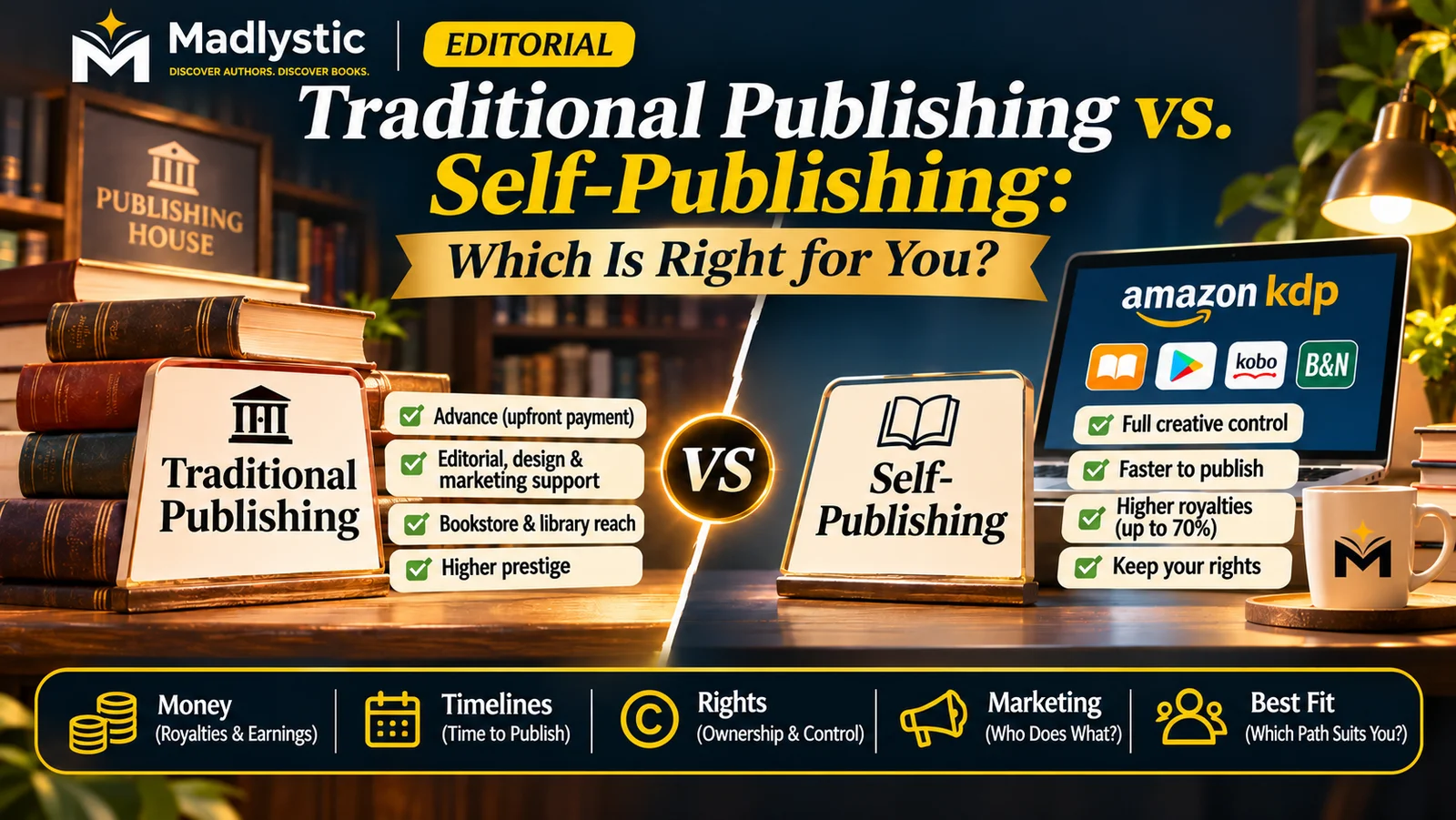
There's a real, if less dramatic, echo of that same idea in what's happening across independent publishing right now. For most of the last century, a writer's path to being read ran through a small number of powerful gatekeepers — publishers, agents, distributors — who decided, largely on their own judgment, whose stories were worth the investment. That system produced genuinely great work. It also, inevitably, left an enormous amount of great work unpublished, simply because it didn't fit what the gatekeepers of a given era believed would sell.
Self-publishing, for all its very real challenges — the ones covered elsewhere on this blog, from cold-start discovery problems to ISBN decisions to the flood of AI-generated noise now competing for the same shelf space — represents a genuine, structural shift in who gets to decide a story is worth telling. Not a perfect shift, and not one without its own new problems. But a real one: the same kind of decision-making power that used to sit almost entirely with a handful of institutions now sits, at least partially, with the writer themselves.
The parallel isn't a stretch — it's the same underlying question
Political independence and creative independence aren't the same thing, and it would be a disservice to the real, hard-won weight of 1947 to flatten that difference. But they do share a single underlying question, asked at very different scales: who gets to decide what a story is allowed to be, and who tells it? Partition literature exists, in large part, because writers refused to let that period's story be told only by the official histories and the men who negotiated the border — they insisted on the version told by the women, the children, the ordinary families whose lives were rearranged by decisions made without them. Indie publishing, at its best, carries a smaller echo of that same insistence: a writer's story doesn't have to wait for someone else's permission to exist.
A reading list worth returning to, whatever today's date is
If any part of this resonates, the actual books are worth reading on their own terms, independent of any anniversary: Midnight's Children, Train to Pakistan, Tamas, Sunlight on a Broken Column, Urvashi Butalia's The Other Side of Silence, and Bapsi Sidhwa's Cracking India all approach the same historical moment from genuinely different angles — political, intimate, documentary, magical-realist — and together they make the case better than any single one of them could alone: that a defining national moment is never actually singular. It's always, on closer inspection, thousands of smaller, equally real stories, each one insisting on being told in its own voice.
Conclusion
Tomorrow's anniversary is, first and always, about a nation's hard-won freedom — that meaning shouldn't be diluted or claimed by anything smaller. But the literature that grew out of that moment offers a genuinely useful lens for thinking about a much quieter kind of independence happening in publishing right now: the slow, uneven shift toward letting more storytellers decide, on their own terms, that their story is worth telling — without waiting for someone else's permission to begin.
Wishing every reader and writer in the Madlystic community a joyful, proud Independence Day. Jai Hind.
Share this article
Share this article with readers who'll want to read it.