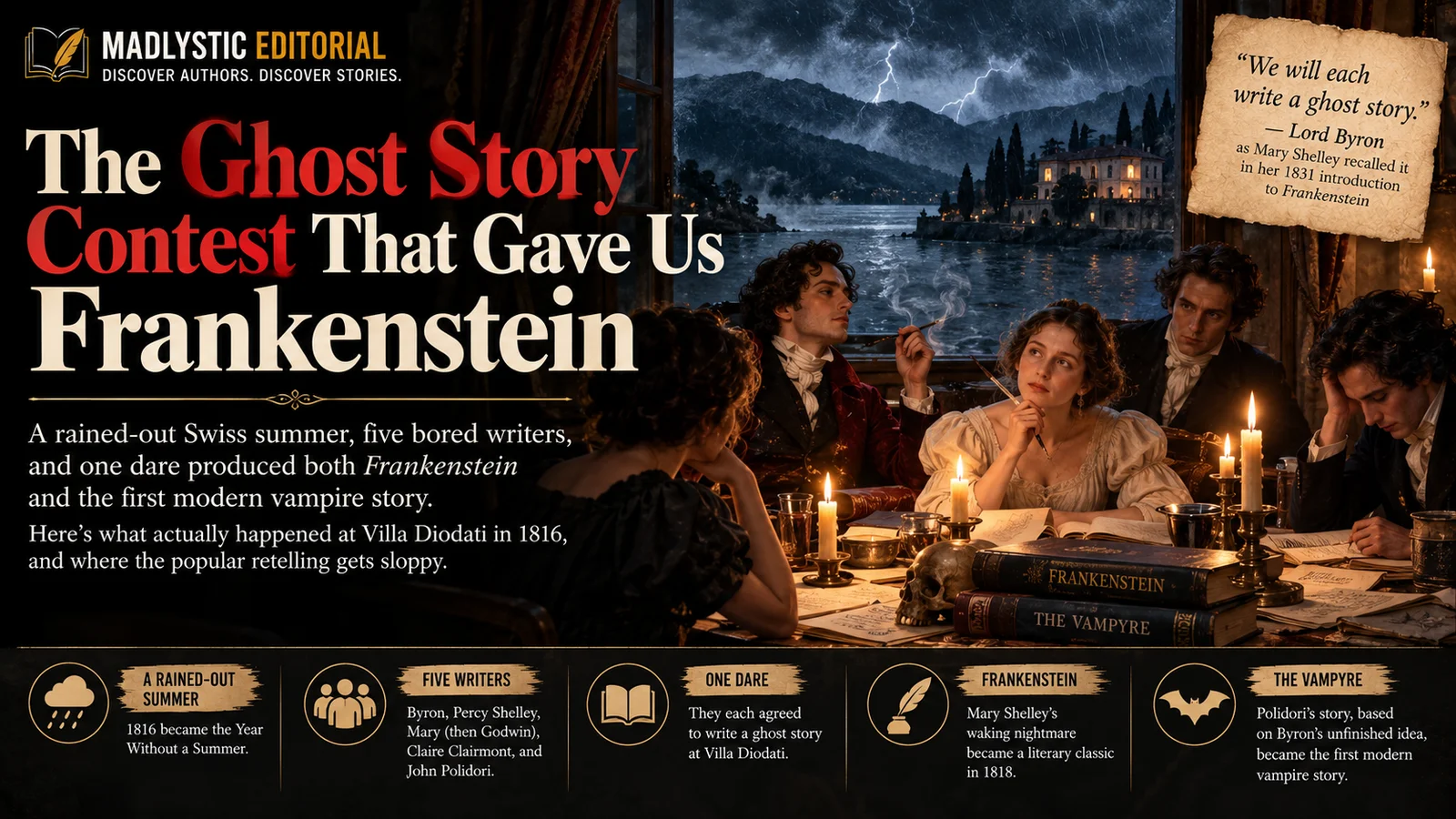
The Ghost Story Contest That Gave Us Frankenstein
A rained-out Swiss summer, five bored writers, and one dare produced both Frankenstein and the first modern vampire story. Here’s what actually happened at Villa Diodati in 1816, and where the popular retelling gets sloppy.
Published October 31, 2026
Quote of the Day
“We will each write a ghost story.” — Lord Byron, as Mary Shelley recalled it in her 1831 introduction to Frankenstein
Every Halloween, someone retells the story of the night Frankenstein was born, and it usually arrives smoothed into a legend: a storm, a dare, a flash of genius by morning. The real version is messier, and in some ways more interesting. It’s a story about bad weather, boredom, and what a deadline among friends can do.
The summer that never came
In 1816, the weather across Europe turned cold, wet, and gloomy, and the year became known as the Year Without a Summer. Lord Byron had rented the Villa Diodati in Cologny, above Lake Geneva. Percy Bysshe Shelley, Mary Wollstonecraft Godwin (not yet Mary Shelley), and Claire Clairmont rented a house nearby. Byron’s physician, John Polidori, was staying at the villa with him.
Trapped indoors by the weather, the group read aloud from Fantasmagoriana, a French collection of German ghost stories. Then Byron proposed the contest: each of them would write a ghost story of their own.
The date and the guest list are less certain than legend suggests
Most retellings say the dare happened on June 16, 1816. Polidori’s diary entry of June 17, noting that the ghost stories had been begun by everyone but him, is the best surviving evidence for the timing, so some sources date the night to June 16 and others to June 17.
Even who took part is disputed. Percy Shelley’s 1818 preface to Frankenstein says three people entered the contest. Mary Shelley’s 1831 introduction counts four, adding herself. Some scholars think Claire Clairmont may never have been part of the writing at all. The popular image of five writers competing is a tidy simplification.
Mary’s story took days to arrive
Mary Shelley’s own account is that she struggled at first. Nothing came to her until, after a late-night conversation about the nature of life, she had what she described as a waking nightmare: a pale student kneeling beside the thing he had made. That image became Frankenstein; or, The Modern Prometheus, published in 1818, and it’s often called the first true science fiction novel.
The vampire story has a stranger history
Byron began a story about a dying aristocrat named Augustus Darvell, then abandoned it. Polidori built on that fragment, and a few “idle mornings” later he had The Vampyre, centered on a charismatic, predatory aristocrat named Lord Ruthven. It’s widely regarded as the first modern vampire story and an ancestor of Bram Stoker’s Dracula.
Then came the part that must have stung. When The Vampyre ran in the New Monthly Magazine on April 1, 1819, it was credited to Byron. Polidori protested, and later printings removed Byron’s name from the title page, but they didn’t replace it with Polidori’s. The authorship stayed muddled for years, and the story’s early popularity was partly driven by the wrong famous name attached to it.
Why this story keeps getting retold
The Diodati night endures because it shows how much of literary history comes from ordinary conditions: bad weather, a restless friend, and a simple rule that everyone has to write something. Two genres that still sell today, science fiction and the romantic vampire, trace back to people who were mostly just trying not to be bored.
Conclusion
The legend says a storm produced genius. The record says something more useful for anyone who writes: a small, low-stakes challenge among peers, with a shared deadline and a shared theme, was enough to produce two founding works of modern fiction. Most of the writers involved never finished their entries. Two did, and those two are still being read two centuries later.
Share this article
Share this article with readers who'll want to read it.