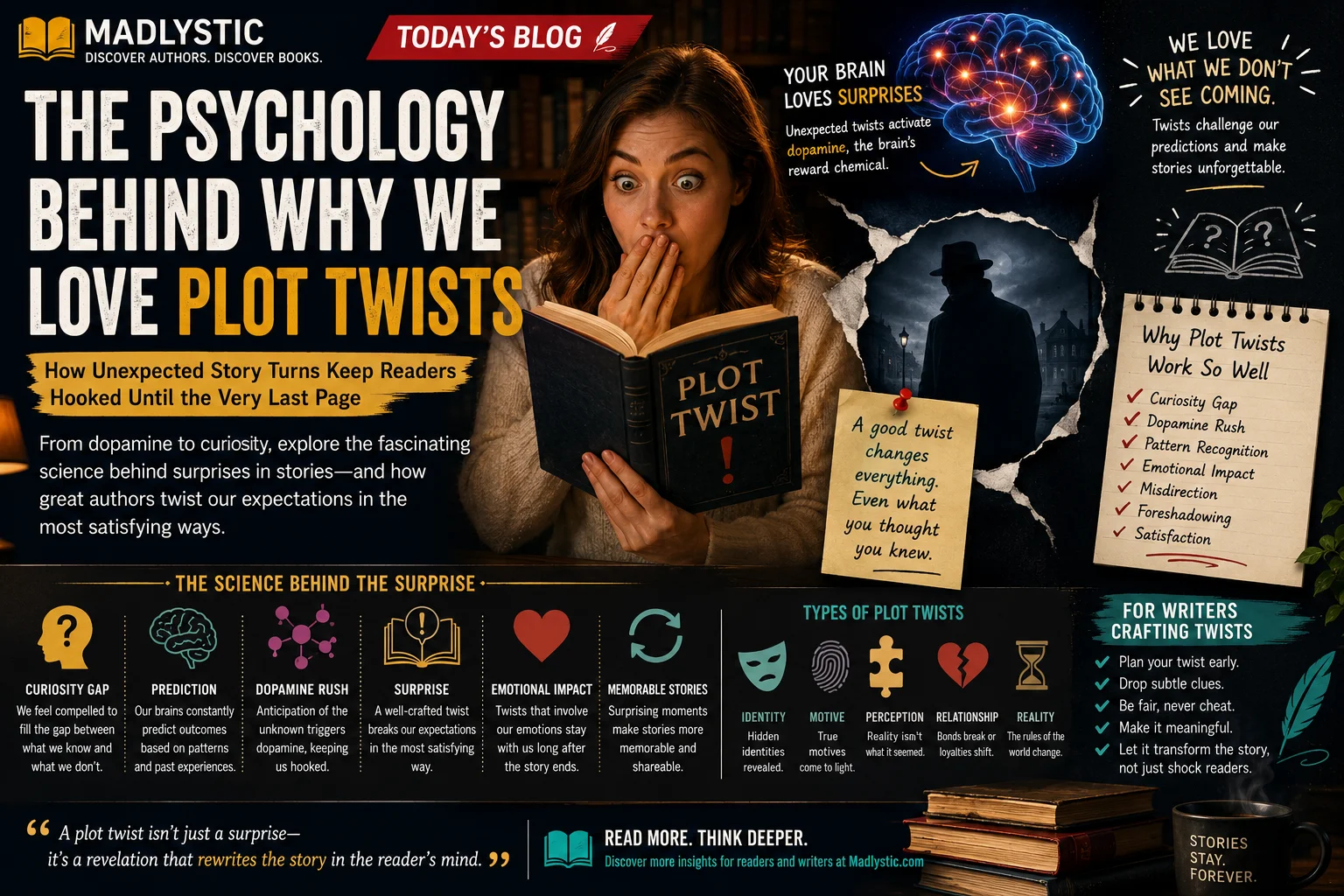
The Psychology Behind Why We Love Plot Twists
The Psychology Behind Why We Love Plot Twists | Madlystic Discover the psychology behind plot twists and learn why suspense, curiosity, dopamine, and clever storytelling keep readers hooked until the final page.
Published July 12, 2026
How Unexpected Story Turns Keep Readers Hooked Until the Very Last Page
Published by Madlystic Editorial Team | July 9, 2026
Estimated Reading Time: 18–22 Minutes
Introduction
Think back to the last book that completely shocked you.
Maybe a trusted character turned out to be the villain.
Perhaps the hero wasn't the hero at all.
Or maybe the ending made you rethink everything you'd read over the previous three hundred pages.
For a brief moment, your brain stopped.
Your eyes widened.
You immediately wanted to tell someone else about the book.
That feeling isn't accidental.
It's the result of one of storytelling's most powerful tools:
The plot twist.
A well-crafted plot twist doesn't simply surprise readers—it changes how they understand the entire story. It rewards careful attention, sparks emotional reactions, and often transforms a good novel into an unforgettable one.
But why do humans love plot twists so much?
Why does discovering the unexpected feel so satisfying?
The answer lies in psychology, neuroscience, and the way our brains are wired to search for patterns.
Let's explore the fascinating science behind why unexpected storytelling has captivated readers for centuries.
Our Brains Are Prediction Machines
The human brain constantly predicts what will happen next.
Every second, it analyzes information and makes assumptions about the future.
While reading a novel, your brain naturally begins asking questions:
Who is the killer?
Will the couple end up together?
Can the hero survive?
Who can be trusted?
What's really happening?
Without realizing it, you're building theories.
Your brain enjoys making predictions because accurate predictions help us understand the world.
Stories take advantage of this natural tendency.
The Curiosity Gap
Psychologists often describe something called the Curiosity Gap.
This happens whenever we know enough to become interested—but not enough to know the answer.
Imagine reading:
"The letter had been hidden for twenty years."
Immediately, questions appear.
Who wrote it?
Why was it hidden?
What's inside?
Questions create psychological tension.
Our brains dislike unfinished puzzles.
That discomfort encourages us to keep reading until we discover the answer.
Dopamine: The Brain's Reward Chemical
One reason plot twists feel exciting is because they activate the brain's reward system.
When we anticipate discovering something important, the brain releases dopamine, a neurotransmitter associated with motivation, learning, and reward.
Contrary to popular belief, dopamine isn't just released when we get the answer—it often increases while we're anticipating the answer.
That's why suspense is so addictive.
Every chapter promises another clue.
Every revelation keeps readers engaged.
When the twist finally arrives, the emotional payoff feels earned.
Humans Love Solving Mysteries
Long before books existed, our ancestors survived by recognizing patterns.
They needed to notice:
Animal tracks
Weather changes
Dangerous plants
Hidden threats
Pattern recognition became one of humanity's greatest survival tools.
Stories tap into this instinct.
Readers naturally collect clues.
They examine dialogue.
They remember small details.
They build theories.
A great plot twist rewards this detective work.
Surprise Makes Stories Memorable
Have you ever forgotten a predictable novel?
Probably.
But chances are you still remember the story that completely caught you off guard.
Psychologists have found that surprising events are often remembered more vividly than expected ones.
Unexpected moments interrupt routine thinking.
They demand attention.
That's why shocking story revelations often remain with readers for years.
Good Plot Twists Feel Inevitable
The best twists don't come out of nowhere.
Instead, readers experience a fascinating feeling:
"I never saw that coming...
...but I should have."
This happens because the author quietly planted clues throughout the story.
Readers simply interpreted them differently.
Great twists reward rereading.
Bad Plot Twists Feel Like Cheating
Not every surprise is satisfying.
Readers dislike twists that exist only to shock.
Examples include:
Suddenly introducing a new villain in the final chapter.
Revealing information that was impossible to guess.
Changing established rules without explanation.
Ignoring earlier clues.
A twist should surprise readers—not betray them.
The Psychology of Misdirection
Magicians understand something writers also use:
People notice what they're encouraged to notice.
Authors direct readers' attention toward one possibility...
while quietly preparing another.
This technique is called misdirection.
It's one of the oldest storytelling tools in history.
Red Herrings: Leading Readers Astray
Mystery novels frequently use red herrings.
These are believable clues that encourage readers to suspect the wrong explanation.
The key word is believable.
A good red herring makes perfect sense until the truth is revealed.
Poor red herrings feel forced.
Emotional Plot Twists Hit Harder
Readers remember emotional surprises more than logical ones.
Consider these examples:
The hero loses.
A trusted friend betrays everyone.
A parent sacrifices themselves.
A lifelong enemy becomes an ally.
These twists matter because they affect relationships—not just events.
Emotion creates lasting memories.
Why We Love Re-reading Great Books
Many readers revisit books with famous twists.
Why?
Because the experience changes.
Instead of wondering what will happen...
they notice how the author prepared it.
Foreshadowing becomes visible.
Hidden clues suddenly seem obvious.
The story transforms into a masterclass in storytelling.
Different Genres Use Plot Twists Differently
Mystery
Focuses on hidden truth.
Who committed the crime?
Thriller
Reveals hidden danger.
Who can be trusted?
Fantasy
Changes the world's understanding.
Ancient prophecies.
Secret identities.
Forgotten history.
Science Fiction
Questions reality itself.
Technology.
Time travel.
Artificial intelligence.
Romance
Emotional revelations.
Hidden feelings.
Unexpected reunions.
Horror
Destroys certainty.
The monster isn't what readers expected.
Or perhaps...
the monster was human all along.
Foreshadowing: The Secret Ingredient
Foreshadowing plants subtle hints before major revelations.
Readers usually don't recognize them immediately.
Later they think:
"It was there the whole time."
This creates immense satisfaction.
Without foreshadowing...
twists rarely feel earned.
Plot Twists and Reader Trust
Readers willingly follow an author's guidance.
In return, they expect fairness.
A successful twist strengthens trust.
An unfair twist damages it.
The relationship between author and reader is built on honesty—even when the author is misleading the reader.
Common Mistakes Writers Make
Many first-time authors believe bigger twists automatically mean better stories.
Not true.
Common mistakes include:
❌ Twisting for the sake of twisting.
❌ Hiding information unfairly.
❌ Introducing random characters.
❌ Changing personalities suddenly.
❌ Forgetting emotional consequences.
The best twists feel natural.
Real-Life Psychology and Surprise
Surprises don't only happen in books.
They're part of everyday life.
Unexpected promotions.
Sudden friendships.
Life-changing discoveries.
Human brains naturally pay attention to unexpected events because they often contain valuable new information.
Stories mirror this psychological process.
Can Readers Predict Every Twist?
Some readers become excellent at spotting clues.
That's okay.
A predictable twist isn't always a failure.
Sometimes the enjoyment comes from watching characters discover what readers already know.
Execution matters more than secrecy.
Why Readers Talk About Plot Twists
Have you noticed how people recommend books?
They rarely spoil the twist.
Instead they say:
"You won't believe the ending."
"Don't let anyone spoil this."
"Trust me—keep reading."
Why?
Because plot twists create social experiences.
Readers love sharing surprise without revealing it.
How Writers Can Craft Better Plot Twists
If you're writing your own novel:
Plan the ending before writing.
Scatter meaningful clues.
Avoid random surprises.
Build emotional stakes.
Reward attentive readers.
Let the twist change the story—not just the facts.
Revise with fresh eyes to ensure clues are fair.
A memorable twist isn't about tricking readers—it's about guiding them toward a revelation they never expected but can fully believe.
Final Thoughts
Plot twists captivate us because they align perfectly with how our minds work. Our brains crave patterns, search for meaning, and delight in solving mysteries. When an author skillfully balances expectation with surprise, the result is more than entertainment—it becomes an experience readers remember long after they close the book.
The most unforgettable twists don't rely on shock alone. They reshape the story, deepen emotional connections, and reward readers for paying attention. They remind us that the best stories are not always the ones we can predict, but the ones that surprise us in ways that feel both unexpected and inevitable.
So the next time a novel leaves you speechless with its final revelation, remember:
The author didn't just change the story.
They changed the way your brain understood it.
And that's the true magic of a great plot twist.
Key Takeaways
🧠 Your brain constantly predicts what will happen next.
❓ Curiosity keeps readers turning pages.
⚡ Dopamine makes suspense exciting.
🕵️ Great twists reward careful readers.
🎭 Emotion makes surprises unforgettable.
📖 Foreshadowing separates good twists from unfair ones.
✨ The best plot twists feel surprising and inevitable.
Short Description
Why do readers love shocking plot twists? Discover the psychology behind suspense, curiosity, dopamine, foreshadowing, and the storytelling techniques that make unforgettable twists so satisfying.
Share this article
Share this article with readers who'll want to read it.