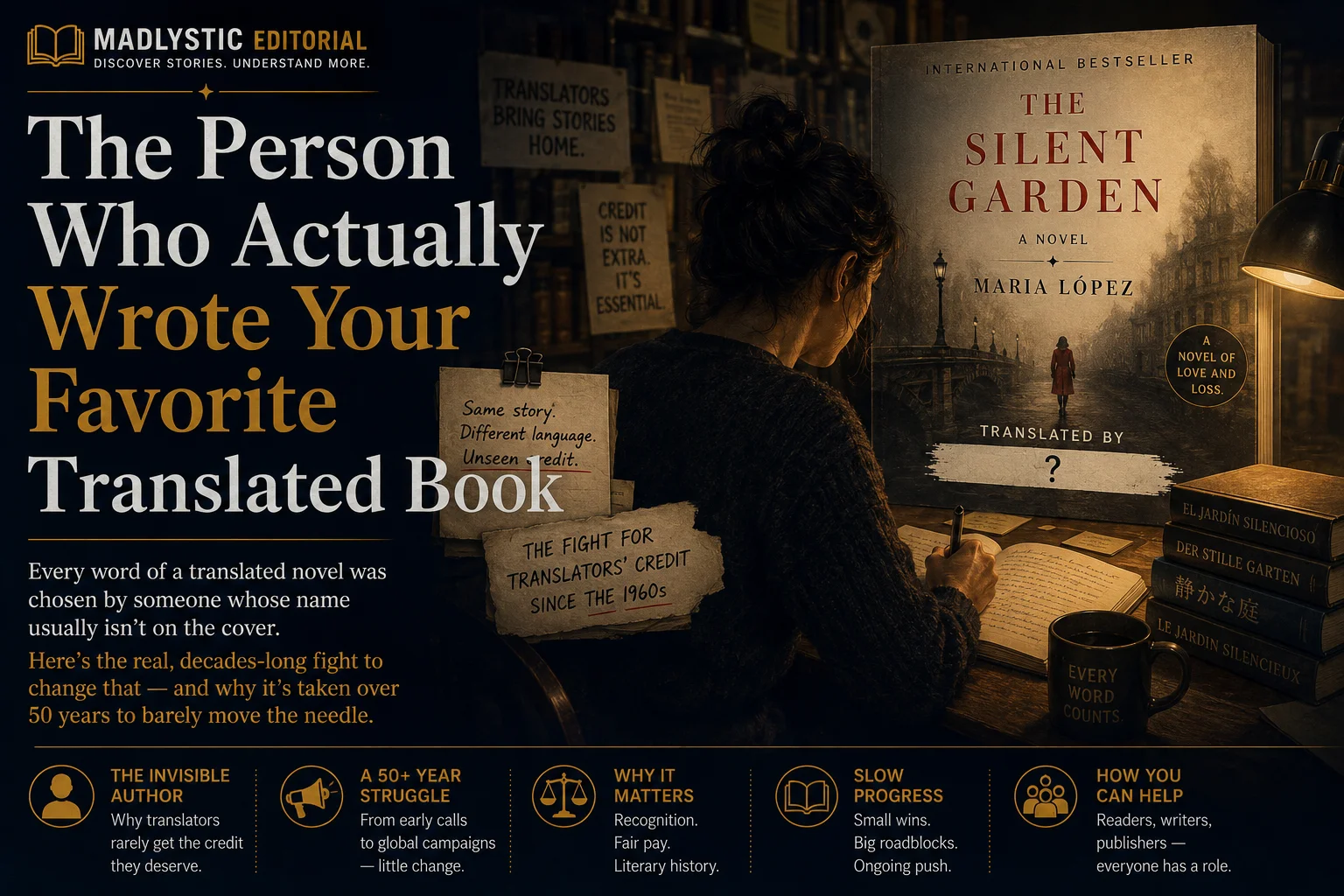
The Person Who Actually Wrote Your Favorite Translated Book
Every word of a translated novel was chosen by someone whose name usually isn't on the cover. Here's the real, decades-long fight to change that — and why it's taken over 50 years to barely move the needle.
Published July 28, 2026
10 min read
Quote of the Day
"Putting our names on the covers of the books we wrote every word of takes two seconds and zero dollars. Why not make that change?" — Jennifer Croft, International Booker Prize-winning translator
Read any translated novel you love, and every single sentence you experienced was, in a very real sense, written twice — once by the original author, and once again, word by word, by a translator making thousands of small, genuinely creative decisions about tone, rhythm, and meaning. Yet open the front cover of most translated fiction sold in English, and there's a real chance you won't find that person's name anywhere on it at all. This isn't a small oversight. It's a documented, ongoing dispute that's been running, largely invisible to ordinary readers, for well over fifty years.
A fight that's older than most people assume
The instinct is to treat this as a recent grievance, something that surfaced alongside social media. It didn't. PEN America's translation committee first raised these exact concerns in a manifesto decades ago, and reissued an updated version of it in 2023 — noting bluntly that despite decades of supposedly increased attention to translators, the broader public and the publishing industry still misconstrue, obscure, and undervalue translation as a craft. Nearly sixty years separate the original document from its 2023 update, and the committee's own assessment was that the core problems remained, in their words, stubbornly the same.
The numbers behind the invisibility
This isn't a vague impression — it's been directly measured. Publishers Weekly's own Translation Database found that of 368 English-language fiction and poetry translations published in a single recent year, only 162 — 44% — credited the translator anywhere on the front cover. The other 206 titles simply didn't, meaning a majority of translated literary fiction released that year gave zero front-cover acknowledgment to the person who wrote every word a reader actually encountered.
The moment this became a public fight, not just an internal grievance
In August 2021, Jennifer Croft — the International Booker Prize-winning translator behind Olga Tokarczuk's Flights — posted a simple, public resolution to her Twitter followers: she would no longer translate any book without her name appearing on its cover. A month later, she turned that personal stance into a formal campaign, co-writing an open letter with novelist Mark Haddon under the hashtag #TranslatorsOnTheCover, later merging with the longer-running #NameTheTranslator movement first launched by translators in 2013.
The letter struck a nerve immediately. Within 48 hours it had surpassed 1,400 signatures from working authors, including major names like Neil Gaiman, Philip Pullman, and Bernardine Evaristo — writers who don't personally need translation credit for their own English-language work, publicly backing translators' right to it on principle. The Authors Guild in the US formally endorsed the campaign within days, with its CEO stating plainly that it was "long past time" for translators to receive cover credit as a bare minimum.
Why publishers actually resist something this simple
Given that adding a name to a cover costs, as Croft herself pointed out, "zero dollars," the resistance from some publishers is worth examining honestly rather than dismissing as pure indifference. Award-winning translator Daniel Hahn has been candid that some publishers cite a genuine, if debatable, business concern: a fear of "reader prejudice" — that some readers see the word "translated" and quietly decide a book isn't for them, and that any visual cue drawing attention to that fact might cost sales. Other publishers raise a purely aesthetic objection, worrying that additional text on a cover clutters a design built to sell the book on emotional impact alone.
Neither justification satisfies the translators pushing back, and it's worth noting the deeper economic layer underneath the credit fight: translator and researcher Annelise Finegan has pointed out that from a pure profit-and-loss perspective, hiring a translator adds a real, visible line-item cost that makes acquiring foreign literature less immediately appealing to a publisher's spreadsheet — which is part of why the prestige of international awards, where authors and translators now often split prize money and recognition equally, has become such an important lever for keeping publishers willing to invest in translation at all.
It's not just about a name — it's about pay too
Cover credit, while the most visible ask, was never the only demand. The Authors Guild's public statement went further than a cosmetic fix, explicitly calling for translators to receive genuine royalties and a share of subsidiary rights — not just acknowledgment, but an actual ongoing financial stake in a book's success, the same way an author benefits when their work sells well or gets optioned for film. Currently, many translators are paid a single flat fee for the work and see no further compensation regardless of how successful the finished translation becomes, a structure some describe as ceding nearly all ownership of a genuinely creative act for a one-time payment.
Why this connects to a bigger, quieter number
This invisibility problem compounds a separate, related fact worth remembering: translated fiction makes up only around 3% of everything published in English-language markets, a strikingly small share compared to many other countries. Every translated book that does make it to English-speaking readers has already survived a real, deliberate filter — a publisher choosing to take on the added cost and perceived risk of bringing it across a language barrier at all. The person who did the actual work of making that crossing possible, sentence by sentence, remaining anonymous on the cover of the finished product is, in a real sense, the final and most avoidable step in an otherwise already difficult journey.
What actually changed, and what still hasn't
Some real, if modest, progress is visible. Independent and smaller presses — Bloomsbury, Charco Press, Feminist Press among them — have adopted cover-crediting as standard practice, something Croft herself has pointed to as proof it's entirely achievable without controversy. Major translation prizes increasingly split award money and billing evenly between author and translator, a meaningful shift in prestige if not yet in standard industry practice. But PEN America's own 2023 assessment — that translators "remain underpaid, often absent from book covers, and regarded as adjuncts to literary production" — makes clear this is nowhere near a solved problem industry-wide, more than fifty years after the concern was first formally raised.
Conclusion
The next time you finish a translated novel that moved you, it's worth pausing on a genuinely uncomfortable fact: the specific sentences you fell in love with, the rhythm and voice that made the story land the way it did, were choices made by a real person whose name you very likely never saw. That's not a minor omission. It's the visible symptom of a decades-long undervaluing of a genuinely creative act — one that a growing, increasingly organized group of translators, backed by some of the most recognizable authors in the world, has spent years trying to correct, with real but still incomplete success. The fix, as Croft put it herself, costs nothing and takes seconds. The fact that it still doesn't happen for the majority of translated books says a great deal about which parts of a book's creation the industry has decided are worth naming out loud, and which parts it hasn't.
Share this article
Share this article with readers who'll want to read it.