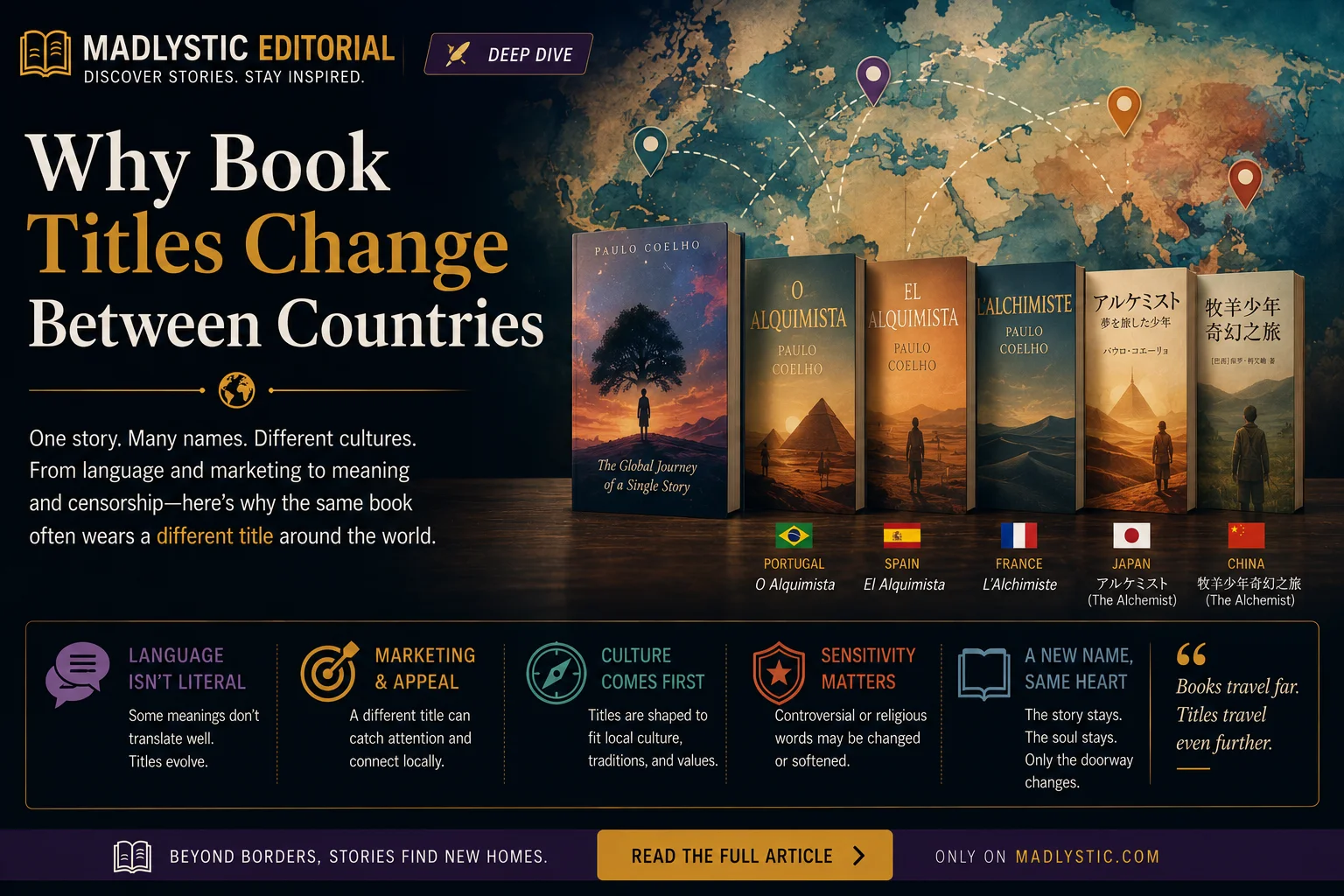
Why Book Titles Change Between Countries
Harry Potter and the Philosopher's Stone. Northern Lights. Voldemort's actual middle name. Book titles quietly rewrite themselves at every border they cross — and almost nobody explains why, or who's actually making that call.
Published July 21, 2026
9 min read
Quote of the Day
"Translation isn't just a clean conversion from one language to another, like GIF to JPG." — author Isaac Marion, on how heavily stylized writing gets filtered through a translator's own creative lens.
Elena Ferrante's second Neapolitan novel is called, in its original Italian, Storia del nuovo cognome — "The Story of a New Last Name." That's roughly how it's titled in French, Portuguese, German, Japanese, Chinese, and Russian too. In English, it's The Story of a New Name, missing the specific "last" that anchors the whole book's plot about identity and inheritance. It's a small change, easy to miss, and it's happening constantly, invisibly, to almost every book that crosses a language border — and almost nobody who reads translated fiction has ever been told why.
There's no single person deciding this — and that's the actual root cause
The instinct is to assume some centralized process governs this: an author, or maybe a lead publisher, signing off on a single "official" title that then gets faithfully rendered into every language. That's not how it works at all. What actually happens is that the original publisher sells foreign-language rights to a separate publisher in each new market — sometimes a subsidiary of the same company, often an entirely unrelated one — and that local publisher takes over the entire production of the book in their market: hiring the translator, designing new cover art, and deciding on a title independently. There is, quite literally, no central figure anywhere in the process making sure a book's title stays consistent across the world's languages. Each market is essentially reinventing the book's packaging from scratch, guided only by what they think will sell in their specific country.
This single structural fact explains almost everything else in this article. Once you understand that title decisions are made locally, market by market, with no coordinating authority, the rest of the phenomenon stops looking random and starts looking like a completely predictable outcome of how the business is actually organized.
When a literal translation just doesn't work
Sometimes the problem is straightforwardly linguistic. Wordplay, puns, rhymes, and alliteration frequently exist in a title specifically because of quirks unique to the original language, and there's often no equivalent device available in the target language that preserves both the meaning and the wit simultaneously. A translator or local editor is then faced with a genuine choice: translate literally and lose the cleverness, or invent something new that captures the feeling of the original title without literally matching its words. One publisher recounted translating a Czech novel titled, literally, Professional Woman — a title that would have sounded like a dull trade magazine in English — and instead choosing The Four Sonyas, based on the protagonist's four different personas, a title that never appears anywhere in the original but arguably serves the book's actual content better than a literal translation would have.
When the change is really about marketing, not language
Just as often, the shift has nothing to do with translation difficulty and everything to do with what a local publisher believes will actually sell. Philip Pullman's Northern Lights became The Golden Compass in the United States — not because "Northern Lights" doesn't translate, but because an American publisher judged that title would resonate more with U.S. readers and align better with the marketing plan they'd already built around the book. Leila Slimani's French novel, translated literally as Lullaby, was retitled The Perfect Nanny for American release, a much more direct, thriller-coded hook aimed squarely at American genre expectations around the book's premise.
This happens even between English-speaking markets that share the exact same language, which is the detail that most clearly proves this is a marketing decision rather than a linguistic necessity. A UK and US edition of the same English-language book can carry two different titles purely because two different publishing teams, working independently, each made their own judgment about what would move copies in their specific market.
It goes deeper than the title — the whole book gets re-packaged
Once you understand that local publishers control the entire production independently, the phenomenon extends naturally to cover art too, and sometimes to specific details inside the text itself. Author Evelyn Skye has documented her novel Damsel receiving entirely different cover illustrations across international editions — an Indonesian edition featuring completely different artwork of the same characters, a German edition with painted page edges styled like dragon fire to match its cover redesign — each local team deciding independently what visual language would actually make readers pick the book up in their market. In an even more specific example, the French translation of Harry Potter changed Voldemort's middle name from "Marvolo" to "Elvis," purely so the anagram revealing "I am Lord Voldemort" would still function correctly in French — a change made not for marketing, but because the puzzle mechanics of the original simply couldn't survive literal translation.
The bigger, quieter number behind all of this
There's a genuinely striking statistic buried in the translation industry that most readers never encounter: translated books make up only around 3% of everything published in English-language markets, compared to roughly 16% in France and similarly high or higher figures across much of the rest of Europe. English-language publishing is, relative to most of the world, unusually insular when it comes to translated fiction — which means the handful of translated titles that do make it to English-speaking readers have typically already survived one significant filter (a foreign publisher deciding it's worth the investment to license, translate, and repackage) before a reader ever encounters whatever title and cover eventually got chosen for their specific market.
Why this actually matters for how books get discovered
This has a genuinely practical consequence for readers and discovery platforms alike: a book with different titles across markets is, functionally, invisible to itself in search and recommendation systems that don't know to connect the two. A reader who loved The Golden Compass searching for "more books like this" in a system that only indexes it under Northern Lights in some other data source may never get matched correctly, even though it's the exact same book. As more discovery happens through AI systems synthesizing an answer from whatever text exists about a book — the same dynamic covered in earlier coverage of AI-driven book search — consistent metadata that explicitly links a book's alternate titles across markets becomes a genuinely underappreciated piece of discovery infrastructure, not just a translation curiosity.
Conclusion
A book's title feels, to most readers, like a fixed, almost sacred part of the work itself — the thing an author presumably chose, deliberately, as the front door to their story. In reality, for any book that travels beyond its original language, that front door gets rebuilt, market by market, by people the original author usually never even communicates with directly. That's not a flaw in the system so much as an honest reflection of what publishing actually is at the international level: not one unified act of storytelling, but dozens of independent local decisions, each one trying to solve the same problem — getting a genuinely good book into the hands of a reader who might never have picked it up under its original name.
Share this article
Share this article with readers who'll want to read it.
You may also like
The Person Who Actually Wrote Your Favorite Translated Book
July 28, 2026

How the New York Times Bestseller List Really Works
November 9, 2026

The AI Detector That Cost a Novelist $2 Million Might Be Wrong 60% of the Time
August 7, 2026

One Celebrity Book Pick Can Boost Sales by 700%
August 6, 2026