What ARCs Actually Are (And Why 500,000 People Compete for Free Books)
That "ARC" badge on a Goodreads or BookTok review isn't just a free book — it's the visible tip of an entire, competitive pre-publication review economy most readers have never seen explained. Here's how it actually works.
Published August 3, 2026
8 min read
Quote of the Day
"ARCs are not finished products. They may contain typos, formatting issues, or placeholder art. That is intentional." — a plain industry description of what a genuine early copy actually is, and isn't
Scroll through any book review on Goodreads, BookTok, or a book blog, and you'll frequently spot a small disclosure: "I received an ARC in exchange for an honest review." Most readers have absorbed the phrase without ever really unpacking what it means, how someone gets one, or why an entire competitive ecosystem — over 500,000 registered reviewers on a single platform alone — has built up around getting early access to books that aren't even finished yet.
What an ARC actually is, precisely
ARC stands for Advance Reader Copy (sometimes called an advance reading copy, or a "galley," an older printing-industry term that's stuck around). It's a pre-publication version of a book, sent out weeks or sometimes months before the official release date, specifically to generate early reviews and buzz before a general reader can even buy it.
The genuinely important detail most readers don't realize: an ARC is deliberately not the finished book. It's typically labeled "uncorrected proof" and may still contain minor typos, placeholder formatting, or an unfinished cover — differences from the final retail version that are intentional, not sloppy, since the entire point is getting real reader reactions into circulation while there's still time for marketing to build around them, not to distribute a polished final product early.
A whole family of related terms worth knowing
The ARC has splintered into several related, format-specific terms as publishing has gone increasingly digital. A DRC (digital review copy) is functionally the same thing, just an ebook file rather than print — sometimes called an "eARC." An ALC (advance listening copy) is the audiobook equivalent, and these tend to go out closer to release than print or ebook ARCs, simply because audiobook production and recording takes considerably longer to finish. Worth distinguishing from all of these: a proof copy, which serves an entirely different purpose — it's for the author, editor, and publisher's own internal quality-control review before a book is approved for publication, not for outside readers at all.
How this actually works today, mechanically
Physical ARCs still exist, but they've become the smaller, more exclusive half of the system — increasingly reserved for big-name authors, legacy publishers, and established media contacts, since printing and shipping a book that isn't even for sale yet is a real, non-trivial cost. Digital ARCs have become the dominant format by far, distributed almost entirely through a small handful of dedicated platforms.
NetGalley, launched in 2008, is the closest thing this space has to an industry standard — used heavily by major publishers, and treated as a credible source by librarians, booksellers, and professional reviewers worldwide. It's genuinely competitive: NetGalley's overall approval rate for new reviewers requesting a given title is estimated at just 20-35%, and the platform tracks every reviewer's "feedback ratio" — the percentage of requested books they've actually followed through and reviewed — which publishers can see and use to decide whether to approve future requests. A reviewer who requests aggressively and doesn't follow through builds a visibly poor track record that actively hurts future approval odds.
Smaller, more accessible alternatives have emerged specifically to serve newer reviewers and indie authors who can't compete at NetGalley's scale — BookSirens and Hidden Gems Books among them, often at lower cost and with an easier approval bar. LibraryThing's Early Reviewers program takes a genuinely different approach entirely: rather than competitive approval based on reviewer credentials, it runs on a lottery system, making it the lowest-barrier entry point for someone brand new to ARC reviewing.
Why publishers and authors do this at all
The purpose isn't just "free publicity" in a vague sense — it's a specific, calculated launch strategy. A book that arrives on its official publication date with zero reviews looks, to both algorithms and browsing readers, indistinguishable from a book nobody's interested in. A book that arrives with dozens of genuine reviews already live solves the exact cold-start problem covered elsewhere on this blog — it gives a brand-new release the appearance, and often the reality, of immediate momentum on day one, rather than the slow, uncertain climb of waiting for organic reviews to accumulate after the fact.
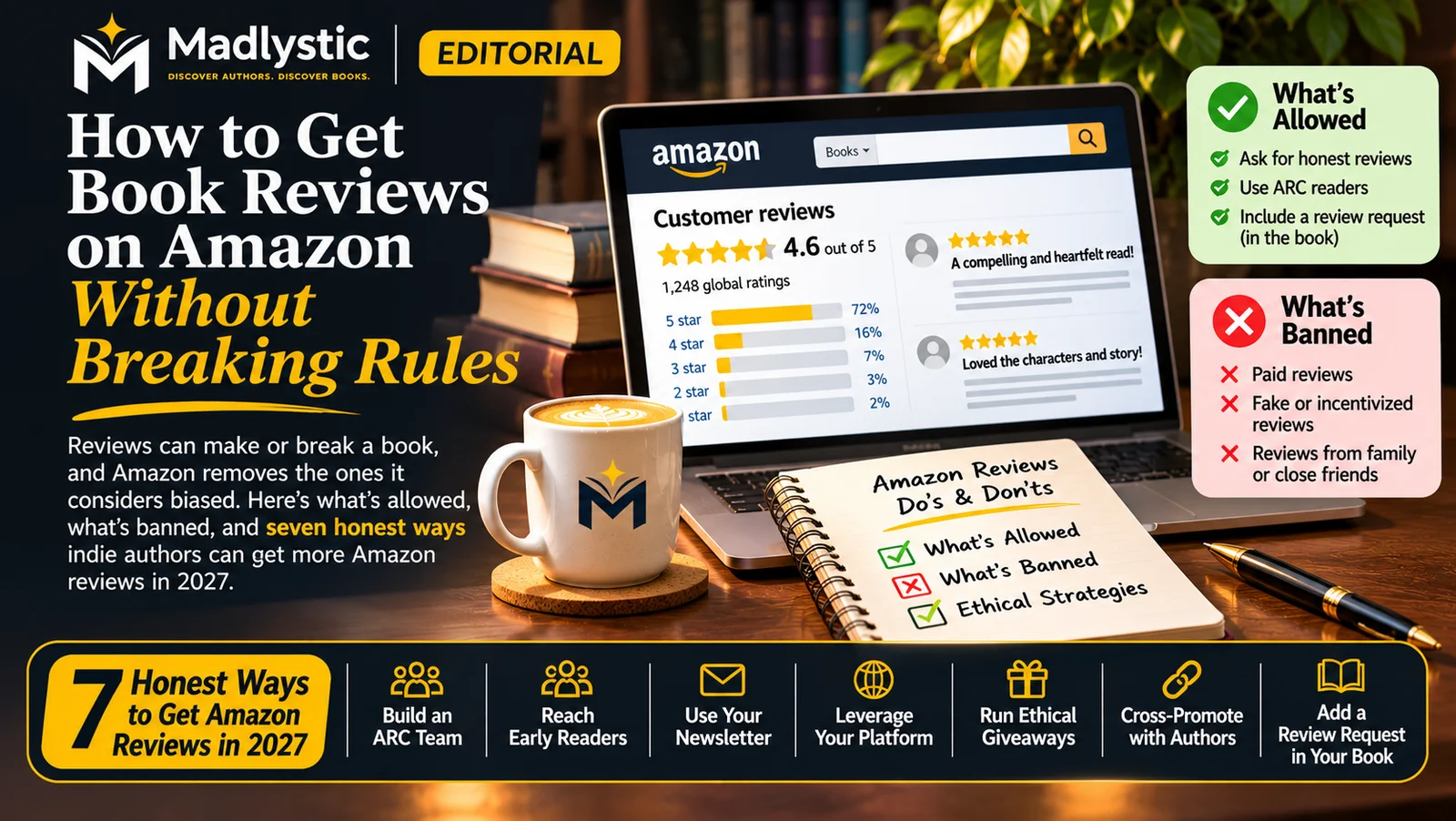
For indie and self-published authors specifically, ARC distribution has become one of the more accessible, low-cost ways to build that same early momentum without needing a traditional publisher's marketing budget or media contacts — the smaller platforms exist largely to serve exactly this need.
The honest tension built into the whole system
There's a real, worthwhile tension sitting at the center of this practice, one worth naming plainly: ARC readers are explicitly asked for "honest reviews," yet the entire relationship exists because the author or publisher chose to give this specific reader early, free access. That's not inherently dishonest — professional reviewers and critics have operated this way for as long as the practice has existed, dating back, per publishing's own history, to traveling sales representatives showing early copies to booksellers decades before the term "ARC" was even coined. But it does mean the reviews generated through this pipeline aren't a neutral, random sample of reader reaction — they're reviews from people specifically selected, and motivated, by early access, which is worth keeping in mind as context when reading one.
Conclusion
The next time you see an ARC disclosure on a review, it's worth recognizing what's actually sitting behind that small line of text: a genuinely competitive, structured system — hundreds of thousands of reviewers, tracked approval rates, feedback ratios, multiple distinct platforms serving different tiers of the industry — built entirely around solving the same problem every new book faces the moment it's released: convincing a stranger, with zero other signal to go on, that this specific book is worth their time. An ARC isn't just a free book. It's an early, deliberate attempt to make sure a book doesn't arrive into total silence on the one day it needs momentum the most.
Share this article
Share this article with readers who'll want to read it.