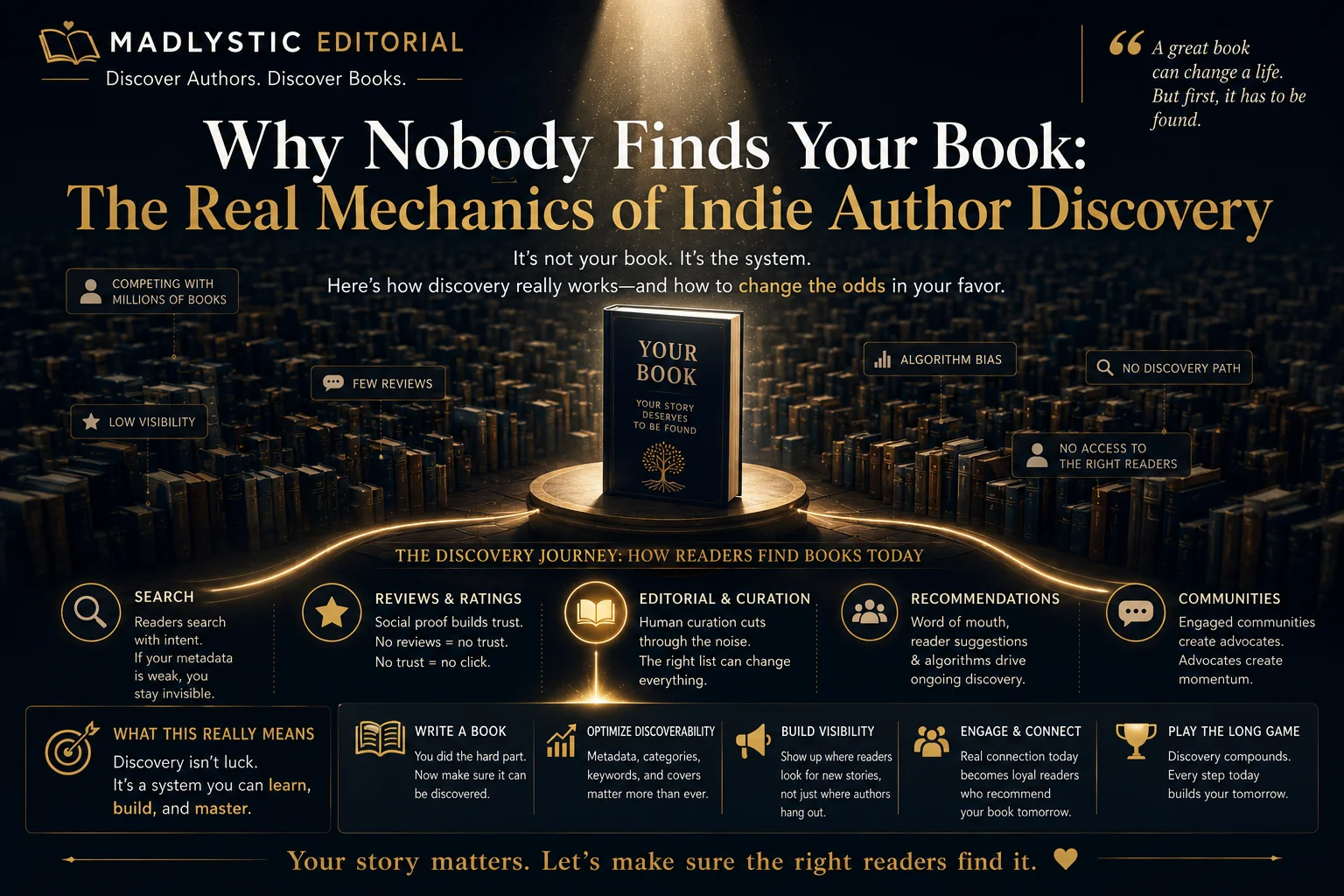
Why Nobody Finds Your Book: The Real Mechanics of Indie Author Discovery
Writing the book was never the hard part. Here's an honest look at why discovery breaks down for indie authors — and what actually moves a stranger from "never heard of you" to "just bought it."
Published July 19, 2026
7 Min read
There's a particular kind of silence that follows publishing a book nobody's heard of. It isn't the silence of failure — the book might be good, even excellent. It's the silence of a room nobody walked into. You can hear it in the way authors describe their first month post-launch: three sales to family, one anonymous review, and then nothing. No malice in that silence. No conspiracy against indie work. Just the absence of a mechanism that would have carried the book anywhere at all.
This is the part nobody prepares you for when they tell you to "just write a good book." A good book is necessary. It has never once been sufficient.
The problem isn't quality. It's physics.
Every year, several million books get published through self-publishing channels alone. Not several thousand — several million. Somewhere in that number is a book as good as anything traditionally published this decade. It will sell nine copies. Not because it's bad. Because discovery, at scale, behaves like physics rather than merit: attention flows toward existing gravity wells, and a new book has none.
Amazon's algorithm, for all its complexity, runs on a simple feedback loop — sales generate visibility, visibility generates sales. It's a flywheel, and flywheels have one brutal property: they only spin faster once they're already spinning. A book with zero reviews and zero sales sits at the bottom of a hill with no momentum, next to a million other books in the same position. The algorithm isn't hiding your book out of prejudice. It genuinely doesn't have a signal to act on yet.
This is why "write a great book and readers will find it" is, functionally, bad advice — not because it's dishonest, but because it describes a world that doesn't exist anymore. Readers don't find books. They find the books that other readers already found. Discovery is downstream of prior discovery. Which means the actual question every indie author needs to answer isn't "how do I write something people will love." It's: how does the first hundred people find it, before any algorithm has a reason to help?
Where readers actually look — and where they don't
If you ask most new authors where readers discover books, they'll say Amazon. It's the intuitive answer, and it's mostly wrong, or at least badly incomplete. Amazon is where a purchase gets finalized. It's rarely where discovery happens for an unknown author, because Amazon's own search and recommendation systems are optimized to surface books that already have traction — which, again, yours doesn't yet.
Real discovery for early-stage indie authors tends to happen in narrower, noisier, more human places: a Reddit thread where someone asks for book recommendations in a specific subgenre, a BookTok video that isn't about your book at all but happens to be about the trope your book uses, a Discord server built around a niche you didn't know existed until you found readers already gathered there. These spaces feel small and unglamorous compared to "getting on Amazon's bestseller list," but they share one property that matters more than reach: the people in them are already looking. You're not manufacturing interest from nothing. You're intercepting attention that already exists and pointing it somewhere.
This is a genuinely different skill than writing. Writing is solitary. Discovery is social, almost anthropological — it requires knowing where your specific reader already spends time, and showing up there in a way that doesn't feel like an ad interrupting them.
The reviews problem nobody explains properly
Here's something rarely said plainly: the "just get reviews" advice, repeated everywhere, is true and also nearly useless as stated, because it skips the actual mechanism. Reviews don't work because they're social proof in some abstract sense. They work because they solve a specific, narrow problem for a specific, narrow moment: a stranger, hovering over the "buy" button, deciding whether the next ten minutes of their life are safe to spend on your first chapter.
That decision happens in seconds, and it's resolved almost entirely by pattern-matching against other readers who look like them. Not five-star average ratings in the abstract — actual sentences, written by people whose taste seems to overlap with the reader's own. A review that says "if you liked the pacing of X, you'll like this" does more work than fifty reviews that just say "loved it!" This is why review count matters less than review specificity, and why chasing volume without asking what those reviews actually communicate is often wasted effort.
What actually breaks the cold-start problem
If discovery is a flywheel problem — no momentum until there's already momentum — then the entire early strategy for an indie author has to be about manufacturing the first turn of the wheel by hand, since no algorithm will do it for you yet. In practice, this tends to look less like marketing and more like relationship-building at small scale:
A handful of early readers who genuinely loved the book, cultivated deliberately rather than hoped for — through ARC teams, direct outreach in the communities where your genre's readers already gather, or simply asking people you trust to read early and say something honest. Not because ten reviews move an algorithm meaningfully. Because those ten people become the first specific, textured social proof a stranger can pattern-match against.
A presence in spaces that are narrow enough to matter but active enough to have real readers in them — a well-chosen subreddit, a genre-specific Discord, a newsletter run by someone who already has your reader's trust. The instinct to go broad (post everywhere, reach everyone) usually performs worse than going narrow and specific, because broad platforms default to surfacing what's already popular, and narrow communities don't.
And, increasingly, platforms built specifically to solve this exact cold-start gap rather than assuming you already have momentum. This is worth naming honestly rather than glossing over: most existing infrastructure — Goodreads, Amazon's own discovery tools, even BookTok's algorithm — is built to organize and amplify attention that already exists. Very little of it is built to manufacture attention where there is currently none. That's a specific, narrow, largely unsolved problem, and it's the reason a handful of newer platforms, Madlystic among them, exist at all — not as another place to catalog reviews, but as curated shelves and editorial placements that surface a book because a human chose to highlight it, not because an algorithm decided it had already earned attention. It's a small piece of the puzzle, not a replacement for the rest of this list, but it targets the exact moment — zero momentum, zero reviews, zero existing audience — where everything else on this list is hardest to do.
The part that's actually hard to hear
Most of what determines whether a book gets found has very little to do with the manuscript itself. This is uncomfortable, because writing the manuscript is the part that felt like the real work — the years, the drafts, the thing you can point to and say I made this. Discovery, by comparison, feels like a separate, almost unrelated skill: knowing where people already gather, understanding what makes a stranger trust a recommendation, building the first ten relationships before any system helps you build the next ten thousand.
But it isn't separate, not really. It's just the second half of the same job. A finished manuscript with no path to a reader is, functionally, an unfinished book — not creatively, but practically. The silence after launch isn't a verdict on the writing. It's a gap in the plumbing. And plumbing, unlike talent, can actually be built.
Share this article
Share this article with readers who'll want to read it.
You may also like
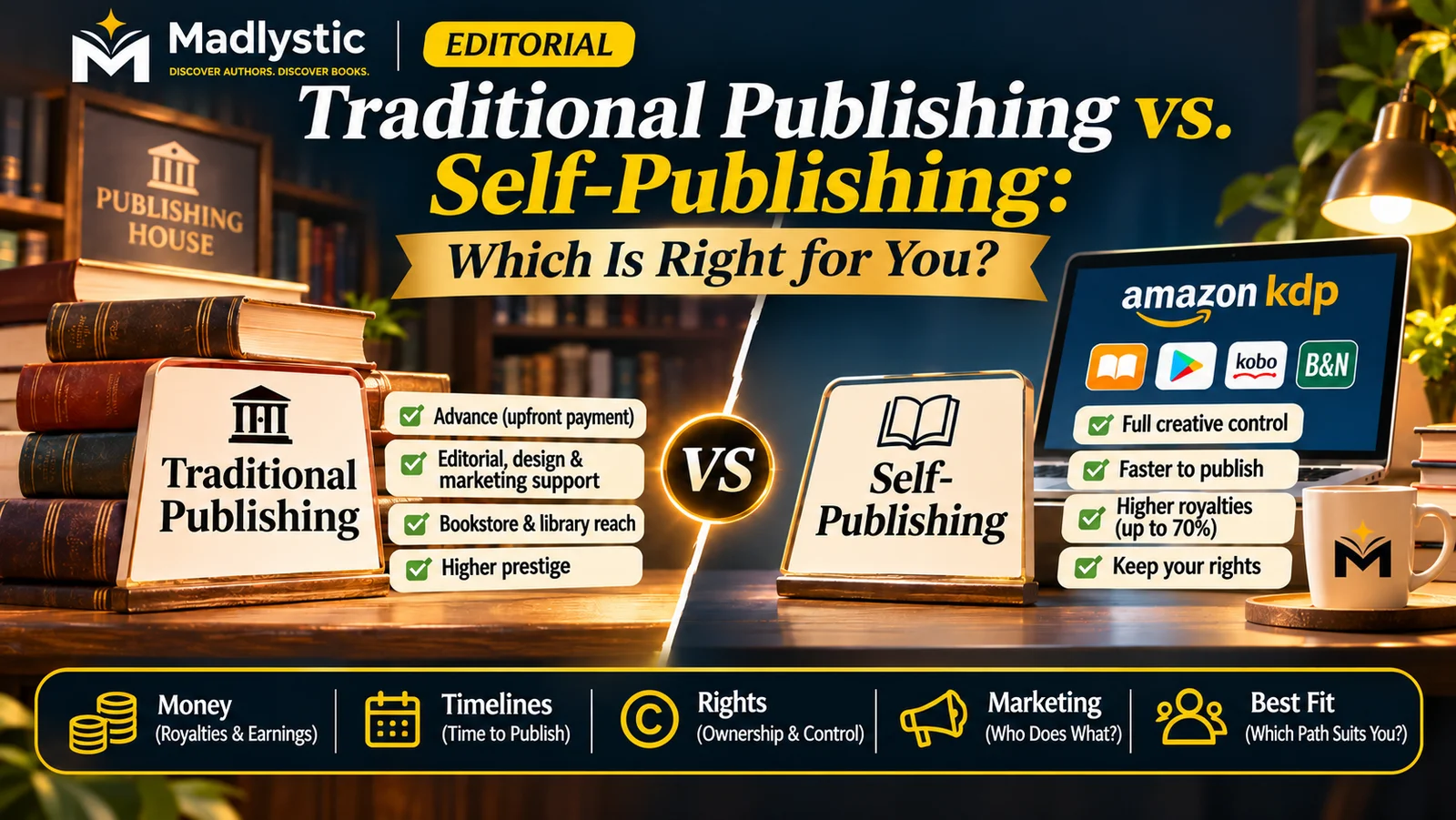
Traditional Publishing vs. Self-Publishing: Which Is Right for You?
November 24, 2026
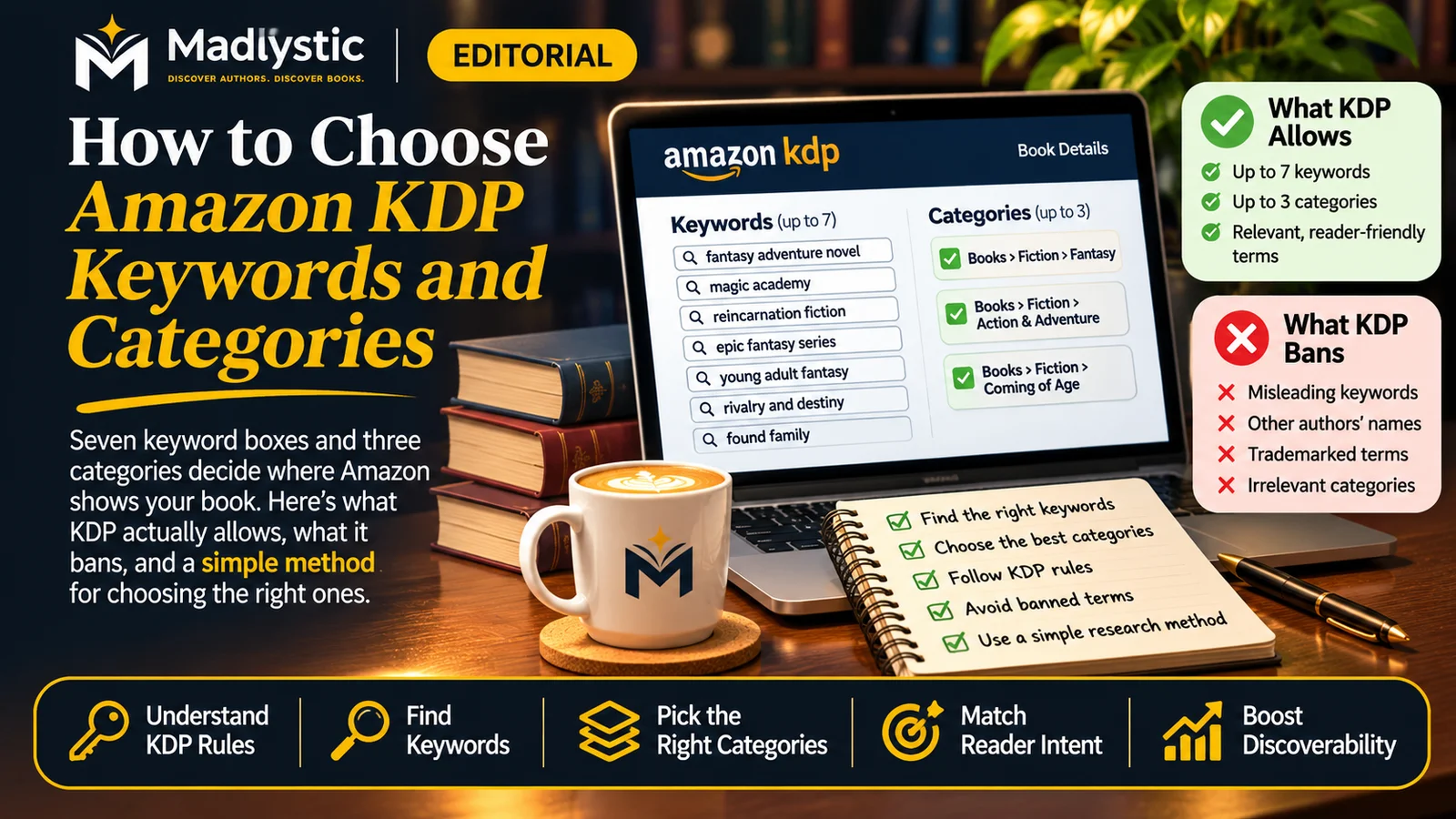
How to Choose Amazon KDP Keywords and Categories
November 20, 2026
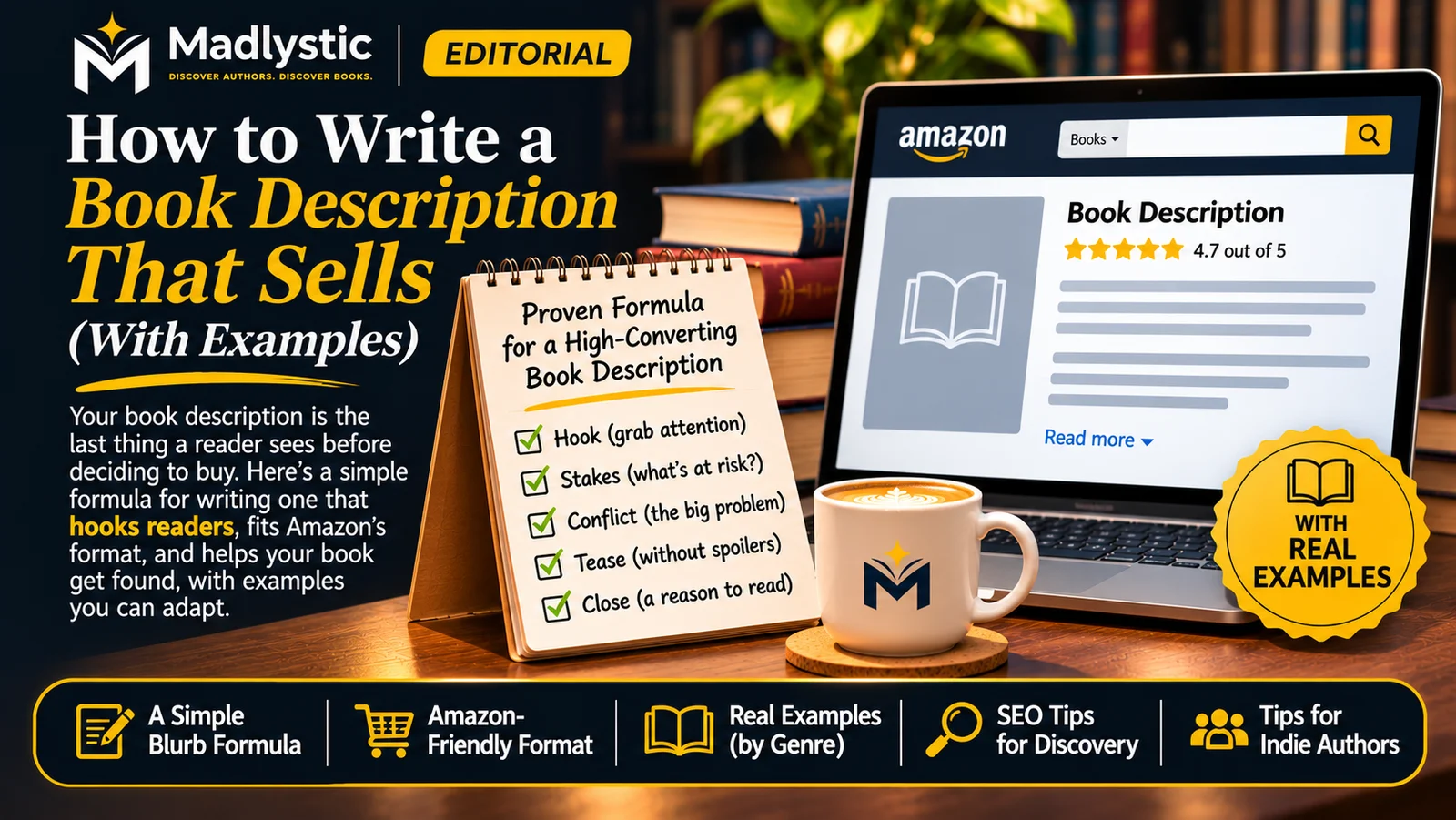
How to Write a Book Description That Sells (With Examples)
November 19, 2026
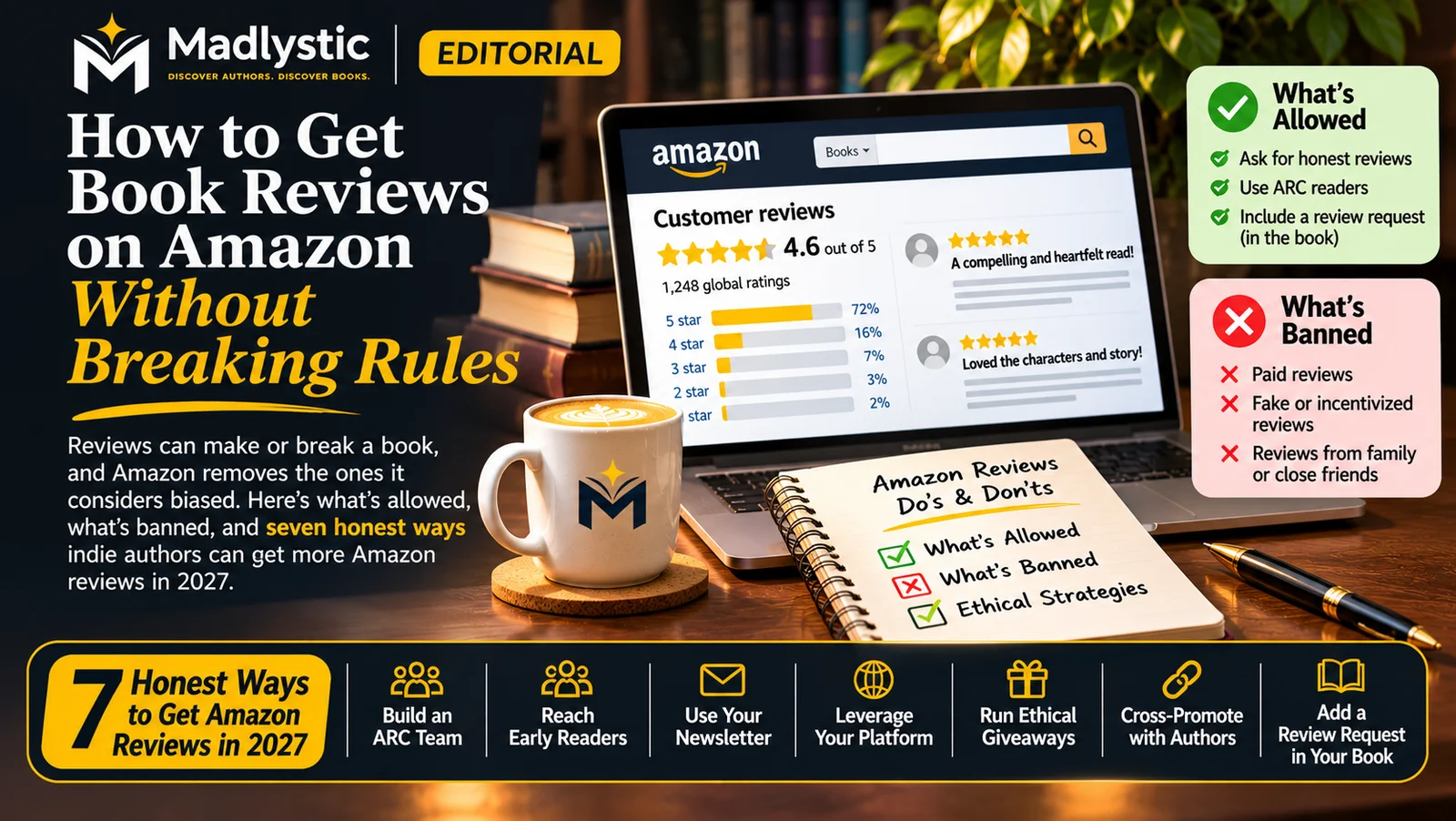
How to Get Book Reviews on Amazon Without Breaking Rules
November 17, 2026