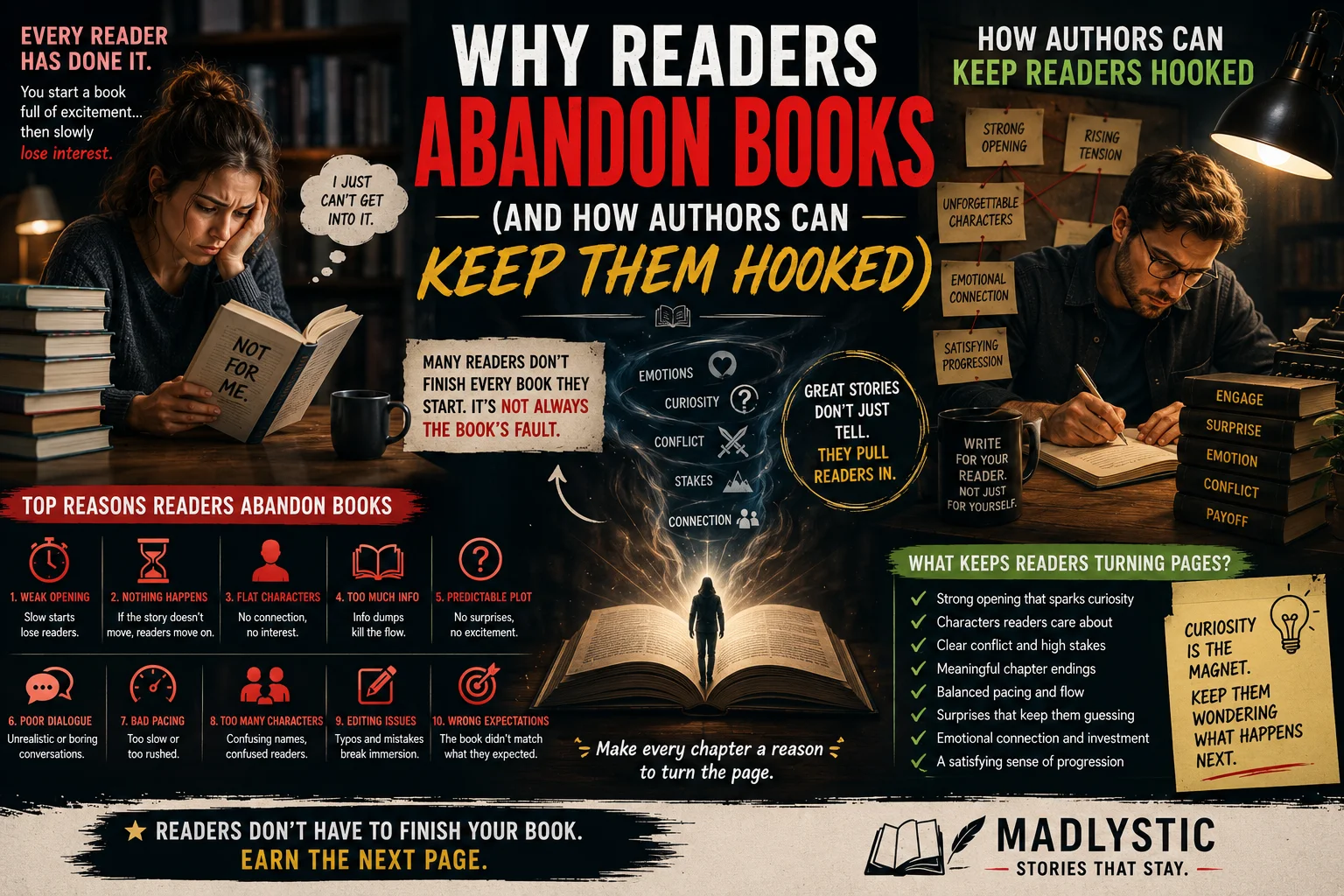
Why Readers Abandon Books (And How Authors Can Keep Them Hooked)
Why Readers Abandon Books (And How Authors Can Keep Them Hooked) Learn why readers abandon books and discover practical storytelling tips to keep your audience engaged, emotionally invested, and turning every page
Published July 6, 2026
Published by Madlystic Editorial Team | July 6, 2026
Every reader has done it.
You start a new book full of excitement, read a few chapters... and then quietly put it back on the shelf. Days turn into weeks, and eventually you realize you're probably never going to finish it.
According to various reading surveys, many readers don't finish every book they start—and that's perfectly normal. But for authors, it raises an important question:
Why do readers abandon books?
The answer usually isn't one single issue. Instead, it's a combination of storytelling, pacing, expectations, and reader engagement. Understanding these reasons can help authors create stories that readers simply can't put down.
1. A Weak Opening
The first chapter is your book's handshake.
If readers aren't intrigued within the opening pages, they'll often move on to another book.
Common mistakes include:
Starting with too much backstory
Long descriptions
Slow pacing
Confusing introductions
How Authors Can Fix It
Open with:
An interesting question
Immediate conflict
A mystery
Emotional stakes
A memorable character
Give readers a reason to keep turning pages.
2. Nothing Happens
Readers enjoy stories that move forward.
If several chapters pass without meaningful progress, excitement fades.
Every chapter should accomplish at least one of these:
Reveal new information
Develop a character
Increase tension
Move the plot forward
If nothing changes, readers lose interest.
3. Flat Characters
Readers don't fall in love with plots.
They fall in love with characters.
If your protagonist feels forgettable, readers have little reason to continue.
Great characters have:
Goals
Flaws
Personality
Growth
Emotional depth
Readers want someone worth rooting for.
4. Too Much Information
Many fantasy and science fiction authors spend pages explaining their worlds before the story begins.
While world-building is important, readers usually care more about people than history lessons.
Instead of explaining everything at once, reveal your world naturally through action and dialogue.
5. Predictable Storytelling
If readers can accurately predict every major event, excitement disappears.
That doesn't mean every story needs shocking twists—but it should include moments of surprise.
Unexpected choices keep readers emotionally invested.
6. Poor Dialogue
Dialogue should sound like real conversations—not information dumps.
Avoid characters explaining things they already know just for the reader's benefit.
Good dialogue:
Reveals personality
Creates conflict
Moves the story forward
Feels authentic
Reading dialogue aloud is an excellent editing technique.
7. Inconsistent Pacing
A story that's too slow becomes boring.
A story that's too fast can feel overwhelming.
The best novels balance quiet emotional moments with exciting scenes.
Readers need both action and breathing room.
8. Too Many Characters
Introducing dozens of names within the first few chapters often confuses readers.
Instead:
Introduce characters gradually.
Give each one a clear purpose.
Make important characters memorable.
Confused readers rarely become loyal readers.
9. Editing Problems
Typos happen.
But frequent grammar mistakes, formatting issues, or inconsistent writing can quickly break immersion.
Professional editing improves:
Readability
Credibility
Reader confidence
A polished manuscript shows respect for your audience.
10. The Book Doesn't Match Expectations
Sometimes the issue isn't the story—it's the marketing.
If your cover promises an action-packed thriller but delivers a slow romance, readers may feel misled.
Your:
Cover
Description
Keywords
Categories
should accurately represent your book.
The right readers are more valuable than the wrong audience.
What Keeps Readers Turning Pages?
Successful books often share several qualities:
✅ Strong opening
✅ Interesting characters
✅ Emotional investment
✅ Clear conflict
✅ Meaningful chapter endings
✅ Balanced pacing
✅ Surprising moments
✅ Satisfying progression
Readers don't necessarily need constant action—they need a reason to care about what happens next.
The Secret Ingredient: Curiosity
Curiosity is one of storytelling's greatest strengths.
Every chapter should leave readers wondering:
What happens next?
Why did that character do that?
Can they succeed?
What's the secret?
How will this end?
Questions keep pages turning.
Readers Don't Expect Perfection
Interestingly, readers often forgive small flaws if they're emotionally invested.
A novel with unforgettable characters and an engaging story will usually outperform a technically perfect book that's emotionally empty.
Connection matters more than perfection.
Final Thoughts
Readers abandon books for many reasons, but most share one common theme: they stop caring about what happens next. Whether it's a slow beginning, weak characters, confusing pacing, or unmet expectations, every page should give readers a reason to continue.
For authors, the goal isn't simply to write more words—it's to create an experience that keeps readers emotionally invested from the first chapter to the last.
The best books don't force readers to finish.
They make readers forget to check the time.
Write stories that spark curiosity, build emotional connections, and leave readers eager for "just one more chapter."
Share this article
Share this article with readers who'll want to read it.