How to Price Your Ebook on Amazon KDP (2027 Guide)
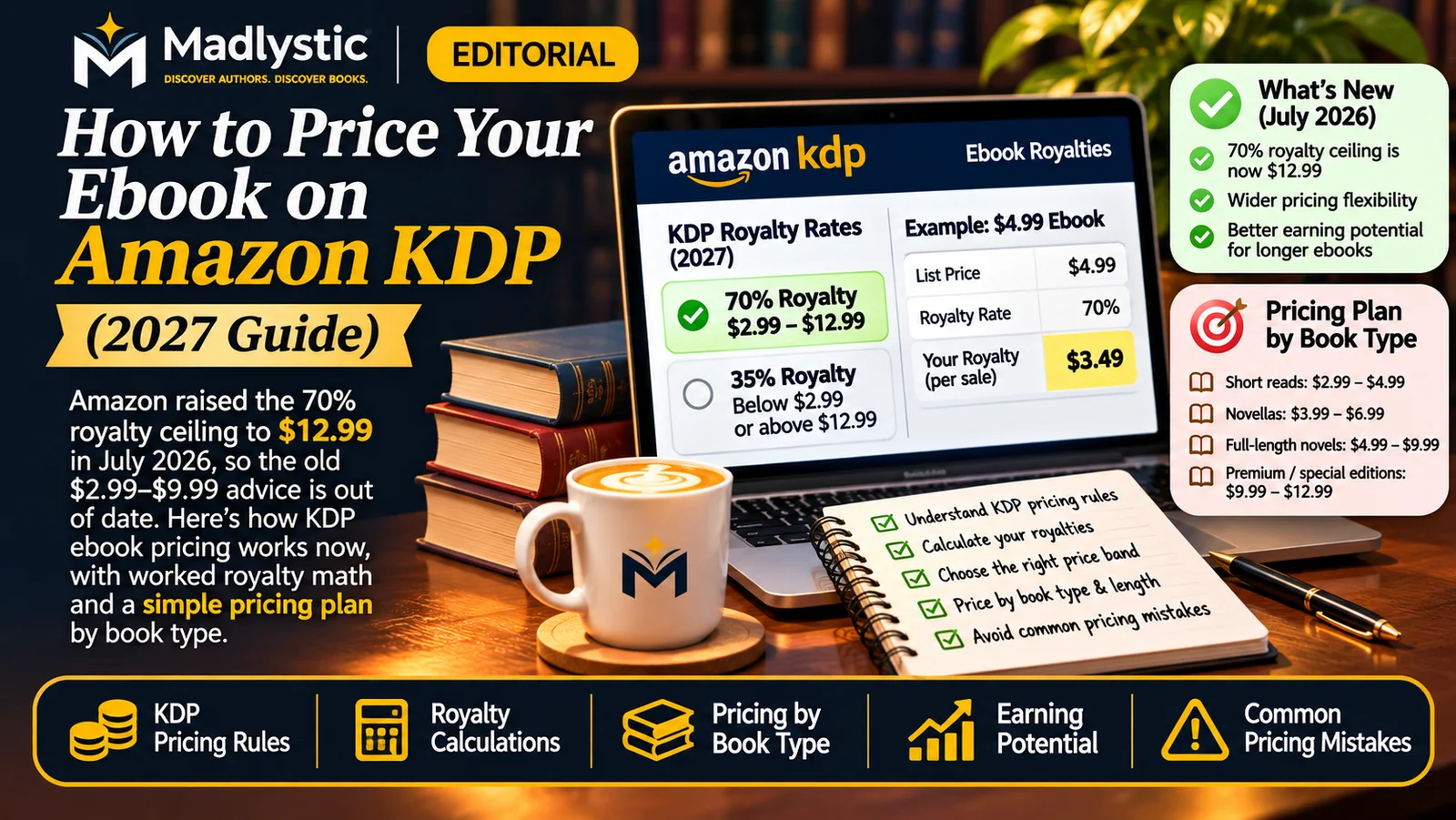
Amazon raised the 70% royalty ceiling to $12.99 in July 2026, so the old $2.99–$9.99 advice is out of date. Here's how KDP ebook pricing works now, with worked royalty math and a simple pricing plan by book type.
Published November 27, 2026
6 min read
Quote of the Day
"Price is what you pay; value is what you get." — Benjamin Graham, as quoted by Warren Buffett in his 2008 letter to Berkshire Hathaway shareholders
You can spend months writing a book and then guess the price in 30 seconds. That guess decides how much you earn on every sale, so it deserves the same care as your cover or your book description.
In 2026, Amazon changed the rules for the first time in nearly two decades, which means a lot of pricing advice online is now outdated. Here's how KDP ebook pricing works today.
The big change: the 70% ceiling is now $12.99
Effective July 7, 2026, the 70% royalty option price band is $2.99-$12.99 on Amazon.com, expanding from the previous range of $2.99-$9.99, with equivalent changes in other KDP marketplaces. According to Amazon, the previous $9.99 maximum list price for the 70% royalty option had been in place since 2007.
The Authors Guild welcomed the change and noted that it brings Amazon closer in line with its competitors: Apple Books and Barnes & Noble Press pay a flat 70 percent at every price point, and Kobo pays 70 percent on any ebook priced at $2.99 or above. authorsguild
Action step: Authors whose books are priced between $9.99 and $12.99 and not enrolled in the 70 percent plan will need to change the plan to get the higher rate. It doesn't switch automatically. authorsguild
The two royalty options
KDP gives every ebook a choice of two plans.
35% royalty
Available from $0.99 up to $200 on Amazon
No delivery fee
Minimum price rises with file size: $0.99 for small files, $1.99 for mid-size files, and $2.99 for large files (over 10 MB)
70% royalty
Only available from $2.99 to $12.99 on Amazon
Amazon deducts a delivery fee based on file size before calculating your share
On Amazon.com the delivery cost is US $0.15/MB (it's ₹7/MB on Amazon.in)
For Indian authors: the 70% band on Amazon.in is ₹99 to ₹599. Also, for sales to customers in Brazil, Japan, Mexico, and India, books must also be enrolled in KDP Select to be eligible for the 70% royalty option.
The royalty formula, with real math
Amazon's formula for the 70% plan is 70% Royalty Rate x (List Price – applicable VAT - Delivery Costs) = Royalty.
Here's what you'd earn on a typical 2 MB novel file sold on Amazon.com (delivery fee: $0.30, no VAT):
$0.99 at 35%: $0.35 per sale
$2.99 at 70%: 0.70 × ($2.99 − $0.30) = $1.88
$4.99 at 70%: 0.70 × ($4.99 − $0.30) = $3.28
$12.99 at 70%: 0.70 × ($12.99 − $0.30) = $8.88
$13.99 at 35%: 0.35 × $13.99 = $4.90
Two lessons stand out:
A $0.99 book has to sell about 5 times as many copies to match a $2.99 book ($1.88 ÷ $0.35 ≈ 5.4).
Pricing just above $12.99 cuts your earnings almost in half. A $13.99 ebook earns $3.98 less per sale than a $12.99 one.
Watch out for these pricing traps
Heavy files. Picture books, cookbooks, and illustrated guides can be 20 MB or more. At $0.15/MB, a 20 MB file costs $3.00 per sale in delivery fees, which can wipe out most of a $4.99 royalty. Compress your images before you upload.
Price matching. If price-matching your Digital Book results in the Amazon price falling below the minimum 70% List Price requirement, you will earn 35% royalty. If your book is cheaper on another store, Amazon may match it.
Non-70% territories. On your Bookshelf, you may see both 70% and 35% royalty rates displayed for the same book. This is expected behavior. The rate depends on where the buyer is.
When the 35% plan actually wins
Staying inside the 70% band is the right default, but not always the right choice. To beat a $12.99 book at 70% ($8.88 per sale on a 2 MB file), a book on the 35% plan has to be priced above $25.37 (0.35 × $25.37 = $8.88).
That makes sense for a small group of books:
Professional or technical reference guides
Niche academic titles
Business manuals that buyers expense to their company
Readers who buy these books care about the content more than the price. If your book isn't one of them, staying under $12.99 almost always earns more.
The 35% plan also makes sense for very large files. It has no delivery fee, so a 30 MB illustrated book can sometimes earn more at 35% than at 70%. Run both numbers before you choose.
Pricing outside the US
Each Amazon marketplace has its own 70% price band and delivery fee. On the 70% plan:
Amazon.co.uk: £1.77 to £12.99, delivery £0.10/MB amazonamazon
Amazon.de, .fr, .es, .it, .nl: €2.69 to €12.99, delivery €0.12/MB amazonamazon
Amazon.ca: C$2.99 to C$12.99, delivery CAD $0.15/MB amazonamazon
Amazon.com.au: $3.99 to $15.99 amazon
Amazon.in: ₹99 to ₹599 (KDP Select required for 70%), delivery ₹7/MB
How VAT works: In the UK and EU, your list price includes VAT, but Amazon calculates your royalty on the price after VAT. Amazon's own example from Spain: 0.70 x (€1.99 - €0.08 - €0.10) = €1.27. So a €1.99 price doesn't earn 70% of €1.99. amazon
Tip: KDP can set your other marketplace prices automatically based on your US price. That's fine to start, but the converted prices often end in odd numbers like £3.71. Rounding them to familiar prices like £2.99 or €3.99 looks more professional.
A simple pricing plan by book type
These ranges are a starting point, not a rule. Check the top 20 books in your exact category (see our guide to KDP keywords and categories) and price within that range.
Short story or novella: $0.99–$2.99. Short work struggles at higher prices.
Debut novel: $2.99–$4.99. Low risk for readers who don't know you yet.
Established genre series: $3.99–$6.99 per book. Use a cheaper first book to pull readers into the series.
Long fantasy or epic novels: $4.99–$7.99. Readers expect more value from a 150,000-word book (see how long a book should be by genre).
Nonfiction and practical guides: $4.99–$12.99. The new ceiling helps here most, because readers will pay more for books that solve a problem.
When to change your price
Don't set a price and forget it. Good times to review it:
Launch week: A lower intro price can help you get early sales and reviews.
Seasonal sales: Short discounts around Black Friday and the holidays (see our Black Friday book sale guide).
When book two comes out: Lower book one to move readers into the series.
After you get enough reviews: Social proof can support a higher price.
Change one thing at a time and give it at least two weeks before judging the results.
Conclusion
The right ebook price for most indie novels on KDP is still somewhere between $2.99 and $6.99, but the new $12.99 ceiling gives nonfiction and long-form fiction more room. Do the royalty math for your actual file size, stay inside the 70% band unless you have a strategic reason not to, and look at your category before you choose a number. If you're new to the process, start with our complete guide to self-publishing on Amazon KDP.
Ready to get your book in front of more readers? List it on Madlystic.
Frequently Asked Questions
What is the best price for a Kindle ebook?
For most indie fiction, $2.99 to $4.99 is a good starting range. It qualifies for the 70% royalty and is low enough for readers to take a risk on a new author.
What is the KDP 70% royalty price range?
On Amazon.com, it's $2.99 to $12.99 as of July 7, 2026. Before that, the maximum was $9.99.
Should I price my ebook at $0.99?
Only for a short-term promotion or a first-in-series book. At $0.99 you earn 35%, about $0.35 per sale, so you need roughly five times as many sales to match a $2.99 price.
What is the KDP delivery fee?
On the 70% plan, Amazon charges $0.15 per MB on Amazon.com before calculating your royalty. The 35% plan has no delivery fee.
Can I change my ebook price after publishing?
Yes. You can update your price on your KDP Bookshelf anytime. Changes usually go live within 72 hours.
Is it ever better to choose the 35% royalty?
Yes, in two cases: books priced well above $12.99 (you need to charge over $25.37 to beat a $12.99 book at 70%), and very large files where delivery fees eat into the 70% royalty.
Sources
Share this article
Share this article with readers who'll want to read it.