Why Stephen King Killed Off "Richard Bachman"
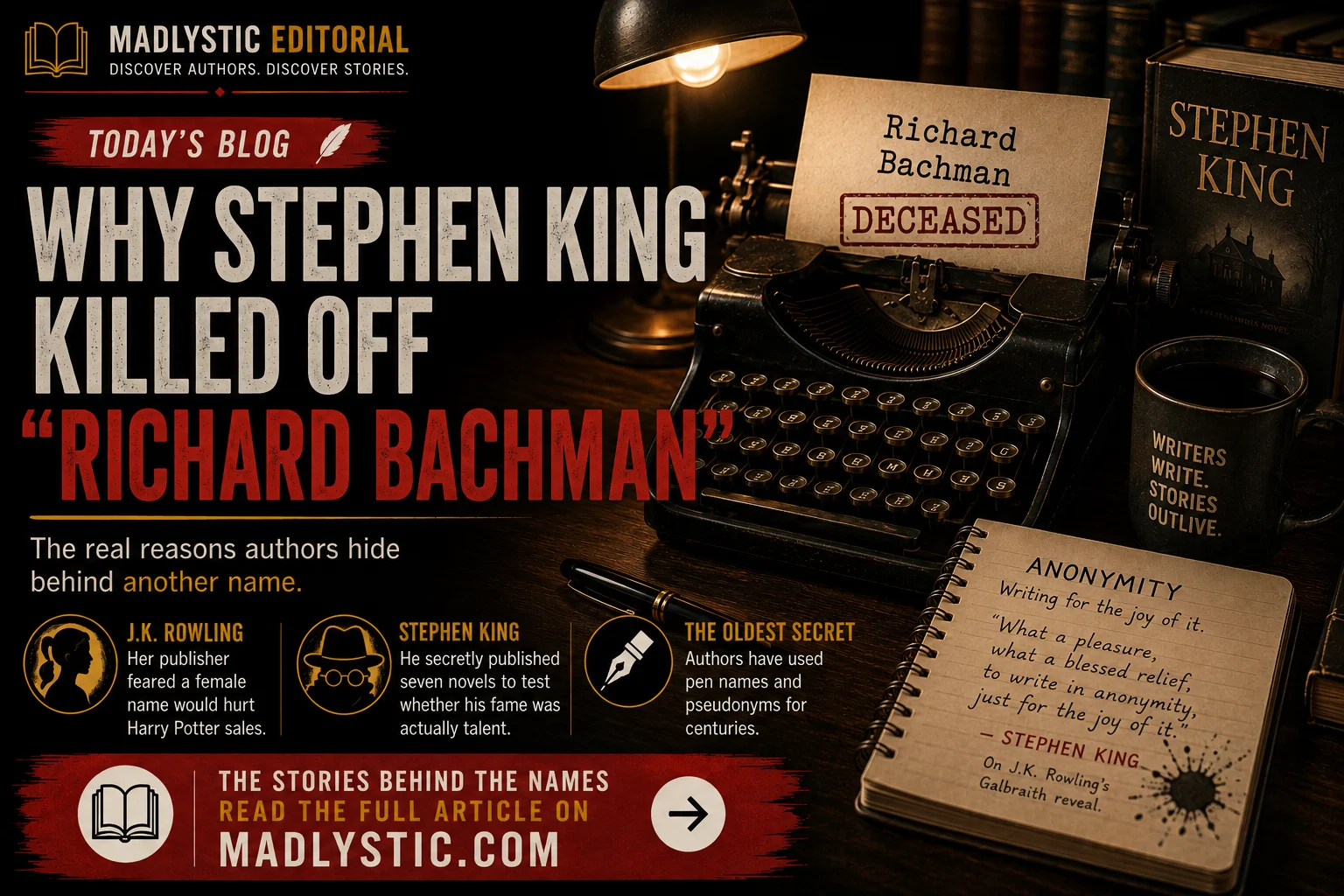
J.K. Rowling's publisher worried a female name would hurt Harry Potter sales. Stephen King secretly published seven novels just to test whether his fame was actually talent. Here's the real reasons behind literature's oldest open secret.
Published August 9, 2026
8 min read
Quote of the Day
"What a pleasure, what a blessed relief, to write in anonymity, just for the joy of it." — Stephen King, on why he understood exactly why J.K. Rowling published under a pseudonym
When J.K. Rowling's crime novel The Cuckoo's Calling was quietly published in 2013 under the name "Robert Galbraith," it sold modestly and earned solid, unremarkable reviews — until a Sunday Times investigation traced the manuscript back to her, and sales instantly exploded. Stephen King, reached for comment at the time, said he understood completely: he'd done the exact same thing decades earlier, for reasons that turn out to be more interesting than simple privacy.
Rowling's own name was already a kind of pseudonym
Here's a detail most readers never realize: J.K. Rowling wasn't hiding behind a pen name for the first time with Robert Galbraith — she'd already done it once before, with her own byline. Publishers worried that her target readership of young boys wouldn't pick up a book if they knew it was written by a woman, so Joanne Rowling became "J.K." instead — borrowing the K from her grandmother Kathleen's name, since she didn't actually have a middle name of her own. The concern wasn't abstract; it reflected a real, if uncomfortable, publishing-industry calculation about how gender perception affects a stranger's willingness to pick a book off a shelf.
Stephen King's genuinely unusual experiment
King's reasons for creating Richard Bachman in 1977 were more layered than simple market strategy. Partly, it solved a real industry constraint of the era: publishers at the time believed a single author releasing more than one book a year would oversaturate the market and hurt sales, a rule that frustrated prolific writers like King and Dean Koontz specifically. But King has also been candid that Bachman served a second, more personal purpose — a genuine experiment to find out whether his success was built on real skill or simply luck and existing fame. He deliberately released the Bachman novels with minimal marketing, in his own words attempting to "load the dice against" the pseudonym succeeding, specifically so any success it did find couldn't be attributed to his existing reputation.
The experiment ended earlier than King wanted: a sharp-eyed bookstore clerk noticed stylistic similarities between a Bachman novel and King's own writing, and the connection became public. King later joked that Richard Bachman had died of "cancer of the pseudonym" — but by his own account, he never got the clean answer he'd actually been hoping the experiment would provide.
A pattern that goes back centuries, not just decades
Neither Rowling nor King invented this practice — they're simply the most recent, most publicized examples of something with genuinely deep roots. Mark Twain was itself a pen name. Lewis Carroll was the pseudonym of mathematician Charles Lutwidge Dodgson, adopted specifically to publish Alice's Adventures in Wonderland under a different identity than his academic work. Agatha Christie, already one of the best-selling authors in history under her own name, wrote six separate novels as "Mary Westmacott" — work that earned critical acclaim entirely independent of her own famous reputation. S.E. Hinton published The Outsiders under her initials in the 1960s specifically to prevent reviewers from dismissing a novel about teenage boys once they realized a woman had written it — the same underlying calculation Rowling's publisher would make with her decades later.
Why genre-switching remains one of the most common modern reasons
Beyond privacy or historical gender bias, one of the most practical, still-common reasons authors adopt a pseudonym today is simpler: reader expectation management. Nora Roberts, established as one of the best-selling romance novelists alive, writes her futuristic crime series specifically as "J.D. Robb" — allowing romance readers and crime readers to each find exactly the book they're expecting, without either audience feeling misled by a genre shift under a familiar name. Iain Banks did something similar with a lighter touch, publishing his literary fiction as "Iain Banks" and his science fiction as "Iain M. Banks" — different enough to signal genre, similar enough that dedicated fans could still connect the two if they wanted to.
The risk this specifically guards against is real and well-documented: when J.K. Rowling published The Casual Vacancy, a literary novel for adults under her own famous name immediately after Harry Potter concluded, many fans reacted with genuine frustration at the tonal and genre shift — exactly the reaction a pseudonym is designed to prevent, by managing expectations before a reader ever opens the book.
Conclusion
A pen name tends to look, from the outside, like a simple branding choice or a bid for mystery — but the actual reasons behind literature's oldest habit are almost always more specific and more human than that: a publisher's calculated fear about gender bias, a genuine desire to be judged on the work alone rather than an existing name, a practical need to keep genre expectations clean for two very different audiences. Whether it's J.K. Rowling quietly testing whether Robert Galbraith could stand on his own, or Stephen King trying to answer a question about his own talent he never quite got to resolve, the pseudonym has always been less about hiding and more about creating one specific, rare thing publishing rarely offers a famous author twice: the chance to be read completely fresh.
Share this article
Share this article with readers who'll want to read it.