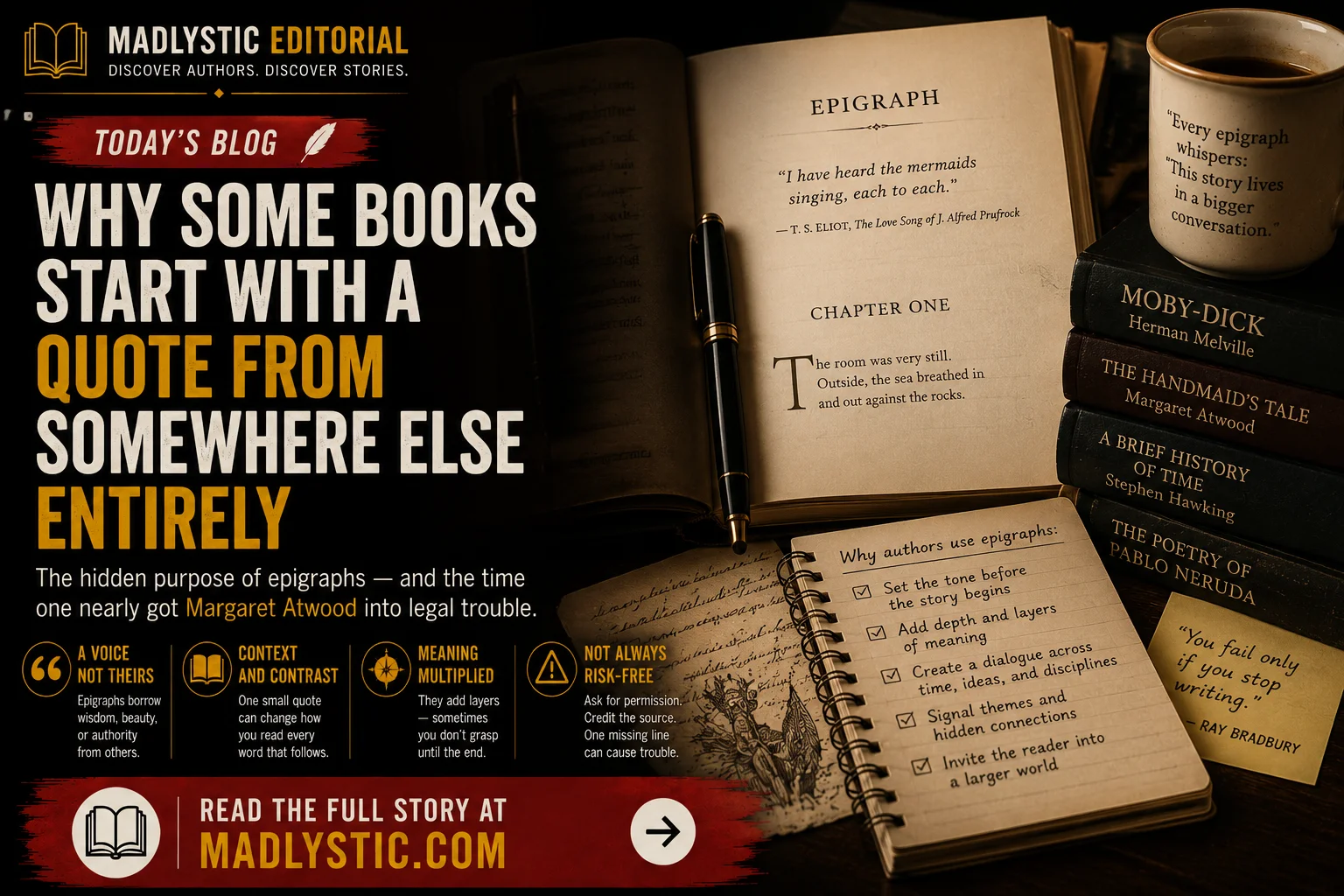
Why Some Books Start With a Quote From Somewhere Else Entirely
Before the story even begins, a surprising number of novels hand the first words to someone else entirely — a poet, a scientist, a Bible verse, sometimes even the author's own imaginary world. Here's what an epigraph is actually doing, and why one nearly got Margaret Atwood into legal trouble.
Published August 9, 2026
7 min read
Quote of the Day
"Let us not become gloomy as soon as we hear the word 'torture': in this particular case there is plenty to offset and mitigate that word — even something to laugh at." — Friedrich Nietzsche, used as the epigraph opening Viet Thanh Nguyen's Pulitzer Prize-winning novel The Sympathizer
Open certain novels and, before a single sentence of the actual story begins, you'll find someone else's words waiting there first — a line of poetry, a fragment of scripture, a lyric, sometimes a quote from a book that doesn't even exist. It's called an epigraph, and it's one of the more curious, least-explained conventions in fiction: an author, having spent years writing their own book, deliberately hands the very first words a reader encounters to somebody else entirely.
What it's actually trying to do
An epigraph's core job, across nearly every writer who's discussed using one, comes down to priming a reader before the story has had time to earn that priming itself. A novel typically needs real pages to establish tone, theme, and stakes organically — an epigraph compresses that groundwork into a single borrowed sentence, sitting there before the exposition even starts. Publishing educators describe this function plainly: an epigraph helps set the mood, theme, or subject that will materialize later in the story, doing in one carefully chosen line what might otherwise take a full opening chapter to establish gradually.
Harper Lee used exactly this technique in To Kill a Mockingbird, opening with a quote — "Lawyers, I suppose, were children once" — that quietly signals the novel's actual concern with innocence and moral formation before the plot itself has revealed any of that. Mary Shelley did something similar with Frankenstein, opening with a passage from Dante's Inferno voicing a creature's anguished question to its own creator — an epigraph that essentially states the novel's central philosophical question outright, before Victor Frankenstein or his creation have even appeared on the page.
Sometimes it's pure world-building, not theme
A second, distinct use shows up heavily in fantasy and science fiction specifically: using an epigraph to deliver exposition a writer doesn't want to clumsily force into the actual narrative. Rather than having a character awkwardly explain their world's history mid-conversation, an author can simply present a fabricated excerpt — a fictional historical text, a fake news clipping, an imagined religious verse — that delivers the same context more elegantly, from outside the story's own voice entirely.
The detail almost nobody knows: some epigraphs are entirely fake
This is the genuinely surprising part: an epigraph doesn't have to be real. Authors sometimes quote themselves, or invent an entirely fictional source — a book, song, or document that exists only within their own fictional universe — specifically to add texture and depth to a world that hasn't been fully revealed yet. Steven Erikson's Malazan Book of the Fallen series does this extensively, using invented in-world poetry to give readers a more textured sense of a world being built entirely from scratch. Rick Riordan took an unusually playful approach in his Trials of Apollo series, opening chapters with haikus written specifically for the book rather than pulled from any existing source at all.
The copyright trap most aspiring authors don't see coming
Here's a genuinely practical warning worth knowing, and it's one that's caught real, established authors off guard: epigraphs pulled from existing copyrighted work aren't automatically free to use just because they're short. Margaret Atwood's The Handmaid's Tale opens with three separate epigraphs, one drawn from the Old Testament (safely public domain) — but song lyrics, more recent poetry, and other post-1920s copyrighted text generally require explicit, sometimes paid, permission from the rights holder before an author can legally print them at the front of their book. This is a real, practical cost many first-time authors don't budget for, and it's precisely why so many epigraphs skew toward older, public-domain sources — Shakespeare, the Bible, classical poetry — rather than a favorite contemporary song lyric that would actually require licensing.
A device some authors deploy again and again as a personal signature
For some writers, the epigraph becomes less a one-off flourish and more a recurring authorial habit. Stephen King uses them throughout much of his catalog, typically opening new sections rather than just the book as a whole — and in The Stand specifically, he leans on song lyrics rather than literary quotes, giving the epigraphs a different, more contemporary texture than the classical-literature convention most readers associate with the device. J.R.R. Tolkien opened every volume of The Lord of the Rings with the same poem — "One Ring to rule them all..." — using repetition itself as a structural device, reminding returning readers of the story's central stakes at the start of each new volume.
Is it ever actually necessary? No — and that's sort of the point
Every source on this topic converges on the same honest answer: a book never needs an epigraph. It's a pure convention, entirely optional, used purely at an author's discretion. That's precisely what makes it a genuinely interesting signal when a writer chooses to include one anyway — it's one of the few purely voluntary choices an author makes about how to frame their own work, unconstrained by plot or character necessity, existing solely to tell a reader something about the sensibility they're about to spend the next several hundred pages inside.
Conclusion
An epigraph is, in a small but genuine way, an author briefly stepping outside their own story to point at something else entirely and say: read this first, it'll help. Whether that borrowed line comes from Nietzsche, an invented haiku, or a Bible verse chosen specifically because it's free to use, the impulse behind it stays the same — a writer trying to hand a reader a key before the door has even opened, betting that someone else's words, placed carefully at the very front, can do something the author's own opening pages haven't had the chance to do yet.
Share this article
Share this article with readers who'll want to read it.
You may also like
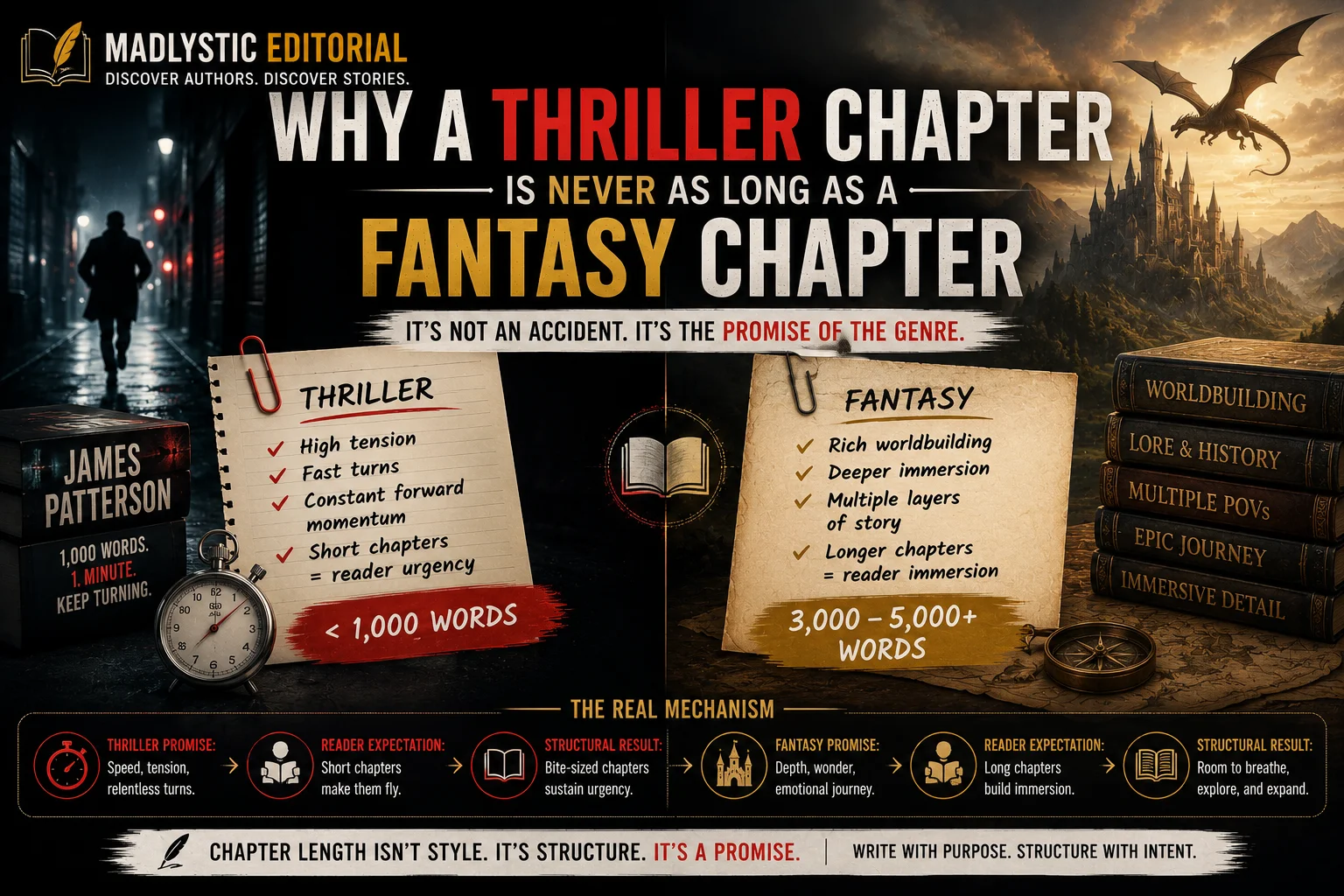
Why a Thriller Chapter Is Never as Long as a Fantasy Chapter
August 24, 2026

The Narrator Was Lying to You the Whole Time — On Purpose
August 12, 2026

Why Literary Agents Say They Hate Prologues (But Keep Signing Books That Have Them)
August 12, 2026

Book Dedications Used to Be a Matter of Survival
September 3, 2026