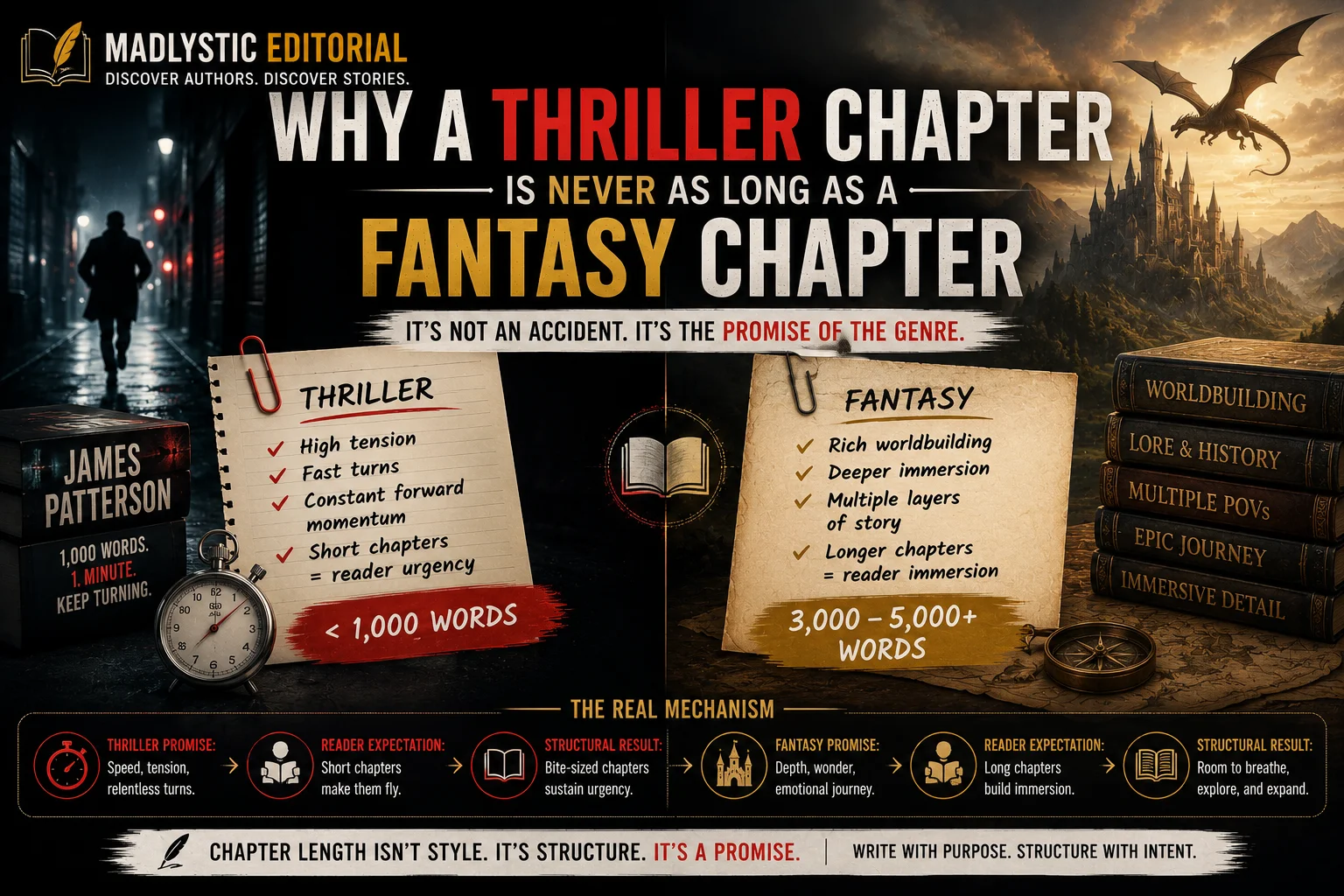
Why a Thriller Chapter Is Never as Long as a Fantasy Chapter
James Patterson built a career on chapters under 1,000 words. Epic fantasy routinely runs five times that. Here's the real mechanism behind why chapter length isn't a stylistic accident — it's a genre's promise to the reader, made structural.
Published August 24, 2026
7 min read
Quote of the Day
"Short chapters promise speed; long chapters promise depth." — a plain summary of what chapter length actually communicates to a reader, whether they consciously notice it or not
Pick up a thriller and a work of epic fantasy at the same time, and you'll notice something structural within the first few pages, even before the plots themselves diverge: one book is moving you through short, rapid bursts, and the other is settling you in for the long haul. That difference isn't a stylistic accident, and it isn't really about genre "tradition" in some vague, inherited sense either. Chapter length turns out to be one of the more quietly deliberate craft decisions in fiction — a structural promise about the kind of experience a reader is about to have.
The mechanism: short chapters manufacture a specific, addictive feeling
Thriller and suspense writers have leaned into short chapters — commonly cited in the 1,000-2,500 word range — specifically because of a well-documented psychological effect: frequent chapter breaks create repeated, small opportunities for a reader to tell themselves "just one more," and that repeated permission is precisely what produces the compulsive, up-past-midnight reading experience the genre is built around. James Patterson has built an entire, hugely commercial career on this exact principle, frequently writing chapters that run under 1,000 words — each one landing on a small cliffhanger or reveal that makes stopping feel harder than continuing. Every chapter break, in this structure, functions less like a pause and more like a dare.
Why fantasy and literary fiction do the opposite, on purpose
Longer chapters — often running 4,000-6,000 words or more in epic fantasy and literary fiction — aren't simply "less disciplined" writing, even though they can look that way next to a thriller's clipped rhythm. They're solving a genuinely different problem. Epic fantasy needs real space for world-building: a reader has to absorb new settings, magic systems, political structures, and expansive casts, and constantly breaking that immersion every 1,500 words would undercut the exact sense of scale and depth the genre depends on. Literary fiction similarly tends to structure chapters around a complete emotional or thematic arc rather than a plot beat — which simply takes more room to develop honestly than a pure momentum-driven scene does.
Romance sits in a deliberately different middle ground
Romance chapters typically land somewhere in between — commonly cited around 2,000-4,000 words — for a reason specific to the genre's actual structure: each chapter frequently needs room to let a single emotional beat (a meet-cute, a moment of conflict, a resolution) breathe fully, without either rushing through the feeling or slowing the overall momentum romance readers generally expect. It's a genuinely different balancing act than either the thriller or the fantasy model — emotional pacing rather than plot pacing or world-building pacing.
Age category matters as much as genre
This isn't purely about adult genre conventions either — reader age and reading stamina shape chapter length just as directly. Middle-grade fiction typically keeps chapters short, often 800-1,500 words, matching younger readers' shorter sustained-attention windows. Young adult fiction sits in a genuinely intermediate zone, commonly 1,500-3,000 words — long enough to handle the more complex emotional and social content YA increasingly explores, but still shorter than most adult literary fiction, respecting a real, well-documented difference in reading stamina between the two audiences.
The honest caveat: these are conventions, not laws
It's worth being straightforward about something several sources on this topic openly acknowledge: specific "average chapter length" numbers circulating online vary meaningfully between sources, often because nobody's using the same sample size, edition, or method for counting where one chapter genuinely ends and another begins. Literary fiction in particular resists tidy averages — some literary novels use chapters running only a few hundred words, others stretch to fifteen thousand, with the author's individual style often mattering more than any genre norm. The specific numbers are best treated as rough, directional conventions rather than hard rules any author needs to hit.
The actual craft question worth asking instead of chasing a number
Multiple writing guides converge on a more useful reframe than "how many words should my chapter be": does this chapter end with a genuine reason to turn the page? A chapter's ideal length isn't really a target word count at all — it's whatever space a specific scene or emotional beat actually needs to land properly, without padding it out to hit a number or cutting it short to match a genre convention that doesn't actually serve that particular moment. Genre expectations are real and worth understanding, precisely because violating them without a clear purpose can create a genuine mismatch a reader feels even if they can't articulate why — a thriller with fifteen-page chapters risks losing its own genre's core appeal, the same way a slow, interior character study broken into 800-word bursts might feel oddly rushed and shallow.
Conclusion
Chapter length looks, on the surface, like a formatting detail — practically invisible compared to plot, character, or prose style. It isn't. It's a structural signal a reader absorbs almost entirely below conscious awareness, shaping whether a book feels propulsive or immersive, urgent or unhurried, long before the actual content of any given chapter has fully registered. A thriller's short, punchy chapters and a fantasy epic's long, expansive ones aren't different levels of craft discipline — they're different, equally deliberate answers to the same underlying question: what kind of reading experience is this specific story actually trying to create, and what shape does the reader need each chapter to take to feel it?
Share this article
Share this article with readers who'll want to read it.
You may also like

Why Literary Agents Say They Hate Prologues (But Keep Signing Books That Have Them)
August 12, 2026
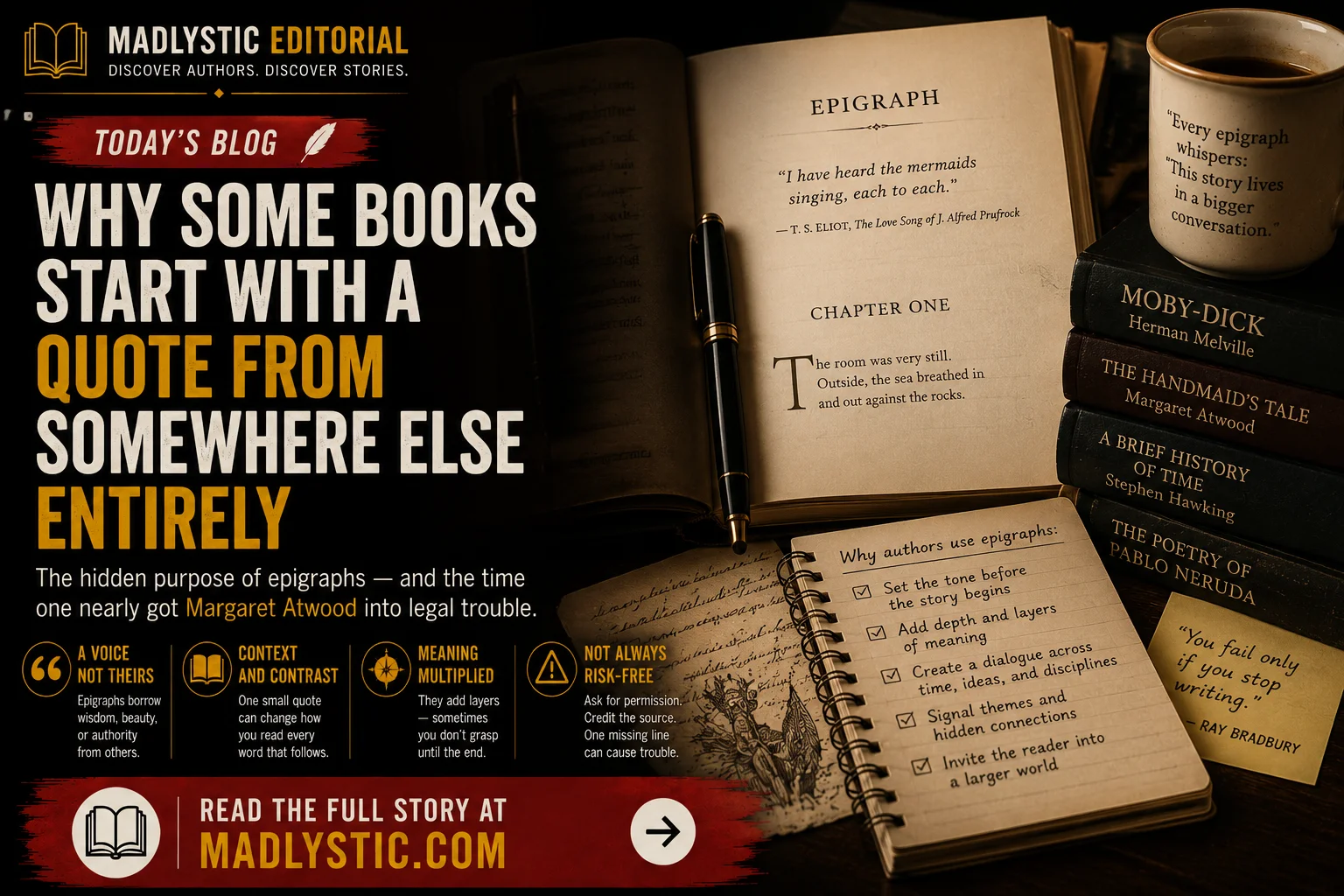
Why Some Books Start With a Quote From Somewhere Else Entirely
August 9, 2026

Book Dedications Used to Be a Matter of Survival
September 3, 2026

The Narrator Was Lying to You the Whole Time — On Purpose
August 12, 2026