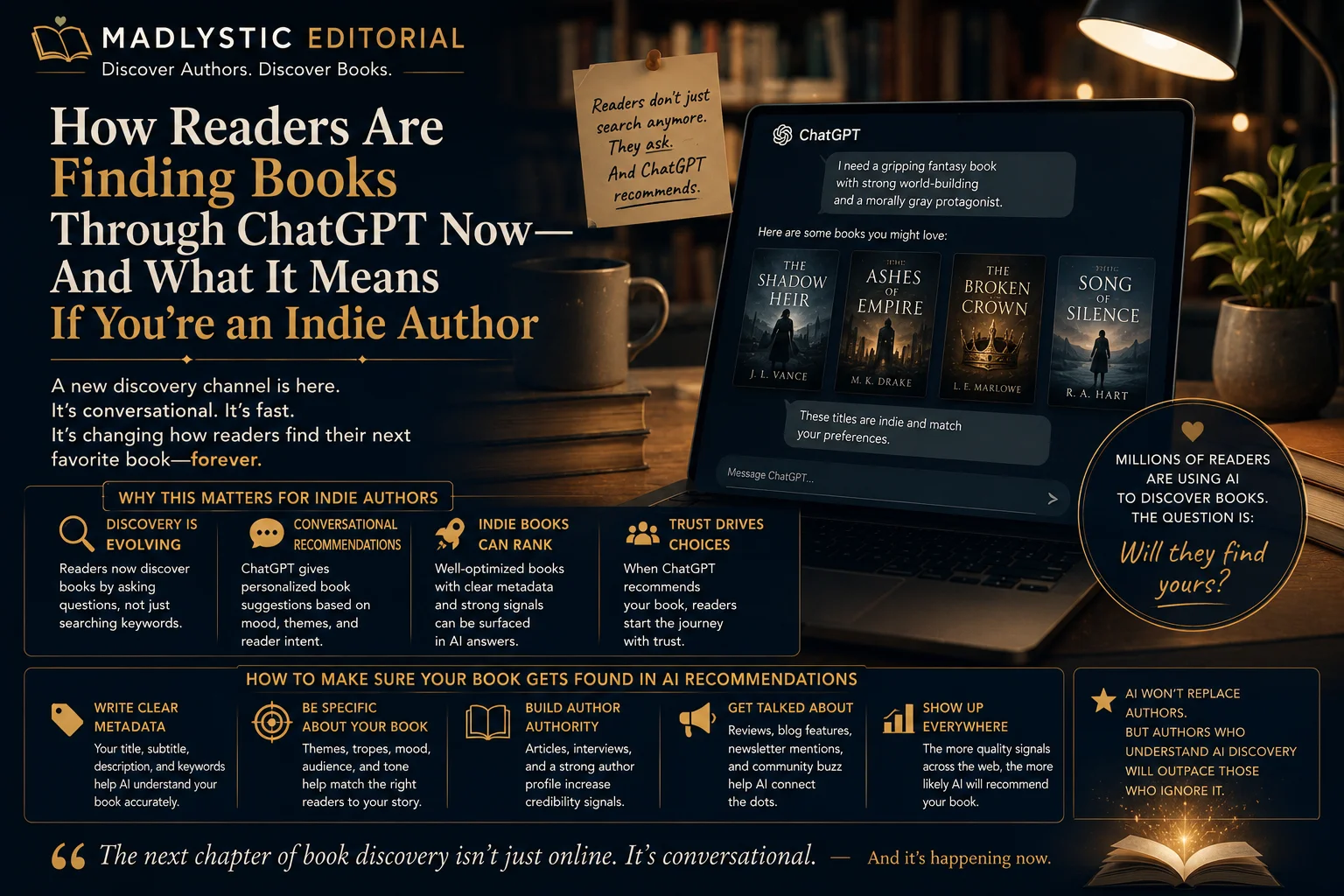
How Readers Are Finding Books Through ChatGPT Now — And What It Means If You're an Indie Author
Search is quietly splitting in two — one half still typed into Google, the other half asked conversationally to an AI. Here's what that shift actually means for how indie authors get discovered, and why most of them aren't ready for it yet.
Published July 19, 2026
15 min read
Quote of the Day
"The reader's imagination does half the work of writing." — a sentiment long attributed to writers reflecting on the collaborative nature of storytelling; the idea holds whether a human or a machine is doing the recommending.
Somewhere in the last two years, a second front-door to book discovery quietly opened, and most of the publishing world hasn't finished noticing yet. It didn't arrive with an announcement. It arrived the way most real shifts do — gradually, then suddenly, in the form of readers typing questions into ChatGPT instead of Google, and getting an actual recommended title back instead of ten blue links to sift through themselves.
If you've spent any time optimizing a book description or an author bio for search engines, you've been playing one game. There's now a second one running in parallel, with different rules, different winners, and — this is the part that matters — almost no indie authors currently competing in it. That's either a warning or an opportunity, depending on how quickly you move.
What actually changed
For twenty years, "getting discovered online" meant one thing: ranking somewhere on a page of search results, competing for a click, hoping the reader picked your link over the nine others on the page. That system rewarded a specific set of skills — keyword density, backlinks, domain authority, technical SEO. It was a game of visibility among options.
AI search doesn't work like that, and the difference isn't cosmetic. When someone asks ChatGPT, Perplexity, or Google's AI Overviews "what's a good slow-burn fantasy romance with a morally gray love interest," they don't get a list of ten links to evaluate themselves. They get an answer — usually two or three specific book titles, sometimes just one, presented as a direct recommendation. There's no scrolling. There's no second page. The AI already decided which one or two answers were worth surfacing, and everything else, effectively, doesn't exist for that conversation.
This is the core shift people mean when they talk about AEO (answer engine optimization) or GEO (generative engine optimization): the target isn't ranking on a results page anymore. It's being the thing the model actually says out loud when someone asks a question in your genre, your niche, your specific corner of what readers are looking for.
It's worth sitting with how different this is from the world every author was trained to operate in. Ranking on Google page one meant a reader still had to do work — read your title, glance at your cover thumbnail, decide whether to click, then decide whether to buy. Every one of those steps was a place a reader could drop off, and a place a competitor's book could catch their eye instead. An AI answer collapses all of that into a single moment. If the model says your book, the reader's already three-quarters of the way to opening the sample. If it doesn't, there was no page two to fall back on — the conversation simply moved on without you, and you'll likely never know it happened at all.
Why this actually matters more for indie authors than big publishers
There's a reasonable assumption that this new landscape favors whoever already has the most institutional weight — major publishers, established franchises, authors with decades of reviews and press behind them. That assumption is mostly wrong, and understanding why is the most useful part of this whole shift.
Traditional SEO rewards accumulated authority: years of backlinks, domain age, sheer volume of existing content. Indie authors are almost always at a structural disadvantage there, competing against publishing houses with decades of web presence behind them. AI models, by contrast, aren't ranking domain authority in the same way. They're synthesizing an answer from whatever text, structured data, and description exists about a book or an author at the moment someone asks — and a lot of that text comes from smaller, specific, well-described sources rather than only the biggest ones.
In practice, this means a very specific, clearly described indie book — with a distinct premise, a clearly labeled subgenre, comparable titles named explicitly, and a coherent presence across a few different platforms — can genuinely get surfaced by an AI model in response to a niche query, in a way it likely never would have cracked page one of Google for the same search. The playing field isn't level exactly, but it's a different shape than the one indie authors have been losing on for the past decade.
There's a second, quieter reason this favors indie authors specifically, and it has to do with specificity itself. Large publishers tend to describe their frontlist in broad, comp-title language designed to appeal to the widest possible reader — "an unforgettable story of love and loss" could describe roughly four thousand different books published this year alone. That kind of description is nearly useless to a model trying to match a precise, narrow question like "a grief memoir written by someone who lost a sibling, not a parent." Indie authors, often writing in tighter subgenres with more specific tropes and structures, are frequently already producing exactly the kind of narrow, identifiable description that AI matching rewards — they just haven't realized that specificity, which used to feel like a limitation in a mass-market sense, is now a genuine advantage.
What AI models are actually reading
This is the part almost nobody explains clearly, and it's worth being precise about, because vague advice here is worse than no advice.
AI answer engines build their responses from a mix of sources: they're trained on large amounts of web text up to a point in time, and increasingly, the more advanced ones also perform live retrieval — actually searching the web in the moment a question is asked, the same way you might, and reading what comes back. What that means practically is that both matter: what already exists broadly about your book across the internet, and what's freshly retrievable right now when someone asks.
For an indie author, this breaks into a few concrete things worth doing, none of which requires any technical expertise:
Write descriptions the way you'd explain the book to a friend, not the way you'd write ad copy. AI models are, at their core, trying to match a reader's plain-language question to a plain-language answer. "A cozy mystery where a retired baker solves crimes in a small Scottish village" is more useful to a model trying to answer "what's a good cozy mystery" than a description built entirely around adjectives like "gripping" and "unputdownable" that describe nothing specific.
Name your comparable titles explicitly, if they're genuinely apt. When a reader asks an AI "books like Fourth Wing," the model is pattern-matching against text that actually says something is similar to Fourth Wing. If your book's description, reviews, or associated articles never make that comparison explicitly, the model has nothing to retrieve when that exact question gets asked — even if the similarity is real.
Consistency across platforms compounds. If your book's premise is described one way on Amazon, a different way on your own site, and not at all on any discovery platform, you've fragmented the very thing a model would otherwise be able to confirm from multiple angles. The same clear, specific description appearing consistently across several places is a much stronger signal than one polished paragraph that exists in only one location.
Reviews and third-party mentions matter more here, not less. Since AI models often weigh independent commentary about a book more heavily than a publisher's own marketing copy, genuine reader reviews that describe what the book is actually like — tone, pacing, comparisons, who it's for — function as retrievable evidence a model can draw on. This is the same mechanism that made specific reviews matter for human readers, just extended to a new audience of one: the model itself, forming an answer on someone else's behalf.
Structured data quietly matters more than it looks like it should. Book metadata — genre tags, series information, format, comparable titles listed in a structured field rather than buried in prose — is exactly the kind of clean, labeled information that's easiest for a model to retrieve confidently. A book with genre and trope tags spread across a filterable catalog is handing a model a cleaner signal than the same information buried in the middle of a long descriptive paragraph on a personal website.
How different AI platforms actually behave
It's worth being specific here too, because "AI search" isn't one uniform thing, and treating it as one blurs together tools that behave quite differently in practice.
ChatGPT, when web search is enabled, retrieves live results much the way a search engine does, then synthesizes an answer from what it finds — meaning current, freshly published, well-described content has a real chance of surfacing even for a brand-new release. Perplexity was built around citation-first answers from the ground up, showing sources alongside its recommendations, which means being the source it cites is arguably more valuable than being mentioned in passing somewhere it doesn't. Google's AI Overviews sit directly on top of the existing Google index, which means traditional SEO fundamentals — a real, well-structured web presence, not just a listing on a marketplace — still feed directly into whether a book gets surfaced there. None of this is an argument for chasing every platform separately. It's an argument for the same underlying discipline — clear, specific, consistent, well-structured description — because that discipline happens to be exactly what each of these differently-built systems is looking for, even though they retrieve it in different ways.
The part that's easy to get wrong
There's a temptation, once you understand any of this, to try to "trick" the system — stuffing comparisons to bestsellers that don't actually fit, writing reviews that oversell the book's similarity to something popular, or generating artificial buzz designed to be picked up rather than earned. This tends to backfire in a specific way that's worth naming: AI models are increasingly good at recognizing when a description doesn't match the actual content or genuine reader sentiment around a book, and a mismatch between what's claimed and what's actually reflected across independent sources is exactly the kind of inconsistency these systems are built to notice and discount. The advice here isn't fundamentally different from good SEO advice ten years ago — be genuinely, specifically accurate about what your book is, rather than trying to game a description toward a comparison that isn't real. The technology changed. The underlying principle — be the clearest, most honest answer to the question someone's actually asking — didn't.
There's a related trap worth naming separately: treating this as a one-time setup task rather than an ongoing practice. A book description optimized for AI discoverability today doesn't stay optimized forever, because the comparable titles readers search for shift as new bestsellers emerge, and a comp that felt fresh and relevant a year ago can start to feel dated or, worse, actively wrong as reader tastes move on. Revisiting a book's description periodically — the same way an author might refresh keywords on a retail listing — is a small, low-effort habit that keeps a book's discoverability current rather than frozen at its launch date.
A real example of this already happening
This isn't a hypothetical shift. Readers are already documenting it in public, in real time.
On Goodreads' own reading-challenge forums, readers have started sharing their actual ChatGPT book recommendations as a matter of course. In one widely-shared thread, a reader typed in four favorite titles — including The House in the Cerulean Sea and the Harry Potter series — and ChatGPT responded with several matched recommendations, including The Night Circus for its atmosphere and The Invisible Life of Addie LaRue for its magical realism. Another reader in the same thread reported a similar experience going the other direction: asking ChatGPT for a recommendation based on The Great Gatsby and The House of Mirth returned The Custom of the Country by Edith Wharton — a title the reader had, coincidentally, also just been recommended by a friend.
These aren't cherry-picked marketing examples. They're ordinary readers, in an ordinary book-club forum, casually treating "ask ChatGPT" as a normal part of finding their next read — the exact behavior this whole shift is about, happening quietly among readers who aren't thinking about SEO or AEO at all. They just wanted a book.
On the author side, the shift is being tracked closely by people who work directly with indie authors. Thomas Umstattd Jr., who runs AuthorMedia and hosts the Novel Marketing podcast, has been vocal that authors should stop thinking of AI purely as a tool for writing a book and start thinking of it as a tool that sells the book — his framing is blunt: soon there will be two kinds of authors, those whose books AI recommends, and those wondering why their sales quietly stopped growing. His concrete advice for showing up in that first group lines up with what's outlined above: explicitly naming the tropes in a book's description helps AI match it to readers searching for those specific themes, and appearing on podcasts and guest blogs builds the kind of inbound linking and public discussion that AI models weigh when forming an answer.
The pattern in both cases is the same one this article has been describing from the outside: readers are already there, asking. The only open question is whether any given book has been described clearly and consistently enough, in enough places, to be the thing that gets said back.
Where this intersects with book discovery platforms
This is also, not incidentally, where discovery platforms — the newer, more curated kind, not just the giants — start to matter in a slightly different way than they did in a pre-AI-search world. A platform that maintains a clean, structured, consistently described catalog of books and authors is, functionally, building exactly the kind of retrievable, well-organized text that AI models draw on when forming an answer. A scattered web presence across a dozen different unstructured mentions is harder for a model to synthesize into a confident recommendation than a single, well-organized profile with a clear description, genre tags, and comparable titles all sitting in one place.
Platforms like Madlystic, structured around genre tags, curated shelves, and consistent author and book profiles, aren't just aimed at human readers browsing a homepage. That same structured, consistent data is exactly the shape of information an AI search tool can most easily retrieve and cite when someone asks a plain-language question about a genre or subgenre. It's a secondary effect of good structure, not the primary purpose — but it's a real one, and it's likely to matter more, not less, as more discovery genuinely happens through a conversation with an AI rather than a typed search query.
What to actually do this month
If all of this feels abstract, here's where it becomes concrete. Pull up your book's description on every platform where it currently exists — Amazon, Goodreads, your own site, anywhere else. Ask honestly: does this description tell a reader (or a model reading on a reader's behalf) exactly what kind of book this is, who it's genuinely comparable to, and who it's for? Not what makes it sound exciting — what makes it identifiable. Then make that description consistent everywhere it appears, rather than a different, more polished version living in just one place.
A simple way to stress-test this yourself: open a fresh AI chat and ask it, in a reader's plain language, for a book like yours — without naming your own title. See what comes back. If your book isn't in the answer, that's not a failure so much as a diagnostic. It tells you exactly which comparable titles the model currently associates with your space, which is often the clearest possible signal of how your own description needs to be sharpened to compete for that same answer next time.
Conclusion
The shift from typed search to conversational AI answers isn't a distant trend to prepare for eventually — it's already how a growing share of readers are finding their next book, right now, in this exact form. And unlike the last two decades of SEO, where indie authors were structurally outmatched by institutional weight, this new landscape rewards something much more achievable: being specific, being consistent, and being honestly described across every place a reader — or a model recommending on a reader's behalf — might look. That's not a technical skill most authors need to hire out. It's a writing and organization task, the same kind of clear thinking that went into the book itself, just aimed at the sentence that introduces it to the world. The authors who treat that sentence with the same care as their opening chapter are the ones who'll quietly start showing up in answers they were never visible in before.
Share this article
Share this article with readers who'll want to read it.
You may also like
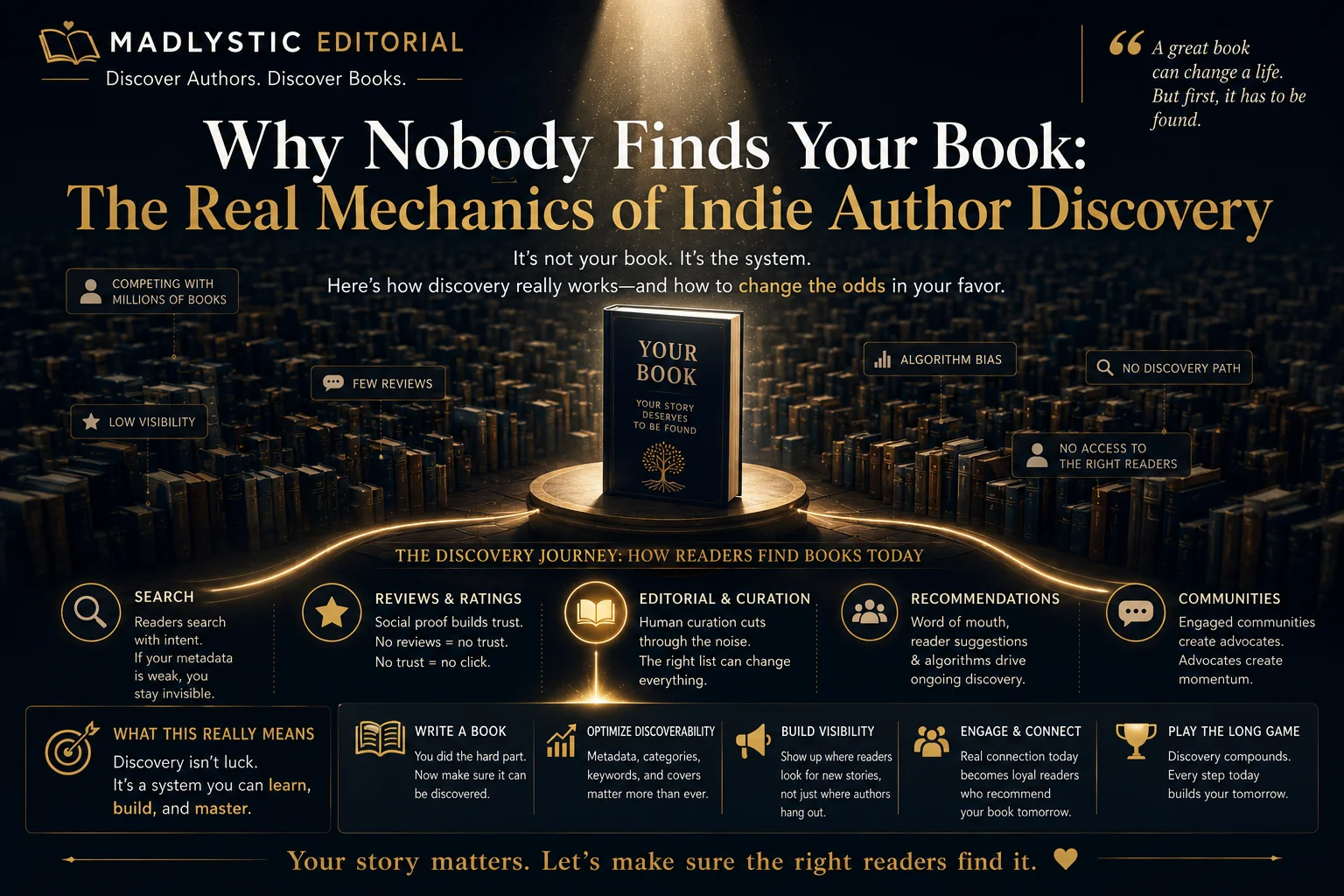
Why Nobody Finds Your Book: The Real Mechanics of Indie Author Discovery
July 19, 2026
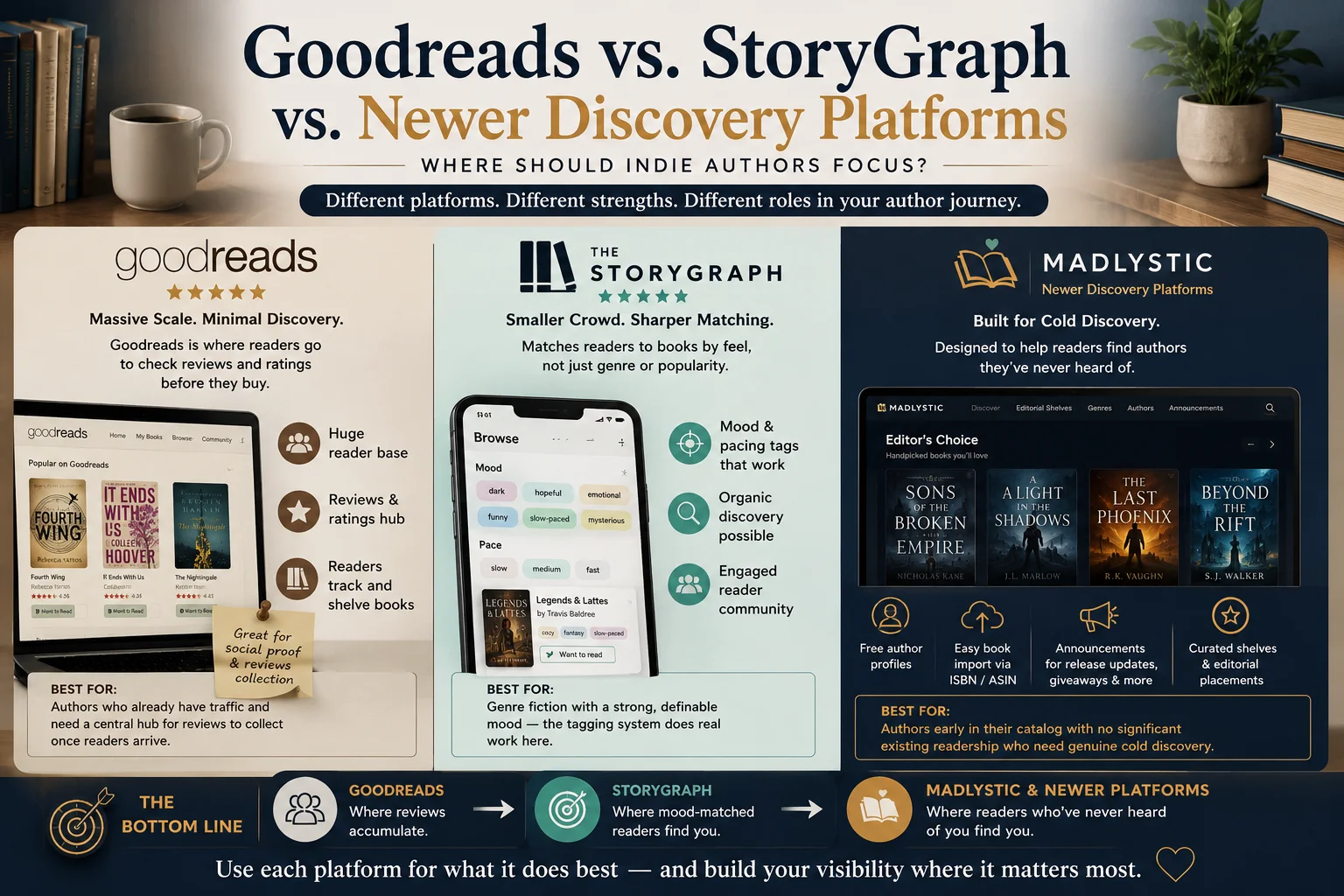
Goodreads vs. StoryGraph vs. Newer Discovery Platforms: Where Should Indie Authors Focus?
July 18, 2026
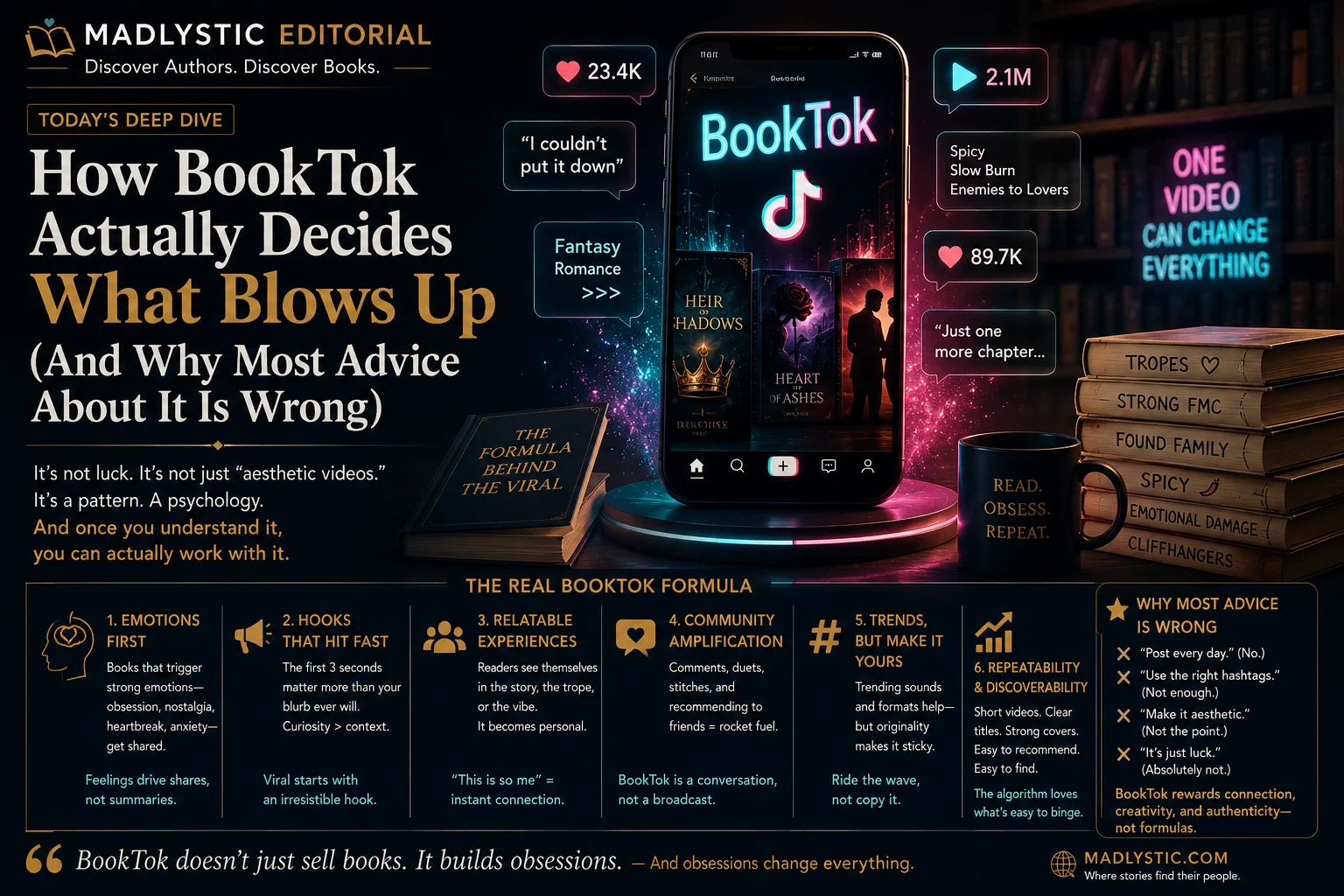
How BookTok Actually Decides What Blows Up (And Why Most Advice About It Is Wrong)
July 19, 2026
Traditional Publishing vs. Self-Publishing: Which Is Right for You?
November 24, 2026